Why Price, Not Climate Policy, Is Driving Solar's Global Boom
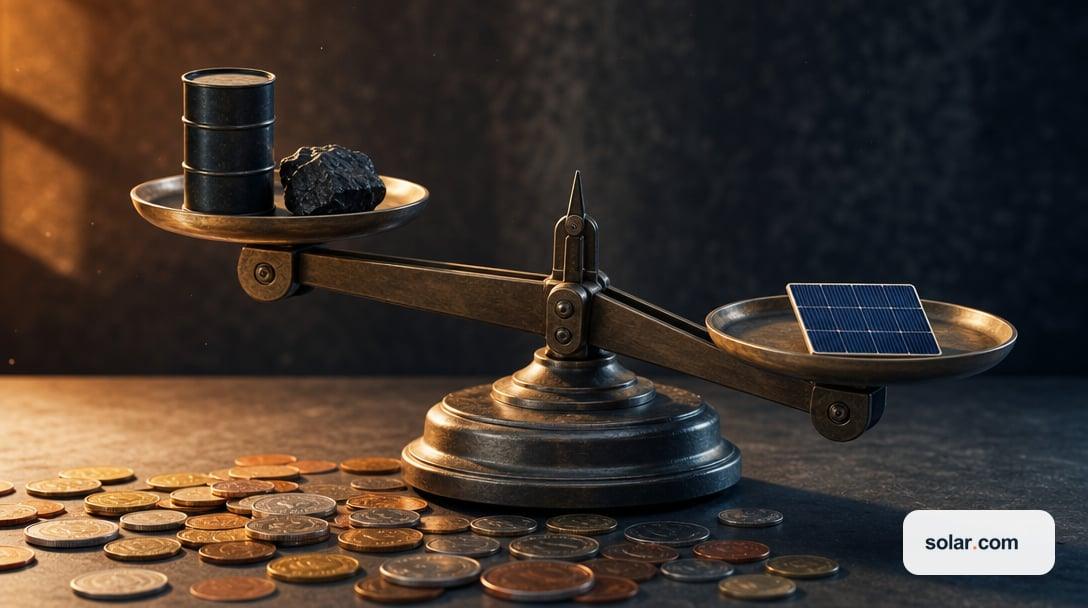
Solar is winning around the world, and it’s no longer leaning on climate policy to gain its edge. Instead, people and governments are rapidly deploying solar and battery storage because it’s more economical and stable than fossil fuels. The 2026 price shocks in coal, natural gas, and diesel only sharpened that math.
More importantly, that math travels. What makes solar-plus-storage a smart buy for a factory in South Africa or a household in Pakistan is the same logic that makes it a smart buy for a house in the US. Let’s connect those dots.
The world is adding solar faster than the record books can keep up
Global solar is scaling fast, and it’s the less developed countries currently leading the charge, not the wealthiest ones. As OilPrice.com reports, a group of emerging economies has now moved ahead of the United States on clean energy adoption, with Brazil, Chile, El Salvador, Morocco, Kenya, and Namibia among them.
The fastest-growing solar market in the last few years has been Pakistan, where residents started rapidly installing rooftop panels and batteries in 2022 to hedge against natural gas price shocks stemming from the Russia-Ukraine conflict.
Africa tells a similar story, just harder to see. The continent officially added about 4.5 GW of solar in 2025 but imported roughly 18.2 GW of modules, with another 12.53 GW of Chinese panels shipped in the first half of 2026. As CleanTechnica reports, satellite imagery found rooftop solar on 76 percent of 209 shopping malls surveyed around Johannesburg. These businesses with big roofs and daytime power bills are protecting themselves from outages and expensive diesel costs.
In South Asia, Bangladesh just rolled out rooftop solar incentives to ease chronic power shortages and bring 4,000 MW of solar online over the next year.
The pattern is consistent. People go solar to escape unreliable, volatile, costly fossil-fueled grid power. Emissions reductions are a bonus, not the driver.
When conflict spikes fuel prices, solar looks even better
Solar’s cost advantage gets even clearer when fossil fuel prices spike, and nothing spikes them faster than conflict. When war broke out in Iran earlier this year, oil markets whipsawed on fears that supply through the Strait of Hormuz could be cut off. As NPR reports, that volatility is exactly what’s pushing people and governments toward solar and EVs, energy sources that don’t ride the same geopolitical roller coaster.
If we’ve learned anything this year, it’s that the price of oil can jump or crash on a single headline from thousands of miles away. The price of sunshine is unaffected. Once you’ve paid for the panels, your fuel is free, and your electricity price is essentially fixed.
Simply put: every time a distant conflict rattles fuel markets, solar becomes the more predictable buy. That’s proving true on a global scale and on individual utility bills.
Ready to see your numbers?
See your real solar price in 90 seconds
Enter your address — we'll show you the system, savings, and price for your exact roof.
The same economics scale down to your roof
Nearly 60 percent of US grid electricity is generated from fossil fuels, mostly coal and natural gas. Those fuels are commodities, bought and sold for profit, which makes them inherently inflationary and sensitive to the same price shocks moving global markets.
That’s what makes solar a hedge against rising energy costs. You can do very little to decouple the power grid from fossil fuels. But you can absolutely decouple your own home from fuel price volatility by going solar. You’re swapping a bill that only goes up for an asset with a steady, predictable cost.
The first step is easy: get a price for your roof in 90 seconds on Solar.com so you know exactly what it costs to power your home with solar for the next 25 years.
Your next step
See exactly what solar costs on your roof
We use satellite data and your utility rates to show your price and payback in about 90 seconds, with no sales calls.