Your electric bill is outpacing inflation by almost 2x — why that trend is about to get worse
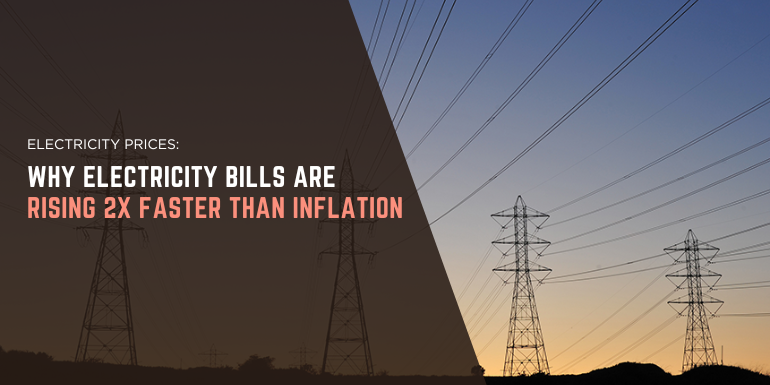
Over the past decade, the average price of grid electricity in the United States climbed from about 12.5 cents per kilowatt-hour to over 17 cents. That’s a rise of nearly 38 percent since 2016.
Looking at just the last four years, the pattern is even sharper: residential electricity prices are up roughly 25% since 2022, according to EIA data, while overall consumer prices rose at a noticeably slower pace — roughly 13% — over the same stretch. Electricity is not just keeping up with inflation. It is running at almost double the pace.
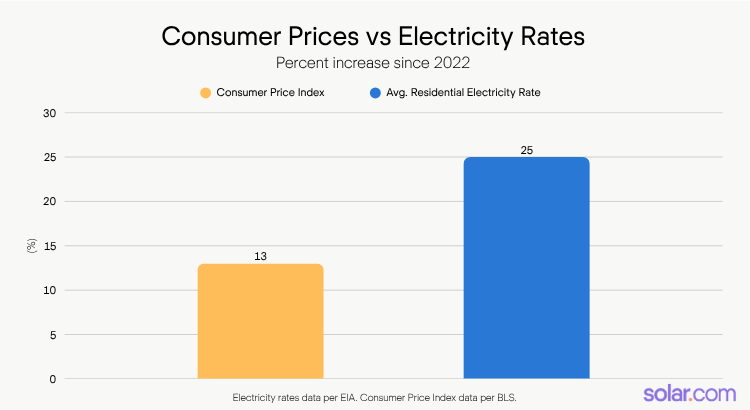
Why electricity rates are outpacing consumer prices
Why is power getting more expensive faster than everything else you buy? It’s important to remember that utility rates include costs for generating electricity and delivering it to your home.
With that said, three basic forces are compounding at once:
- Utilities are spending heavily on grid hardening in response to extreme weather events.
- Aging transmission and distribution infrastructure needs replacing regardless of what it costs.
- Demand is climbing at a pace the grid was not built for.
That third factor is the one to watch. Data center construction, driven almost entirely by AI infrastructure, is adding electricity demand to the grid faster than utilities can add generation and transmission capacity. When demand grows faster than supply, prices rise. That is not a forecast — it is basic economics, and it is already showing up in the rate data.
Every hyperscale AI campus that comes online is a new, enormous customer competing with your household for the same limited grid capacity. Expect utility rate increases to accelerate from here, not level off.
Stabilizing your electricity costs
Here is the part of the story that gets less attention: while grid prices have been climbing steadily, the cost of going solar has done the opposite.
Installed solar costs fell sharply through the late 2010s as panel prices, financing structures, and installation efficiency all improved. After a bumpy stretch during the supply chain disruptions of 2021 and 2022, solar costs settled into a stable range, and when you finance a system over 20 years, the effective cost of that power has leveled out at around 14 cents per kilowatt hour.
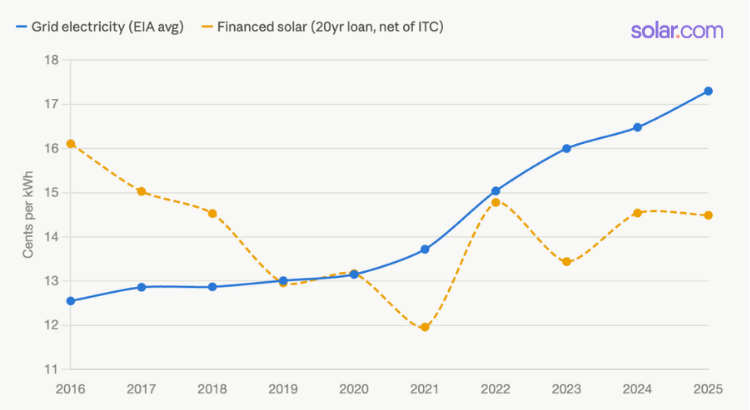
That number matters because it is fixed. When you finance a rooftop solar system, you are locking in your cost of electricity for the life of the loan. The utility cannot raise your rate next summer, next year, or in 2035 when the next data center comes online in your region. You already own your production cost, but your neighbor without solar does not have that same protection. Every rate hike simply lands on their bill.
So the choice in front of homeowners right now is not really about environmental values, though that is part of it for many people. It is a question of who you want setting your electricity price for the next two decades: a utility responding to AI-driven demand growth it cannot fully control, or a fixed rate you locked in the day your system was installed. Grid prices are on a trajectory that is likely to steepen. Solar costs, for the first time in years, are stable.
That gap is the story of the next decade, not just the last one.
Your next step
See exactly what solar costs on your roof
We use satellite data and your utility rates to show your price and payback in about 90 seconds, with no sales calls.