How Many Watts Does a Refrigerator Use? kWh per Day and Cost to Run

Wondering what your fridge really pulls? A new full-size refrigerator uses about 40 to 75 watts on average, or roughly 1 to 1.8 kilowatt-hours (kWh) a day. Those are the medians for ENERGY STAR certified top-freezer and side-by-side models in November 2026, with bottom-freezer models in between.1 At the U.S. average home electricity price of 18.17 cents per kWh in September 2026, that’s about $5.50 to $9.70 a month.2
A fridge never draws one steady number, though. Its compressor runs until the box is cold, then rests, so what you pay for is an average.
Jump ahead:
- Watts and kWh by type of fridge
- Running, starting and average watts
- What a fridge costs to run in your state
- What makes a fridge use more
- How much solar it takes to run a fridge
- Keeping your fridge cold in a power outage
- Frequently asked questions
Refrigerator watts and kWh by type of fridge
Where the freezer sits matters more than most people expect. We took the full ENERGY STAR list of certified refrigerators, 4,942 listings as of November 26, 2026, and found the middle value for each type.1
| Type of fridge | Median kWh a year | Middle half of models (kWh a year) | kWh a day | Average watts | Cost a month at 18.17 cents per kWh |
|---|---|---|---|---|---|
| Compact (mini fridge) | 246 | 218 to 278 | 0.67 | 28 | $3.72 |
| Single door or freezerless | 288 | 260 to 314 | 0.79 | 33 | $4.36 |
| Top freezer | 363 | 332 to 390 | 0.99 | 41 | $5.50 |
| Bottom freezer, including French door | 560 | 465 to 634 | 1.53 | 64 | $8.48 |
| Side-by-side | 642 | 598 to 694 | 1.76 | 73 | $9.71 |
Solar.com analysis of 4,942 ENERGY STAR certified refrigerator listings, downloaded November 26, 2026.1 Average watts are yearly kWh divided by 8,760 hours. Cost uses the U.S. average residential price for September 2026, a preliminary EIA figure.2
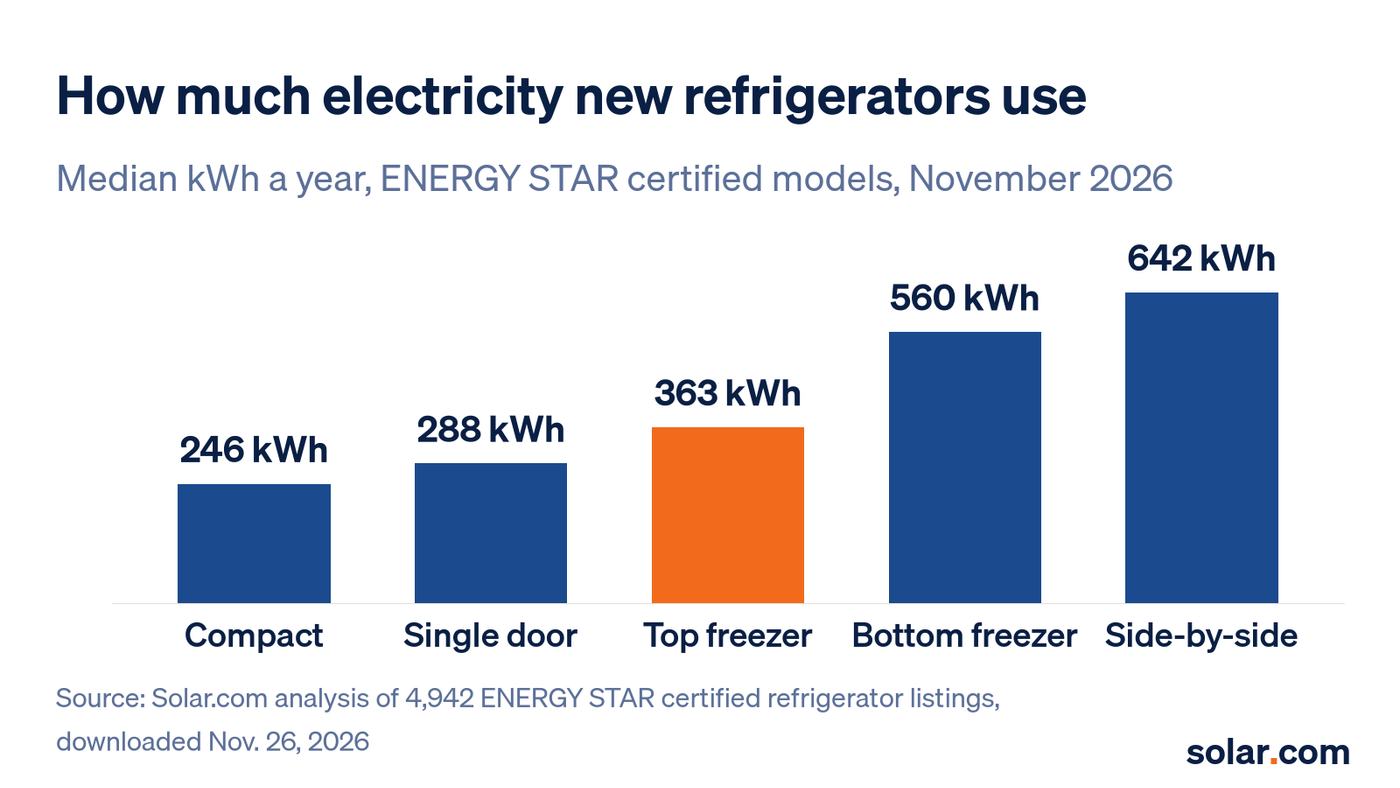
What that means for you. A top-freezer fridge used a median of 363 kWh a year, about 35% less than a bottom-freezer model’s 560.1 At the national average price, that gap is worth about $36 a year. Over the 12 years ENERGY STAR uses as a fridge’s lifetime, it adds up to about $430.3 The agency’s buying advice points the same way: freezer-on-top models tend to use the least, and fridges of 16 to 20 cubic feet are usually the most efficient.3
Keep in mind that these are ratings from a standard test. Your kitchen moves the real number: a warm spot next to the oven or a worn door seal makes the compressor work longer.3
Running watts, starting watts and average watts
Because the compressor cycles, “how many watts” has more than one answer.
- Average watts are what your bill sees. Take the yearly kWh from the fridge’s yellow EnergyGuide label or the ENERGY STAR list, divide by 8,760 hours and multiply by 1,000. A fridge rated at 560 kWh a year averages about 64 watts.1
- Running watts are the draw while the compressor is on, so they’re higher than the average. The label doesn’t list them. A plug-in watt meter will show yours.
- Starting watts are a short surge as the compressor starts. They matter when you size a generator or a battery. They don’t move your bill.
There’s also the sticker inside the fridge, which lists its volts and amps. Multiply the two and you get the most the fridge is rated to draw. If it says 115 volts and 6 amps, that’s 690 watts. Treat that as a ceiling for wiring and backup power, not as what the fridge uses hour after hour.
Home batteries list both a steady rating and a short peak. The Enphase IQ Battery 5P, for example, is rated for 3.84 kW of continuous power and 7.68 kW for 3 seconds.4 That continuous rating alone is more than five times the 690-watt ceiling in the example above.
What a fridge costs to run in your state
Your price per kWh matters as much as the fridge. The same median bottom-freezer model, rated at 560 kWh a year, costs about $271 a year to run in Hawaii and about $74 in Nevada, at each state’s average home electricity price for September 2026.2
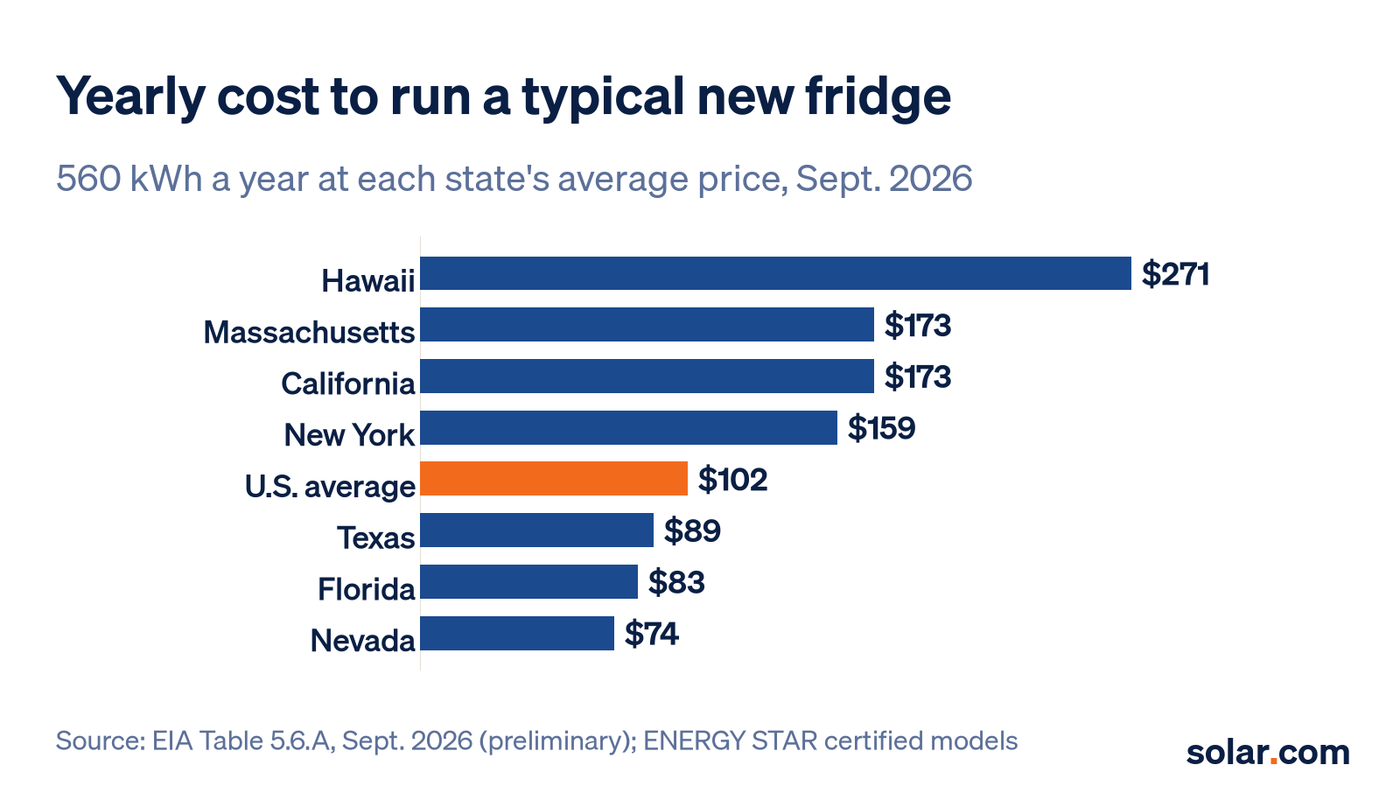
A worked example. Say you have a roomy French-door fridge with ice and water in the door. Among certified bottom-freezer models with a door dispenser, the median rating is 715 kWh a year.1 In California, the average home price was 30.86 cents per kWh in September 2026.2
- 715 kWh x $0.3086 = about $221 a year2
- $221 / 12 = about $18 a month
Now take a top-freezer fridge rated at 363 kWh in Texas, where the average was 15.91 cents.2 It costs about $58 a year, under $5 a month. Same job, roughly a quarter of the cost.
For your own fridge, use the price per kWh on your bill.
What that means for you. A fridge is a small slice of most bills. The average U.S. home uses about 10,500 kWh a year, according to EIA, so a 560 kWh fridge is about 5% of it.5 If your whole bill feels too high, the fridge probably isn’t the reason. See how many kWh a day is normal for the bigger picture.
See it for your home
Get your real solar price in 90 seconds
Enter your address — we’ll show the system, savings, and price for your exact roof. No sales calls.
What makes a fridge use more
Size. Bigger boxes use more power. Here are the medians for full-size fridge-freezers, with top-freezer, bottom-freezer and side-by-side models counted together, by total volume:1
| Total size | Median kWh a year | Average watts |
|---|---|---|
| Under 17 cubic feet | 371 | 42 |
| 17 to 20.9 cubic feet | 461 | 53 |
| 21 to 24.9 cubic feet | 601 | 69 |
| 25 to 28.9 cubic feet | 699 | 80 |
| 29 cubic feet and up | 715 | 82 |
Solar.com analysis of ENERGY STAR certified listings, downloaded November 26, 2026.1
Ice and water in the door. Dispenser models tend to be bigger, so we compared fridges of the same size. Among bottom-freezer models of 25 to 28.9 cubic feet, those with a door dispenser had a median rating of 730 kWh a year, against 633 for those without.1
Age. Every new fridge has to meet a federal efficiency limit. Across certified bottom-freezer models, the median limit is 623 kWh a year, and ENERGY STAR models beat the federal minimum by about 9%.1 3 Older fridges fall behind. ENERGY STAR puts an old refrigerator’s use at about 20% above a certified one, and it estimates that replacing yours and recycling the old one saves about $150 over 12 years.3
The second fridge. About a third of U.S. homes (34%) had two or more refrigerators in 2020. That year, the main fridge cost about $87 on average to run and a second one about $66, according to EIA.5 If yours sits in the garage holding a few drinks, unplugging it is the cheapest upgrade you can make.
How much solar it takes to run a fridge
Less than you might think. We ran NREL’s PVWatts model for a single 400-watt panel facing south in eight cities. Over a typical year, one panel makes about as much electricity as a median bottom-freezer fridge uses: more in the sunny Southwest, less in cloudy Seattle.6
| City | One 400-watt panel, kWh a year | Share of a 560 kWh fridge | December, kWh a day |
|---|---|---|---|
| Phoenix | 704 | 126% | 1.52 |
| Los Angeles | 673 | 120% | 1.29 |
| Denver | 640 | 114% | 1.26 |
| Miami | 623 | 111% | 1.42 |
| Houston | 571 | 102% | 1.13 |
| Chicago | 526 | 94% | 0.74 |
| New York | 519 | 93% | 0.84 |
| Seattle | 437 | 78% | 0.42 |
NREL PVWatts v8, typical-year weather, one 0.4 kW panel tilted 20 degrees and facing south, 14% system losses, run by Solar.com in November 2026.6 Fridge: median ENERGY STAR certified bottom-freezer model, 560 kWh a year.1
What that means for you. Over a year, a fridge is about one panel’s worth of solar. How much that saves depends on how your utility credits the power you don’t use right away. The December column shows the catch: in Chicago, one panel makes about 0.74 kWh on an average December day, about half of the 1.53 kWh a median bottom-freezer fridge needs.6 1 Solar is sized for your whole bill, not one appliance. To see a real price for your roof, start with your address.
Keeping your fridge cold in a power outage
Without power, a closed fridge keeps food cold for about four hours. A full freezer holds its temperature for about 48 hours. Toss any food that has sat at 40 degrees or warmer for two hours or more.7
So how long can a battery carry a fridge? Divide the battery’s usable kWh by the fridge’s kWh a day.
| Fridge (median certified model) | kWh a day | Days on a 5 kWh battery, fridge alone |
|---|---|---|
| Top freezer | 0.99 | About 5 |
| Bottom freezer | 1.53 | About 3.3 |
| Side-by-side | 1.76 | About 2.8 |
Battery: Enphase IQ Battery 5P, 5.0 kWh of usable capacity, from the maker’s product page.4 Fridge use: ENERGY STAR certified medians, November 2026.1
That’s on paper. In a real outage, the same battery also runs your lights and anything else on its circuits, so plan on less. If your solar panels are set up to keep working when the grid is down, they can recharge the battery on sunny days. Our guide to how long a battery powers a house in an outage walks through bigger loads.
What it costs: on current installer price lists on the Solar.com marketplace, the IQ Battery 5P’s median installed price is about $10,300 when it goes in with new solar, and about $12,000 when it’s added to an existing system, before rebates. The middle half of price lists for the first case runs from about $8,500 to $13,100 (November 2026).8
To be fair, that’s a lot to spend just to save a fridge full of groceries. A battery makes more sense when it also keeps your lights and internet on, or cuts your bill where evening power costs more. Our battery page shows how that works on time-of-use rates, and battery vs generator for outages weighs the other option. If you do use a generator, run it outdoors, at least 20 feet from windows, doors and attached garages, with working carbon monoxide alarms inside.7
See it for your home
Get your real solar price in 90 seconds
Enter your address — we’ll show the system, savings, and price for your exact roof. No sales calls.
Frequently asked questions
How many watts does a fridge draw?
A new full-size fridge averages about 41 to 73 watts over a day, based on the medians for ENERGY STAR certified top-freezer and side-by-side models in November 2026.1 It draws more while the compressor runs and surges briefly as the compressor starts. The volts and amps on the sticker inside give the most it’s rated to draw.
How much electricity does a refrigerator use per month?
A median new bottom-freezer fridge uses about 47 kWh a month (560 kWh a year), a top-freezer model about 30 kWh and a side-by-side about 53 kWh, by ENERGY STAR certified ratings in November 2026.1 At the U.S. average price of 18.17 cents per kWh in September 2026, that’s about $5.50 to $9.70 a month.2
How many watts does a mini fridge use?
An ENERGY STAR certified compact refrigerator uses a median of 246 kWh a year, about 0.67 kWh a day, which averages out to roughly 28 watts.1 That comes to about $3.72 a month at the September 2026 U.S. average price of 18.17 cents per kWh.2
Can a 5,000-watt generator run a refrigerator and freezer?
Check the stickers. Multiply the volts by the amps on each appliance and add the two. Two appliances rated at 690 watts each, for example, come to 1,380 watts, well under 5,000. Leave headroom for the brief surge as each compressor starts, and run the generator outdoors, at least 20 feet from windows, doors and attached garages.7
How long can a home battery run a refrigerator?
On paper, a 5 kWh battery such as the Enphase IQ Battery 5P runs a median new bottom-freezer fridge for about 3.3 days with nothing else on.4 1 Other loads shorten that. Solar panels that keep working in an outage can recharge the battery during the day.
Does an older refrigerator use more electricity?
Usually, yes. ENERGY STAR says an old fridge uses about 20% more energy on average than a certified model, and that replacing it and recycling the old one saves about $150 over 12 years.3
Sources
- Solar.com analysis of the ENERGY STAR Certified Residential Refrigerators list, U.S. Environmental Protection Agency, 4,942 listings downloaded November 26, 2026. Medians by type and size.
- U.S. Energy Information Administration, Electric Power Monthly, Table 5.6.A, average residential price by state, September 2026 (preliminary).
- ENERGY STAR, Refrigerators, read November 26, 2026.
- Enphase Energy, IQ Battery 5P product page, read November 26, 2026.
- U.S. Energy Information Administration, Electricity use in homes, Residential Energy Consumption Survey 2020 data, updated December 18, 2023.
- Solar.com runs of NREL PVWatts v8 for a 0.4 kW panel in eight cities, typical-year weather, 20-degree tilt, facing south, 14% losses, November 2026.
- Ready.gov, Power Outages, updated June 4, 2026.
- Solar.com analysis of current installer price lists on the Solar.com marketplace, November 2026, median installed prices before rebates.
Your next step
See exactly what solar costs on your roof
We use satellite data and your utility rates to show your price and payback in about 90 seconds, with no sales calls.