Battery Storage Value in SoCal: Grid Services and Savings
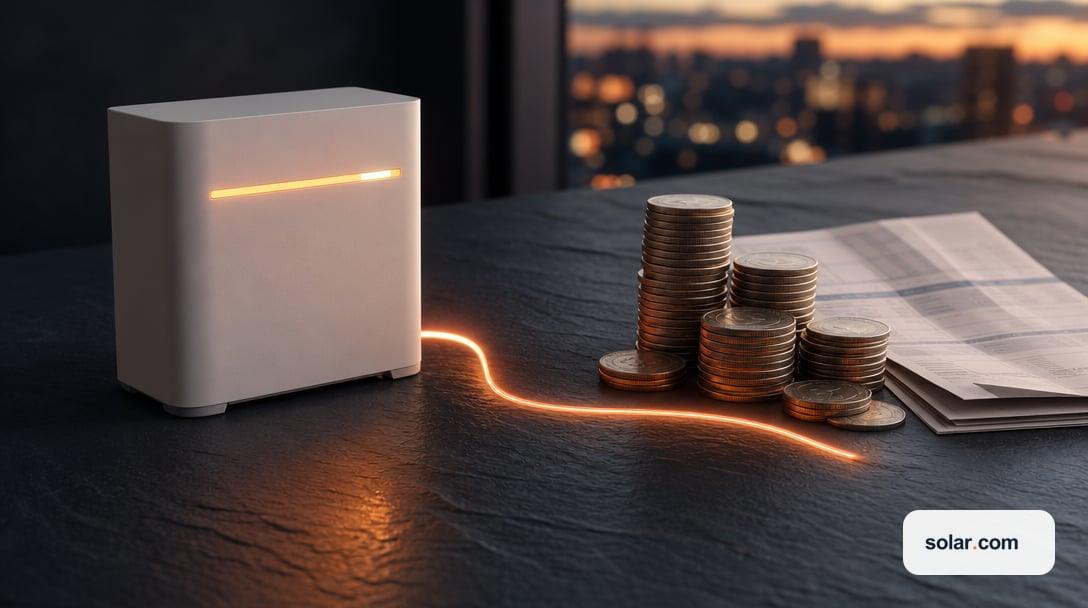
In Southern California, home battery storage is much more than just backup power when the grid fails. It’s the key that unlocks additional value from power generated by rooftop solar panels.
This is especially important to consider with the homeowner tax credit gone for purchased systems. Many homeowners shopping for solar in 2026 are deciding between owning the system from Day 1 or having a third-party own it to capture the remaining federal tax-credit value as an upfront discount through third-party ownership.
The full value of battery storage, and who claims that value, is a key part of this decision. Let’s break it down.
The Value of Battery Storage for Southern California Edison (SCE) Customers
Under NEM 3.0 solar billing structure used by SCE, it pays very little to trade electricity back and forth with the utility grid. SCE offers very low-value credits for excess solar power, and charges up to 59 cents per kWh to use grid power during On-Peak evening windows.
Battery storage saves that excess daytime solar power to use in the evenings and at night, so you can avoid pulling expensive electricity from the grid. This function is called “Time-of-Use Arbitrage,” and it unlocks $9,000-$13,500+ in additional savings for a typical solar and battery system.
Battery storage can also earn revenue through Grid Services programs. A single Tesla Powerwall 3 battery in SCE territory can generate an estimated $2,000-$7,500 in grid services revenue alone over a 10-to-15-year life.
Between these two functions, battery storage can provide between $12,000 and $21,500 in value over its lifetime. But that grid services revenue potential only fully belongs to you if you own the battery. If you’re comparing a prepaid lease or PPA against a cash or loan purchase, this is the piece of the math that’s important to consider.
What Are Grid Services, Exactly?
Since 2023, California’s utilities have built out paid programs that turn your battery into a small, on-demand grid resource. For owners, that’s an additional, ongoing revenue stream. In Southern California, this revenue comes primarily through two utility-administered programs that Tesla (and other manufacturers) plug your battery into via their app:
- Demand Side Grid Support (DSGS): A capacity-based program run through the California Energy Commission. You commit dispatchable capacity for the summer season (roughly May to October), and you’re paid a performance-based amount monthly, settled annually. Tesla advertises earnings up to $350 per Powerwall 3 per season, with most participants landing in the $200-$500 range.
- Emergency Load Reduction Program (ELRP): An event-based program run by the utility (SCE, in this case) and called on by CAISO during genuine grid emergencies. You’re paid roughly $2.00 per kWh your battery discharges above your normal baseline during a declared event. Expect roughly 7-15 events per summer in a hot year, concentrated in short 1-2 hour windows during peak demand.
You can generally enroll in one or the other, and these program structures change over time.
Lifetime Grid Services Revenue: A Single PW3 in SCE Territory
So, let’s say you purchase solar with a Powerwall 3 battery, what does the grid services revenue look like over the battery’s expected lifetime?
Grid Services (DSGS / ELRP)
- Annual: $200-$500
- 10-Year: $2,000-$5,000
- 15-Year: $3,000-$7,500
These figures assume a fairly typical enrollment pattern and don’t account for program changes, rate escalators, or expansion of eligible events, all of which have generally trended upward as California leans more heavily on distributed batteries for grid reliability.
Key Variables That Affect Your Actual Earnings
- Backup reserve setting. If you set your PW3’s backup reserve to 20%, roughly 10.8 kWh of its 13.5 kWh capacity is available to dispatch during events. Raising your reserve for extra outage protection reduces the capacity available to earn.
- Weather. Heat waves drive grid stress, which drives more ELRP events and higher potential payouts in any given summer.
- Battery degradation. Tesla guarantees 70% capacity retention at year 10, so dispatchable capacity, and with it, event-based earnings, gradually declines in the back half of the battery’s life.
- Program evolution. DSGS and ELRP are relatively young programs (DSGS launched in 2023). Rates, eligibility, and event frequency have changed before and will likely change again over a 10-15 year horizon. Treat these figures as a reasonable range, not a locked-in schedule.
Ready to see your numbers?
See your real solar price in 90 seconds
Enter your address — we'll show you the system, savings, and price for your exact roof.
Why Ownership Structure Changes the Math
Under a Third-Party Ownership (TPO) arrangement, a prepaid lease or PPA, a solar company or investor owns the battery for the life of the contract, typically 20-25 years. You get the backup power and a lower monthly cost (i.e., bill savings from Time-of-Use Arbitrage), and the owner captures the remaining federal tax-credit value and typically passes it through as an upfront discount. In most agreements, the owner also controls how the hardware is used and monetized, including enrollment in demand response and VPP programs.
Some TPO providers do run their own fleet-wide VPP programs and pass along a partial credit or bill discount to participants, but the homeowner rarely captures the full per-battery payout, and enrollment terms are set by the provider, not you.
Under direct ownership (cash or loan), you hold title to the battery from day one. That means you decide whether to enroll in a grid services program, you receive the payments directly, and you keep 100% of the upside as those programs mature or expand. This is the same asymmetry that applies to the remaining federal tax-credit value in TPO deals: the third-party owner captures it and passes it through as an upfront discount, not a homeowner tax refund. Grid services revenue works the same way.
It’s worth asking any TPO provider directly: Will I be enrolled in a VPP program, who receives the payments, and can I see the enrollment agreement?
The Real Comparison: What a Lease or PPA Actually Forfeits
When you’re weighing a $0-down lease or PPA against buying outright, the sales pitch usually stops at the monthly payment comparison. But don’t overlook the thousands of dollars in potential Grid Services revenue!
None of this means TPO is the wrong choice for every homeowner. Third-party ownership can still make sense if the upfront cost is the deciding factor, or if you’re not planning to stay in the home long-term. But if a proposal is pitching backup power and bill savings without mentioning who keeps the grid services revenue, that’s a $2,000-$7,500 question worth asking before you sign.
Questions to Ask Before You Decide
- Under this contract, who owns the battery, and who is contractually entitled to enroll it in DSGS or ELRP?
- If the provider enrolls the fleet, do I receive any share of the payments, and how is that documented?
- Does my backup reserve setting change under a VPP enrollment, and can I control it?
- What happens to program participation and payments if I sell the home or the contract transfers?
Your next step
See exactly what solar costs on your roof
We use satellite data and your utility rates to show your price and payback in about 90 seconds, with no sales calls.