How Many Watts Does a Space Heater Use? Cost per Hour and per Month

Most plug-in space heaters use 1,500 watts on high and about 750 to 900 watts on low. Every heater in our table below, from 9-inch desk models to towers and baseboard styles, lists 1,500 watts as its top setting.1 2 3 Run one on high for an hour and it uses 1.5 kilowatt-hours (kWh). With power at 18.17 cents per kWh, what U.S. homes paid on average in September 2026, that hour costs about 27 cents.4
That’s the most it can use. A heater with a thermostat shuts its heat off once the room reaches the temperature you set, so over a day it usually draws less than nonstop math suggests.1
Jump ahead:
- Space heater watts by type and setting
- Cost per hour, day and month
- What it costs in your state
- Space heater or heat pump?
- Running a heater on a battery or generator
- Safety basics
- Frequently asked questions
Space heater watts by type and setting
Heaters come in every shape, but the top wattage barely changes:
| Heater (maker’s listing) | Style | High setting (watts) | Lower settings (watts) |
|---|---|---|---|
| Lasko 9-inch ceramic | Small desk or floor heater | 1,500 | 900 |
| Vornado VC-01 | Personal ceramic heater | 1,500 | 785 |
| Vornado VH10 | Whole-room fan heater | 1,500 | 750 |
| Dreo Ceramic Heater 314 | Ceramic, three heat levels | 1,500 | 1,300 and 900 |
| Dreo Convection Heater 711 | Fanless panel | 1,500 | Not listed |
| Lasko QB16103 | Infrared quartz | 1,500 | Not listed |
| Lasko low-profile baseboard | Ceramic, baseboard style | 1,500 | Not listed |
Makers’ product pages, read November 26, 2026.1 2 3 Examples to show the range, not recommendations.
What that means for you. On high, all of these make the same amount of heat. Electricity turns into heat at 3,412 British thermal units (Btu) per kWh, so 1,500 watts gives you about 5,118 Btu an hour, whatever the heater looks like.5 Style changes how the heat gets to you. A fan pushes warm air across the room, while a fanless panel lets it rise and spread on its own. It doesn’t change how much heat a kWh buys. An “eco” mode can only save you money by running the heater less.
Amps. Divide watts by volts and you get amps. A 1,500-watt heater on a regular 120-volt outlet draws 12.5 amps, and about 6.25 amps on a 750-watt low setting.2 That’s a big, steady load for one outlet. Heater makers say to plug straight into a wall outlet, not a power strip or an extension cord.2
What a space heater costs per hour, day and month
The formula is short: watts divided by 1,000, times hours, times your price per kWh. Here’s how it plays out at the September 2026 U.S. average of 18.17 cents per kWh:4
| Hours a day | kWh a day on high | Cost a day on high | Cost a month on high | Cost a month on low (750 W) |
|---|---|---|---|---|
| 1 | 1.5 | $0.27 | $8.18 | $4.09 |
| 4 | 6 | $1.09 | $32.71 | $16.35 |
| 8 | 12 | $2.18 | $65.41 | $32.71 |
| 12 | 18 | $3.27 | $98.12 | $49.06 |
| 24 | 36 | $6.54 | $196.24 | $98.12 |
Thirty-day month, U.S. average residential price for September 2026 (EIA, preliminary).4 High is 1,500 watts.
What that means for you. Read these as worst cases. With the thermostat on, the heater cycles off when the room is warm, so the hours it actually heats are fewer than the hours it’s plugged in. A plug-in watt meter will show your real kWh.
So do space heaters use a lot of electricity? Next to most things you plug in, yes. Eight hours a day on high comes to 360 kWh a month. That alone would add about 42% to the 863 kWh an average U.S. household bought each month in 2024.6
A worked example. Say you work from home in Illinois and keep a heater on high in your office for 8 hours on each of 22 workdays. That’s 264 kWh. At Illinois’s September 2026 average of 19.14 cents per kWh, it adds about $51 to the month. On low, it’s about $25.4
For your own number, use the price per kWh printed on your bill. Here’s how many kWh a day is normal for a whole home.
What a space heater costs in your state
Where you live matters as much as the heater. Running one on high for 8 hours a day for a month (360 kWh) costs about $111 in Massachusetts and about $53 in Florida at September 2026 prices.4
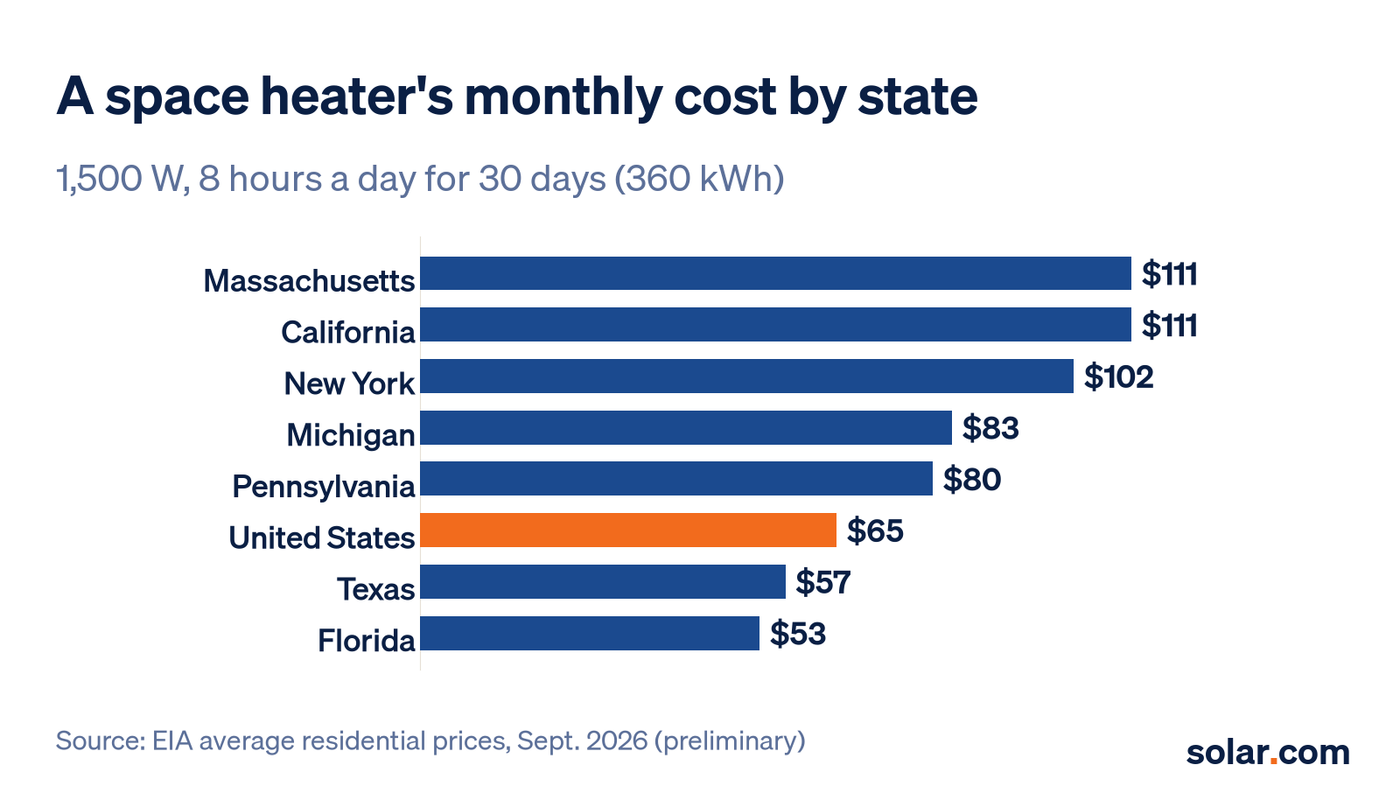
Hawaii had the highest average that month, 48.31 cents per kWh, which would make the same month about $174. Nevada’s 13.25 cents was the lowest, for about $48.4
What that means for you. If you pay 28 cents per kWh or more, 8 hours a day on high runs about $100 a month or more.4 A heater can’t lower your price per kWh. Solar works on the other side of the bill: power your panels make and you use at home is power you don’t buy. To see what panels would cost on your roof, with prices from local installers, start here:
See it for your home
Get your real solar price in 90 seconds
Enter your address — we’ll show the system, savings, and price for your exact roof. No sales calls.
Space heater or heat pump: which costs less?
Every heater in the table above turns a kWh into the same 3,412 Btu of heat.5 A heat pump gets more out of each kWh, because it pulls heat from the outdoor air into your home instead of making it.7
Federal rules set the floor. A split-system heat pump made since January 1, 2023, must have a heating rating, called HSPF2, of at least 7.5.8 The rating divides the heat delivered over a heating season, in Btu, by the electricity used, in watt-hours.9 By that measure, a space heater scores 3.412.5 So even a heat pump at the federal minimum delivers about 2.2 times as much heat per kWh.
In dollars: the 5,118 Btu a 1,500-watt heater puts out in an hour would take a minimum-rated heat pump about 0.68 kWh. At the U.S. average price, that’s about 12 cents instead of 27.4 8 As the outdoor air nears 32 degrees or colder, air-source heat pumps lose efficiency and usually lean on backup resistance heat.7
Is it cheaper to turn up the heat or use a space heater? It depends on what you’re heating. With a heat pump, turning up the thermostat usually costs less per unit of heat than a space heater does. A space heater can still come out ahead when you only need one room warm for a few hours and can turn the rest of the house down. If your furnace burns gas, compare your gas and electric rates before you decide.
Plenty of homes mix the two. In 2020, about 1 in 5 U.S. homes used a portable electric heater for extra heat, according to EIA’s Residential Energy Consumption Survey.10
Can a home battery or generator run a space heater?
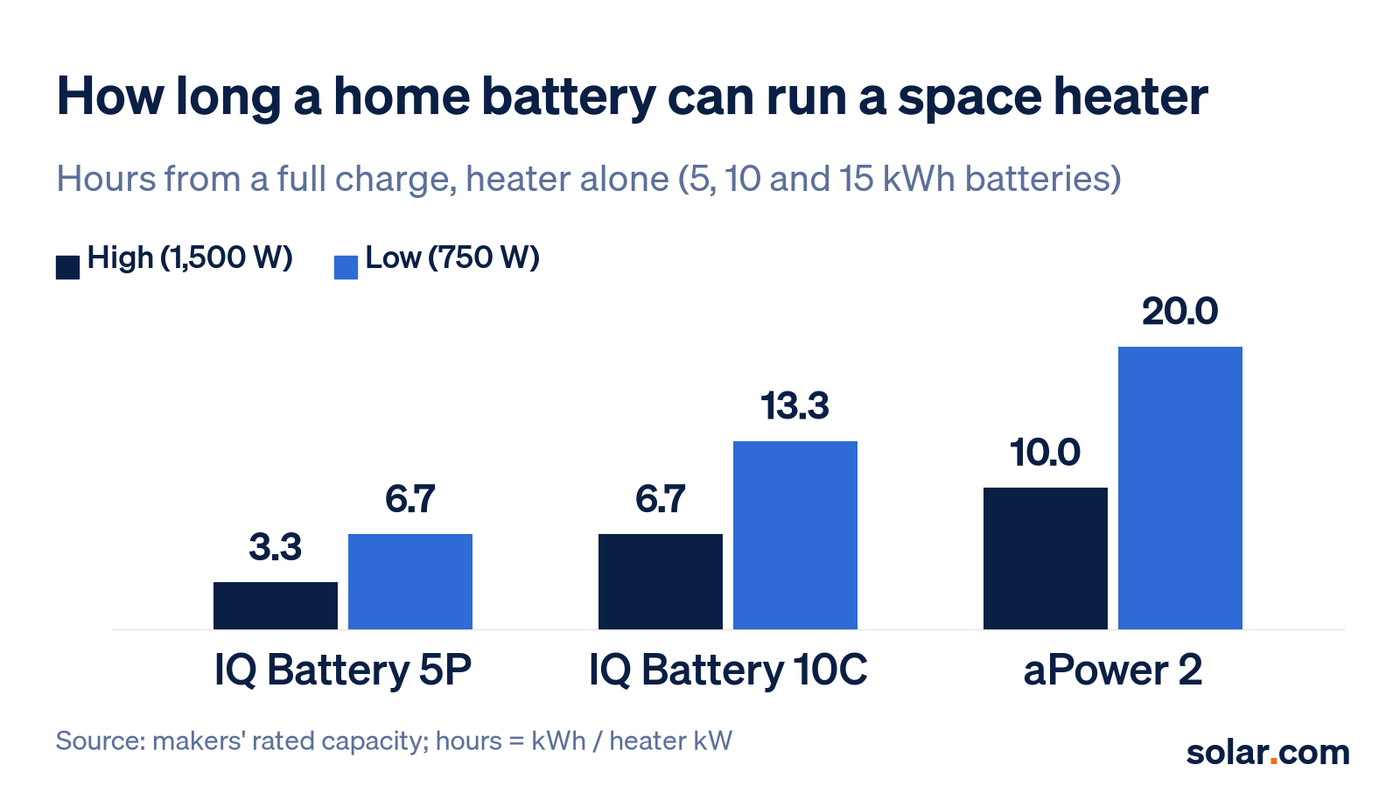
Yes, but not for long. Divide the battery’s capacity in kWh by the heater’s draw in kW. A 1,500-watt heater draws 1.5 kW.
| Battery | Capacity (kWh) | Continuous power (kW) | Hours on high | Hours on low (750 W) | Median installed price with new solar |
|---|---|---|---|---|---|
| Enphase IQ Battery 5P | 5.0 | 3.84 | 3.3 | 6.7 | About $10,300 |
| Enphase IQ Battery 10C | 10 | 7.08 | 6.7 | 13.3 | About $14,000 |
| FranklinWH aPower 2 | 15 | 10 | 10 | 20 | About $17,000 |
Capacity and power from each maker’s product page.11 12 13 Price column: the middle value of what installers on the Solar.com marketplace list for each battery when it goes in with new panels, November 2026, before any rebate.14
Each of these batteries can supply well over 1.5 kW at once, so power isn’t the limit. Stored energy is.
What that means for you. A battery makes a poor furnace. In a long winter outage, it does more for you keeping the fridge, lights, phones and internet going, with a heater on low in one small room and the door shut. Our guide to how long a battery can power a house in an outage covers whole-home loads. A battery also pays its way on normal days if your utility charges more for evening power, which our battery page explains.
Generators and power stations. A 1,000-watt generator can’t run a 1,500-watt heater on high. On a 750-watt low setting it can, with little to spare. A portable power station with 2,000 watt-hours of storage would run a 1,500-watt heater for about 1 hour and 20 minutes on paper, and only if it can put out 1,500 watts continuously. Keep a generator outside, 20 feet or more from any window, door or attached garage, with carbon monoxide alarms working indoors. And never heat your home with a gas stove or oven.15
See it for your home
Get your real solar price in 90 seconds
Enter your address — we’ll show the system, savings, and price for your exact roof. No sales calls.
Space heater safety basics
Portable heaters start few home heating fires but a large share of the deadly ones. From 2017 to 2019, they were 3% of home heating fires and 41% of the fatal ones, according to the U.S. Fire Administration.16
- Set the heater on a flat, level surface, clear of bedding and anything else that can burn.2
- Plug it straight into a wall outlet.2
- Look for a tip-over switch and overheat protection. The makers above list both on many models.1
Frequently asked questions
How many watts does a small space heater use?
Small doesn’t mean low wattage. Lasko’s 9-inch ceramic heater and Vornado’s VC-01 personal heater both list 1,500 watts on high, with low settings of 900 and 785 watts.1 2
How much does it cost to run a space heater for 8 hours?
A 1,500-watt heater on high for 8 hours uses 12 kWh. Those 12 kWh cost about $2.18 at 18.17 cents a kWh, the U.S. average for homes in September 2026. At Hawaii’s 48.31 cents, the highest state average that month, it’s about $5.80.4
How many amps does a 1,500-watt space heater draw?
About 12.5 amps on a 120-volt outlet, because amps equal watts divided by volts. A 750-watt low setting draws about 6.25 amps. Heater makers advise plugging straight into a wall outlet rather than a power strip or extension cord.2
Will a 1,000-watt generator run a space heater?
Not on high, since a 1,500-watt heater needs more than the generator can supply. Some heaters have a low setting of about 750 watts, which a 1,000-watt generator can carry with little to spare.2
Is a space heater cheaper to run than a heat pump?
Not per unit of heat. A new split-system heat pump must deliver at least 7.5 Btu per watt-hour over a rated heating season, about 2.2 times the 3.412 Btu a space heater gets from the same electricity.8 9 5 A space heater can still save money when it lets you keep the rest of the house cooler while you warm one room.
How long can a home battery run a space heater?
Divide the battery’s kWh by the heater’s kW. Take the Enphase IQ Battery 5P, which stores 5.0 kWh: on paper it runs a 1,500-watt heater about 3.3 hours, or about 6.7 hours at a 750-watt low setting.11 Other loads on the battery cut that.
Sources
- Lasko product pages for its 9-inch ceramic heater (1,500 and 900 watts), its QB16103 infrared quartz heater and its low-profile baseboard heater, read November 26, 2026. 9-inch ceramic, infrared quartz, baseboard
- Vornado specification tables for the VH10 (120 volts, 1,500 and 750 watts) and VC-01 (1,500 and 785 watts), and its placement and wall-outlet advice on the AVH2 page, read November 26, 2026. VH10, VC-01, AVH2
- Dreo product pages for the Ceramic Heater 314 (900, 1,300 and 1,500 watts) and Convection Heater 711 (1,500 watts), read November 26, 2026. Ceramic Heater 314, Convection Heater 711
- U.S. Energy Information Administration, Electric Power Monthly, Table 5.6.A, average residential price by state for September 2026 (preliminary). EIA
- U.S. Energy Information Administration, Energy Explained: British thermal units, conversion of 1 kWh to 3,412 Btu. EIA
- U.S. Energy Information Administration, 2024 average monthly residential bill by state (Table 5A): U.S. average 863 kWh a month. EIA
- U.S. Energy Information Administration, Glossary, entries for heat pumps, including air-source models in cold weather. EIA
- Code of Federal Regulations, 10 CFR 430.32(c)(5), minimum SEER2 and HSPF2 for central air conditioners and heat pumps made on or after January 1, 2023. eCFR
- Code of Federal Regulations, 10 CFR Part 430, Subpart B, Appendix M: how the heating seasonal performance factor is defined (Btu of heat per watt-hour over a season). eCFR
- U.S. Energy Information Administration, Residential Energy Consumption Survey 2020, Table HC6.1, space heating in U.S. homes. EIA
- Enphase, IQ Battery 5P product page: 5.0 kWh usable, 3.84 kW continuous. Enphase
- Enphase, IQ Battery 10C product page: 10 kWh usable, 7.08 kW continuous. Enphase
- FranklinWH, aPower 2 product page: 15 kWh capacity, 10 kW continuous. FranklinWH
- Solar.com analysis of the battery prices installers list on the Solar.com marketplace, November 2026. Medians and middle halves for a battery installed with new solar, before any rebate.
- Ready.gov, Power Outages, generator and heating safety. Ready.gov
- U.S. Fire Administration, Heating Fire Safety. USFA
Your next step
See exactly what solar costs on your roof
We use satellite data and your utility rates to show your price and payback in about 90 seconds, with no sales calls.