California Legalizes Plug-In Solar: Newsom Signs AB 868

Beginning in 2027, Californians will have another tool in their belt to combat rising electricity prices: a small solar kit that plugs into a standard wall outlet.
Newsom signs the Plug and Play Solar Act
On September 30, with part of the state bracing for a prolonged heat wave, California Governor Gavin Newsom signed Senate Bill 868, the Plug and Play Solar Act, into law. The bill, authored by Sen. Scott Wiener (D-San Francisco), cleared both houses of the Legislature in August, including a 73-0 vote in the Assembly.
With the governor’s signature, California becomes the 10th state to legalize plug-in solar. The law takes effect January 1, 2027.
Here’s what SB 868 does:
- Removes the utility gatekeeping. Qualifying systems are exempt from interconnection agreements, so you don’t need your utility’s permission to plug in. Utilities can ask you to notify them, which Sen. Wiener’s office says will happen through a free online registration form.
- Caps system size at 1,200 watts. Systems must offset your own home’s electricity use, not sell power back to the grid.
- Sets strict safety rules. Kits must be certified by UL or an equivalent lab, meet national and California electrical codes, and shut off automatically within seconds of a grid outage to protect line workers.
Two caveats are worth knowing. First, the interconnection exemption sunsets on January 1, 2030, unless lawmakers extend it. Second, no kit on the market yet meets every requirement in the bill, so Wiener’s office expects compliant products to reach California shelves by spring 2027.
What is plug-in solar?
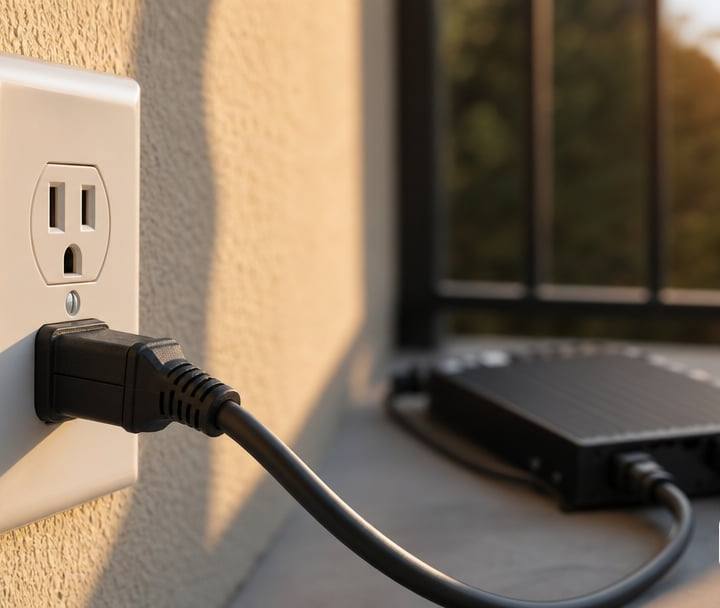
Plug-in solar, often called balcony solar, is a small system of one to three lightweight panels that clamp onto a balcony railing, sit on a patio, or mount to a fence. Instead of wiring into your main electrical panel like a rooftop system, it plugs into a regular 120-volt outlet through a microinverter, which converts the panels’ power into the same electricity your appliances use.
The idea is to treat solar like a household appliance rather than a power plant. There’s no drilling, no permits, and no installer. When you move, the kit moves with you. These systems won’t take you off the grid or backup your home during a power outage, but they chip away at the “always-on” loads from your fridge, router, and electronics.
Ready to see your numbers?
See your real solar price in 90 seconds
Enter your address — we'll show you the system, savings, and price for your exact roof.
Why this is a big deal for Californians
California has the perfect ingredients for plug-in solar savings: some of the highest electricity rates in the country and some of its most abundant sunshine.
Start with rates. California’s electricity prices have nearly doubled over the past decade, and the state now has the second-highest energy prices in the nation. The more you pay per kilowatt-hour, the more each kilowatt-hour from your own panels is worth.
Then add the sun. A plug-in kit in a sunny California location can produce 1,000 to 1,400 kWh per year.
Here’s a simple example:
- A $1,000 kit producing 1,000 kWh a year works out to about 10 cents per kWh over 10 years.
- Buying that same electricity at California’s average rate of about 35 cents per kWh would cost $3,500.
- Over 10 years, the kit provides $2,500 in energy cost savings (and that’s with utility rates staying flat).
The bigger story is who can now access solar. Rooftop solar simply isn’t viable for millions of Californians: renters, condo owners, apartment dwellers, and homeowners with shaded or unsuitable roofs. But many of those same households have a sunny balcony, patio, or backyard fence that can fit a small kit. SB 868 opens solar savings to them for the first time. With roughly 39 million residents, California alone doubles the size of the U.S. plug-in solar market, which should bring more products and lower prices.
One note for homeowners: plug-in solar trims your bill, but it won’t erase it. If you own your home and have a good roof, a full rooftop system with battery storage can offset far more of your bill and provide backup power. See what solar costs on your roof in about 90 seconds.
Your next step
See exactly what solar costs on your roof
We use satellite data and your utility rates to show your price and payback in about 90 seconds, with no sales calls.