Plug-In Solar Panels: The 2026 Guide to Balcony Solar
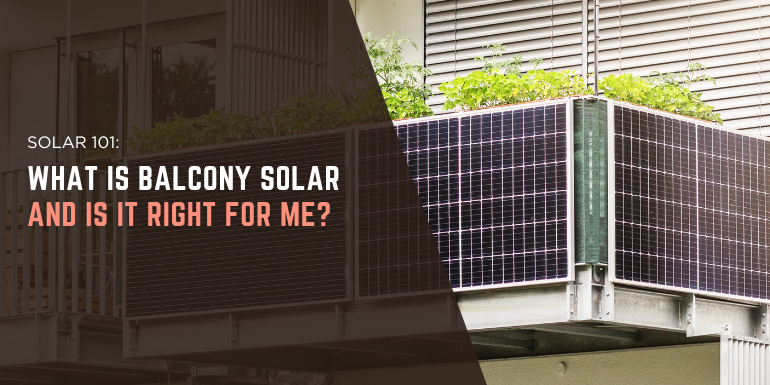
No roof? A sunny balcony, patio or fence may be all you need to start making your own solar power.
Plug-in solar, also called balcony solar, is a small solar kit that plugs into a regular wall outlet and powers whatever is running in your home. Ten states, including California, have passed laws that let you use one without your utility's approval.
An 800-watt kit costs about $1,100 to $2,000 and, in the cities we checked, is worth about $100 to $450 a year in lower bills, depending on your electricity rate and how you mount it.
Jump ahead:
- What is plug-in solar?
- Where plug-in solar is legal in 2026
- Is plug-in solar legal in California?
- Is plug-in solar safe? The UL 3700 standard
- What a plug-in solar kit costs
- How much can you save?
- Plug-in solar vs rooftop solar
- Is plug-in solar right for you?
- Frequently asked questions
What is plug-in solar?
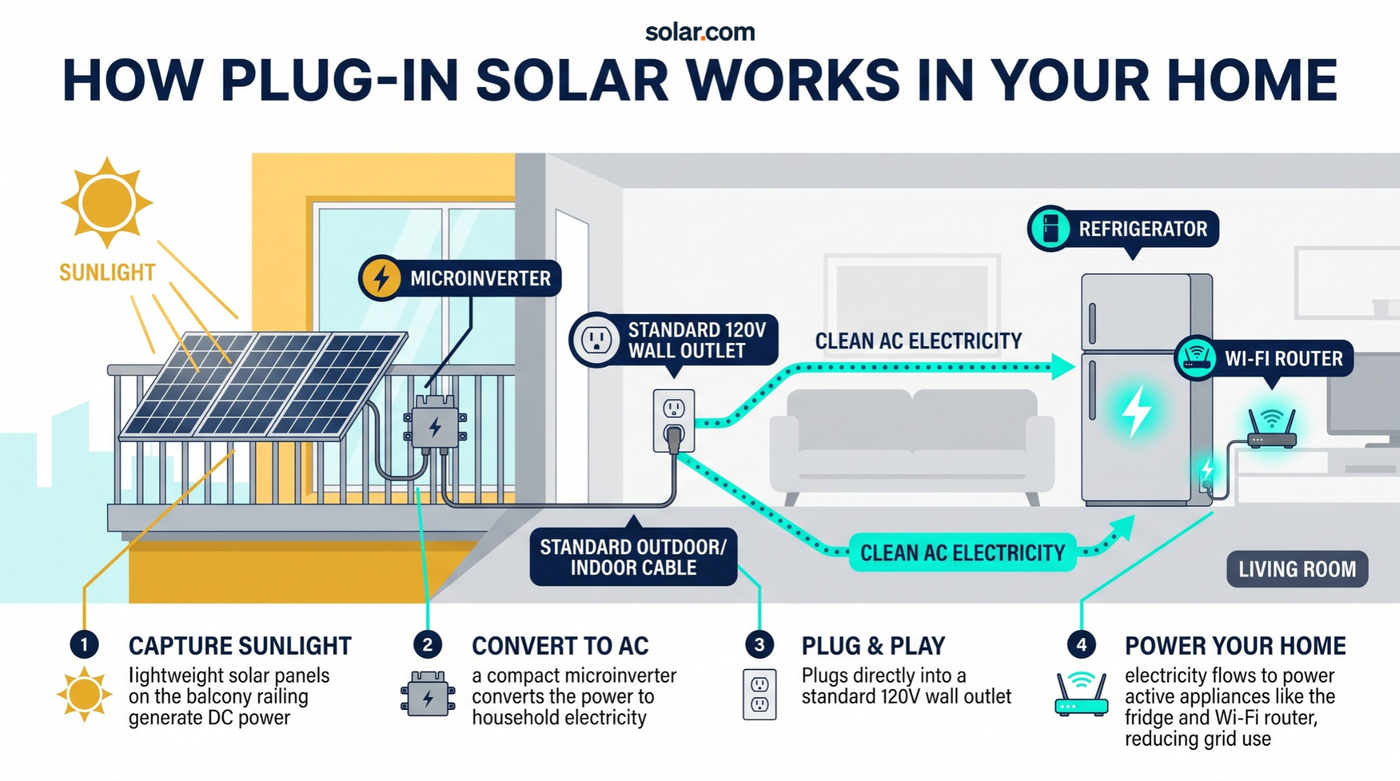
Plug-in solar (also called balcony solar or plug-and-play solar) is a small solar system you set up yourself. A typical kit has:
- A few lightweight panels that hang on a balcony railing, sit on a patio or mount to a fence, with no drilling.
- A microinverter, a small box that turns the panels' power into the same kind of electricity your outlets use.
- A cord that plugs into an outlet in your home.
The power goes straight to whatever is running in your home at that moment, like your fridge, your Wi-Fi router and devices on standby. You buy that much less from your utility. When you move, the kit comes with you.
What it won't do:
- Keep your lights on in an outage. Certified kits shut off when the grid goes down, so they can't send power onto lines that crews are repairing.
- Earn bill credits. None of the 10 state plug-in laws pays you for power a kit sends to the grid. Plan on saving only on power your home uses as it's made.
- Replace your utility. An 800-watt kit covers about 11% to 22% of an average apartment's electricity.
Where plug-in solar is legal in 2026
Ten states have passed laws that let you plug in a small solar kit without your utility's approval. Six are in effect now. Virginia, New Hampshire and California follow on January 1, 2027, and New Jersey on March 1, 2027.
| State | Law | Takes effect | Size limit | Renters and HOAs |
|---|---|---|---|---|
| Utah | HB 340 | In effect since May 7, 2025 | 1,200 watts | No protections |
| Maine | LD 1730 | In effect since July 29, 2026 | 420 watts, or up to 1,200 watts with a licensed electrician and a dedicated outlet | No protections |
| Maryland | HB 1532 | In effect since July 1, 2026 | 1,200 watts per meter | No protections |
| Vermont | S. 202 | In effect since July 1, 2026 | 1,200 watts per meter, on homes with smart meters | Renters give 10 days' notice and landlords can set reasonable rules; HOA covenants can't ban kits |
| Colorado | HB26-1007 | In effect since August 12, 2026 | 1,920 watts | Landlords and HOAs can't unreasonably ban kits, starting January 1, 2027 |
| Connecticut | HB 5340 | In effect since October 1, 2026 | 1,200 watts, one kit per meter | No protections |
| Virginia | HB 395 / SB 250 | January 1, 2027 | 1,200 watts | Landlords with more than 4 rental units can't ban kits; no HOA or condo protections |
| New Hampshire | SB 540 | January 1, 2027 | 1,200 watts | No protections |
| California | SB 868 | January 1, 2027 | 1,200 watts per home | No protections |
| New Jersey | S 2368 | March 1, 2027 | 1,200 watts per home | Landlords and HOAs can't ban kits; renters who pay their own electric bill give 14 days' written notice |
Size limits are a kit's maximum power output. Each state's enacted law, checked October 14, 2026.
What these laws have in common:
- No utility approval or interconnection paperwork for a kit that qualifies, and in most states no fees or extra equipment. Maryland and Virginia let a utility require a disconnect switch in some cases.
- A safety certification. Kits must be certified by UL or another nationally recognized testing lab. More on UL 3700 certification below.
- No pay for extra power. None of the 10 laws passed so far allows you to get paid for power a kit sends to the grid, and most exclude kits from net metering. Connecticut's requires a warning that unused power can be billed to you as usage unless your meter supports net metering.
- Sometimes, a note to your utility. Virginia and Maryland require notice before you install, and Maine within 30 days for kits over 420 watts. California, Colorado and New Hampshire let utilities ask for one.
A note for renters: these laws mainly stop utilities from blocking plug-in solar. Only Colorado (from 2027), New Jersey, Vermont and, for larger landlords, Virginia also limit landlord or HOA bans. Check your lease or HOA rules before you buy.
Bills in other states
Lawmakers in 24 more states and Washington, D.C. introduced plug-in solar bills in their 2025 to 2026 sessions. As of October 14, 2026, these are still alive:
| State | Bill | Status |
|---|---|---|
| New York | SUNNY Act (A.9111-C / S.8512-C) | Passed the Legislature; not yet sent to the governor |
| Massachusetts | H.5175 / S.3143 | In a House and Senate conference committee |
| Illinois | HB 4371 / SB 3104 | Stalled; lawmakers return in November |
| Michigan | HB 5764 | In committee |
| North Carolina | H 1129 / S 957 | In committee |
| Ohio | HB 755 / SB 383 | In committee |
| Pennsylvania | HB 1971 | In committee |
| Washington, D.C. | B26-0602 (GRID Act) | In committee |
These bills died when their 2026 sessions ended:
| State | Bill | What happened |
|---|---|---|
| Alaska | HB 257 | Died in committee |
| Arizona | HB 2843 / SB 1606 | Died in committee |
| Delaware | SB 270 | Died in committee |
| Georgia | HB 1304 | Died in committee |
| Hawaii | SB 2902 / HB 2435 | Passed the Senate, died in the House |
| Idaho | H0612 | Died in committee |
| Indiana | HB 1084 / SB 74 | Died in committee |
| Iowa | HF 2046 | Died in committee |
| Minnesota | HF 3555 / SF 4504 | Passed the Senate in an energy bill, died in the House |
| Missouri | HB 2528 / HB 2444 | Died in committee |
| New Mexico | SB 157 | Died in committee |
| Oklahoma | HB 4060 | Passed the House, died in the Senate |
| Oregon | HB 4080 | Died in committee |
| Rhode Island | H 7269 / S 2359 | Passed the House, died in the Senate |
| South Carolina | H 4579 | Died in committee |
| Washington | SB 6050 | Died in the Senate |
| Wyoming | HB 146 | Died in committee |
Each legislature's bill records, checked October 14, 2026.
What's next
- New York: the SUNNY Act passed the Legislature on May 28, 2026, but it hasn't been sent to Gov. Kathy Hochul yet. Once it is, she'll have a short deadline to sign or veto it. It would allow kits up to 1,200 watts, ask owners to tell their utility within 30 days of installing, and take effect 90 days after it becomes law. It doesn't require landlords, co-op boards or condo associations to allow kits.
- Massachusetts: the House and Senate energy bills both include plug-in solar, and a conference committee appointed July 16 is working out the differences. Formal sessions ended July 31, but lawmakers can still vote on a conference committee's report.
- Everywhere else: bills that “died in committee” in 2026 would have to be filed again in 2027.
Ready to see your numbers?
See your real solar price in 90 seconds
Enter your address — we'll show you the system, savings, and price for your exact roof.
Is plug-in solar legal in California?
Yes, starting January 1, 2027. Gov. Gavin Newsom signed SB 868, the Plug and Play Solar Act, on September 30, 2026, making California the 10th state with a plug-in solar law.
A kit qualifies if it:
- Puts out no more than 1,200 watts per home.
- Plugs into an outlet and is meant to cover your own use.
- Meets the national and California electrical codes.
- Is certified as a complete plug-in solar system by UL or an equivalent testing lab, including a certified shut-off that keeps it from sending power to the grid in an outage. The law doesn't name UL 3700.
For a kit that qualifies:
- No utility approval, fees or extra equipment. That applies to the big utilities and to city-owned ones like LADWP and SMUD.
- Your utility can ask you to register it on a simple online form with your address and the kit's make, model and size. Registering is a notice, not a request for permission.
- The exemption ends January 1, 2030, unless lawmakers extend it. From that date, kits that don't meet the law's code and certification rules can't be sold in California.
What the law doesn't do:
- Protect renters or condo owners. It says nothing about landlords, HOAs or leases, so check your lease or HOA rules.
- Pay you for extra power. It sets up no credit for power a kit sends to the grid.
Until January 1, 2027, the exemption doesn't apply. Solar that connects to the grid goes through your utility's approval process. Use the time before January 1 to:
- Check how much sun your balcony or patio gets.
- Check your lease or HOA rules.
- Look for a kit certified as a complete plug-in system. In late August, the Legislature's analysis of the bill said none on the market had that yet.
At California's average rate, an 800-watt kit in Los Angeles is worth about $264 to $454 a year.
Is plug-in solar safe? The UL 3700 standard
It’s fair to question whether it's safe to plug a power source into your wall. Our safety explainer covers the details. The short answer: a certified kit is built for exactly this.
UL 3700 is the first U.S. safety standard written just for plug-in solar. UL first published it in December 2025, and UL Solutions began certifying products to it in January 2026. To pass, a kit needs protections that:
- Keep you from touching live electrical parts.
- Guard against overloads, so the kit can't overheat your home's wiring.
- Stop power from flowing the wrong way.
- Make a safe installation easier.
The state laws also require kits to shut off in a blackout, so they can't send power onto lines that crews are repairing.
Maine, Vermont and New Jersey name UL 3700, or an equivalent, in their plug-in laws. California and most other states require certification by UL or another nationally recognized testing lab.
What to look for:
- A certified system, not just a certified part. The first UL 3700 certifications went to microinverters, the part that connects the panels to your outlet. Hoymiles and APsystems announced theirs earlier in 2026, and Mango Power in September. California's law, and New York's bill, call for the whole kit to be certified as a plug-in system. In late August, California's Assembly analysis said no plug-in system on the market had that yet.
- The right outlet. UL 3700 is written for kits that plug into a permanently installed outlet, and California's Assembly analysis says it can call for an electrician to do some extra work to protect your home's wiring. Ask the seller what your outlet needs.
See our full rundown of which plug-in solar products have UL 3700 certification.
What a plug-in solar kit costs
Kit prices depend mostly on size. Here's what brands listed on their own U.S. stores in October 2026:
| Kit size | List price | What it is |
|---|---|---|
| Starter kit (180 to 400 watts) | About $285 to $800 | One or two panels |
| 800 watts | About $1,100 to $2,000 | Usually 2 to 4 panels |
| 1,200 watts | About $2,250 to $3,050 | The largest size most state laws allow |
List prices on four plug-in solar brands' own U.S. online stores, Oct 14, 2026, before shipping and tax. The lowest price is a nonprofit's at-cost price for members.
That works out to about $1.15 to $2.80 per watt.
There's no federal tax credit for a kit you buy in 2026. The homeowner credit ended at the end of 2025.
How much can you save?
A plug-in kit saves you the cost of the electricity it makes, as long as your home uses that power as it's made. How much it makes depends on where you live and, even more, on how you mount it.
Here's what an 800-watt kit facing south makes and saves in a year:
| City | Hanging on a balcony railing | Tilted toward the sun on a patio | Yearly savings |
|---|---|---|---|
| Los Angeles | 794 kWh | 1,366 kWh | $264 to $454 |
| New York City (bill pending) | 669 kWh | 1,054 kWh | $197 to $310 |
| Newark, NJ | 711 kWh | 1,072 kWh | $170 to $257 |
| Baltimore | 745 kWh | 1,139 kWh | $159 to $243 |
| Denver | 889 kWh | 1,316 kWh | $149 to $220 |
| Salt Lake City | 800 kWh | 1,219 kWh | $105 to $160 |
Savings run from railing to tilted, at each state's average home electricity rate for January to July 2026 (EIA): California 33.25 cents per kWh, New York 29.38, New Jersey 23.98, Maryland 21.30, Colorado 16.72, Utah 13.16. Savings assume your home uses all of the kit's power as it's made. Output from NREL's PVWatts calculator: panels facing south, upright on a railing or tilted 30 degrees, with no shade. Shade from the balcony above or the railing itself will lower these numbers. New York's plug-in solar bill has passed the Legislature but isn't law yet.
What that means for you:
- Tilt matters most. Hanging upright on a railing, a kit makes about 32% to 42% less than the same kit tilted toward the sun.
- Face south if you can. In Los Angeles, the same kit on a west-facing railing makes about 16% less than on a south-facing one. On a north-facing railing, it makes only about a quarter as much as facing south.
- High rates pay back faster. The same kit saves about 2.5 times as much in Los Angeles as in Salt Lake City, because California's electricity costs about 2.5 times as much.
- Expect a slice, not your whole bill. An average apartment uses about 6,100 kWh a year (EIA). An 800-watt kit covers about 11% to 15% of that on a railing, or 17% to 22% tilted.
A worked example: in Los Angeles, an 800-watt kit that costs $1,100 to $1,500 pays for itself in about 4 to 6 years hanging on a south-facing railing, or about 2.5 to 3.5 years tilted toward the sun. In Salt Lake City, with some of the lowest rates in the country, the same kit on a railing takes 10 years or more. Rising electricity rates would shorten these paybacks.
If your kit makes more than your home is using at that moment, the extra flows to the grid, and you won't get a credit for it.
Plug-in solar vs rooftop solar
If you own your home and have a good roof, it's worth comparing. Here's how an 800-watt kit stacks up against a typical rooftop system:
| Plug-in kit (800 watts) | Rooftop system (6 kW) | |
|---|---|---|
| Price | About $1,100 to $2,000 | About $17,700 in California on Solar.com |
| Price per watt | About $1.15 to $2.80 | $2.95, our California average |
| Yearly output in Los Angeles | About 790 to 1,370 kWh | About 10,000 kWh |
| How much of your use it covers | About 13% to 22% of an average apartment's | About 95% of an average U.S. home's |
| Who installs it | You | A licensed installer, with permits |
| Utility approval | Not needed in states with a plug-in law | Needed |
| Credit for power sent to the grid | No | Yes, under your utility's net metering or billing plan |
| Power in an outage | No | Only with a battery |
Rooftop price at our $2.95 per watt California average (Sept 2026), before incentives. Output for south-facing panels in Los Angeles from NREL's PVWatts calculator; average use from EIA.
- Per kWh it makes, a kit isn't much cheaper. Hanging on a railing, a kit costs about as much as a rooftop system for each kWh it makes in a year. Tilted toward the sun, it costs less, but it's still capped at a small share of your use.
- A rooftop system covers far more. A 6 kW system can cover most or all of a typical home's electricity. A kit trims the always-on part.
- Rooftop solar gets credit for what you send back. A kit doesn't, so anything your home isn't using at that moment is lost.
If you buy your system (cash or loan), there's no federal tax credit in 2026. The homeowner credit ended at the end of 2025. The way to still capture that value on a new rooftop system is a Prepaid TPO (a prepaid lease): a partner owns the system for the first five years, claims the business credit, and passes it to you as an upfront discount on your price. You own it after year five. How the Prepaid TPO works
Is plug-in solar right for you?
Plug-in solar fits best if you:
- Rent, or live in an apartment or condo, where rooftop solar isn't an option.
- Have a sunny spot facing south or west, like a balcony, patio or yard.
- Pay a high electricity rate, as in California, New York or New Jersey.
- Live in one of the 10 states with a plug-in solar law, once it takes effect.
Before you buy:
- Check your state's rules in the tables above.
- Buy a certified kit. Look for UL 3700, or the certification your state's law names, and ask what kind of outlet it needs.
- Check your lease or HOA rules. Only some state laws protect renters and condo owners.
- Tell your utility if your state requires it. Virginia and Maryland require notice before you install. California's law lets utilities ask for a short online form.
- Check your meter. Vermont allows kits only on homes with smart meters, and Connecticut's law warns that without a net-metering meter, power your home doesn't use can be billed to you as usage.
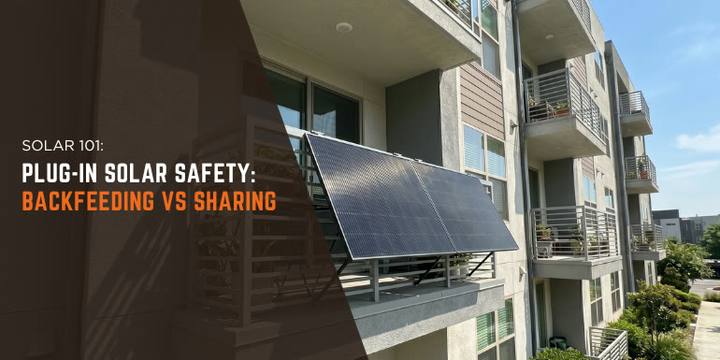
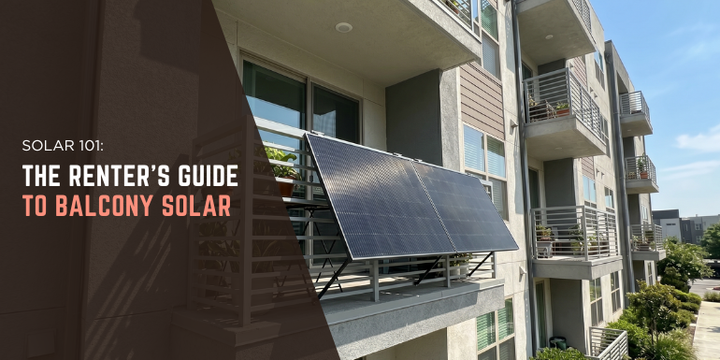
- Mount it securely. Wind on a high balcony can be strong. Our renter's guide to no-drill balcony solar covers mounts, safety tethers and shade.
If you own your home and have a good roof, a rooftop system can cover far more of your bill, and adding a battery keeps your power on in an outage.
Plug-in solar FAQs
How much does a plug-in solar panel cost?
On brands' own U.S. stores in October 2026, a starter kit of 180 to 400 watts listed for about $285 to $800, an 800-watt kit for about $1,100 to $2,000, and a 1,200-watt kit for about $2,250 to $3,050. There's no federal tax credit for a kit you buy in 2026.
Can I plug a solar panel into a regular wall outlet?
In the 10 states with a plug-in solar law, yes, once the law takes effect, with a certified kit up to the state's size limit, usually 1,200 watts. In other states, no law exempts kits from your utility's rules for connecting solar, so check with your utility first.
Will a 400-watt solar panel run a fridge?
Not by itself. Over a year, a 400-watt panel in Los Angeles makes about 400 kWh hanging on a railing, or about 680 kWh tilted toward the sun. A typical ENERGY STAR certified full-size fridge uses about 460 kWh a year. But the panel only makes power in daylight, while your fridge runs day and night, so the panel offsets part of what the fridge uses rather than running it.
How much power can balcony solar produce?
An 800-watt kit facing south makes about 670 to 890 kWh a year hanging on a railing, or about 1,050 to 1,370 kWh tilted toward the sun, depending on the city. See the table.
Is plug-in solar worth it?
It depends on your rate and your spot. In Los Angeles, an 800-watt kit can pay for itself in about 4 to 6 years on a south-facing railing, or less if you can tilt it. Where electricity is cheap, as in Utah, it can take 10 years or more.
What are the downsides of plug-in solar panels?
- It covers a small share of your use: about 11% to 22% of an average apartment's for an 800-watt kit.
- It shuts off in a power outage.
- You don't get credit for power your home doesn't use right away.
- Only 10 states have laws that let you skip utility approval, and four of them don't start until 2027.
- Some landlords and HOAs can still say no.
Is plug-in solar legal in California now?
California's law was signed on September 30, 2026, and takes effect on January 1, 2027. See the California section.
How many solar panels does it take to power an apartment?
More than a plug-in kit allows. An average apartment uses about 6,100 kWh a year. In Los Angeles, covering all of it would take about 3.6 kW of panels tilted toward the sun, or about 6 kW hanging on railings. That's far above the 1,200-watt cap in most state laws.
Own your roof? See your real price
Plug-in solar is a great start. If you own your home, a rooftop system can cover most or all of your bill. See your real price for your address in about 90 seconds, with no sales calls.
Your next step
See exactly what solar costs on your roof
We use satellite data and your utility rates to show your price and payback in about 90 seconds, with no sales calls.