Is "Active Glass" Solar’s Next Big Performance Breakthrough?
California-based Caelux has announced an impressive backlog of solar original equipment manufacturers lining up to ink deals to purchase the company’s “Active Glass.”
What exactly is Active Glass and is this the next big thing for the solar industry? Let’s break it down.
What is Solar Glass?
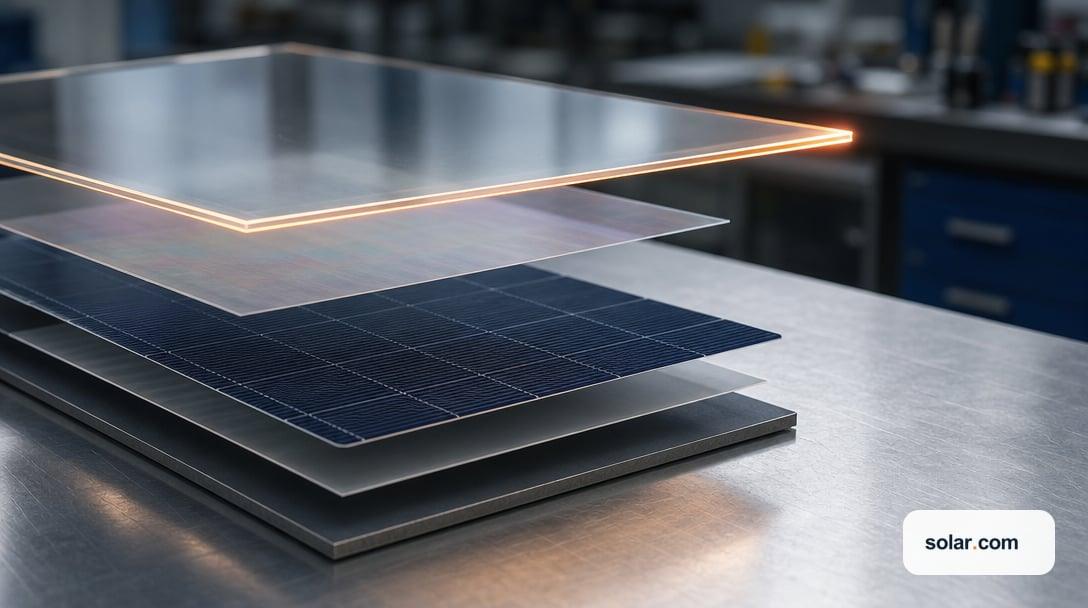
Every non-flexible solar panel today technically uses glass on its front side. Glass allows for the right combination of durability and light transmission. Some manufacturers coat the glass with an anti-reflective coating while others texture their glass, but the goal is the same: protect the solar cells on the inside while allowing for as much light absorption as possible. If you think of a solar panel like a sandwich, that front sheet of glass is the top layer of bread.
However, there’s another manufacturing process that’s been used for a while, mostly in thin-film applications such as those manufactured by First Solar (used almost exclusively in utility-scale applications) where the active solar layer is actually printed on the glass. To keep the sandwich analogy going, this would be like baking your turkey inside your sourdough.
There are pros and cons to this methodology, but it ultimately comes down to what the conductive layer is (silicon vs non silicon) and the best way to expose it to sunlight within the package.
Active Glass, as marketed by Caelux, is almost a hybrid between traditional cover glass and an active cover layer. Caelux is a perovskite technology company that is prototyping perovskite deposition on glass, and then joining this front layer with a traditional Silicon cell underlayer in a “tandem” module. (More on what tandem means below!)
The goal is to unlock substantial efficiency gains with only incremental cost increases.
Understanding Perovskites
Perovskites are any material that shares a distinct crystal structure with the natural titanium oxide mineral. In a solar cell, perovskites are generally organic materials that follow this crystal structure. They’ve been studied extensively in universities and labs for several decades, and they potentially hold the holy grail for improving solar panels:
- Organic materials
- High efficiency
- Very cost-effective
The challenge in commercializing perovskite solar cells and panels is that they’re notoriously unstable. So while you can achieve fantastic results in a lab, real-world performance means they rapidly degrade in efficiency (whereas today’s best solar panels will degrade in efficiency on average around 0.5% or less per year).
As one R+D leader once told me: “Perovskites represent the best opportunity to take a meaningful leap forward for the solar industry. The challenge is they’re, well, challenging. They degrade if exposed to water, air, humidity, heat, cold, even sunlight. It’s like Mother Nature playing a giant joke on us, here’s the perfect solution, it just doesn’t like what you want to do with it.”
Ready to see your numbers?
See your real solar price in 90 seconds
Enter your address — we'll show you the system, savings, and price for your exact roof.
Enter tandem technology
What companies like Caelux are attempting to do is marry together the performance “boost” of a front-layer perovskite with a traditional silicon solar underlayer. Because the two materials absorb light at different frequencies, they’re a natural coupling. A perovskite front layer can allow an existing solar cell technology platform to achieve a relatively large increase in efficiency. And the technology is close; lab results are showing increasing stability and performance characteristics.
Is tandem technology right for your project?
Tandem solar panels could take a solar panel efficiency from 23% to close to 30%. This means today’s average 20-panel system that would be rated at 8.6kW might be rated at over 11kW in the future using the same-sized panels. That’s a lot more power from the same number of modules!
But panels that are commercially accepted and available are probably another 5+ years away. Not to mention the requirements of Balance of System manufacturers, such as inverters and racking, needing to keep up. And, as any new technology goes, the first years of production will likely be unstable and could potentially have challenges.
The solar.com team is keeping a close eye on perovskite manufacturers, and rooting for Caelux and other companies working to perfect the technology, from the sidelines. But the old adage remains: to combat ever-increasing utility prices, the best day to go solar was yesterday. And since you can’t do that, the best day is today.
Your next step
See exactly what solar costs on your roof
We use satellite data and your utility rates to show your price and payback in about 90 seconds, with no sales calls.