New Jersey Passes Plug-In Solar Bill: Here's Who Benefits Most
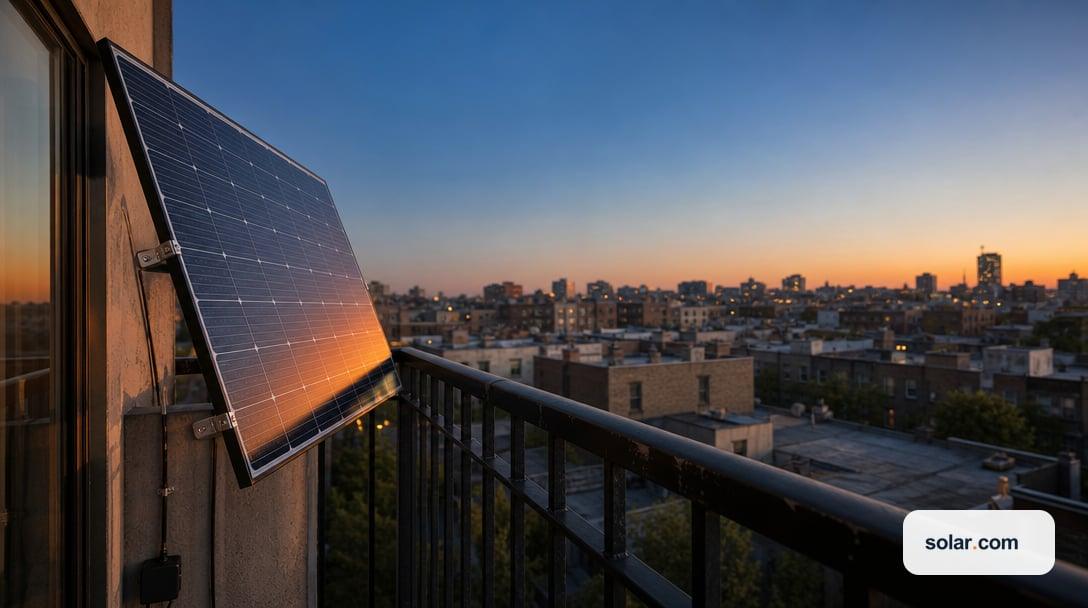
New Jerseyans are on their way to legally using plug-in or “balcony” solar to reduce their fast-rising electricity bills. On September 1, 2026, Gov. Mikie Sherrill signed the Garden State Balcony Solar Act. She did it by literally plugging in a panel outside the State House in Trenton. The law passed both chambers unanimously back in late June, and it takes effect six months after signing, so plan on that protection kicking in around March 2027.
Why does this matter? New Jersey has had some of the sharpest utility rate increases in recent years, and not all homes are suited for rooftop solar. This bill unlocks plug-in solar as a tool renters and homeowners can use to lower their electricity costs with a minimal upfront investment.
What does the Garden State Balcony Solar Act do?
Sherrill signed the bill during a stretch of rising utility costs across the state. Her pitch was blunt. Balcony solar units “cost a fraction as much as rooftop solar, but they can still shave up to $50 off the typical monthly bill,” she said at the signing ceremony reported by the New Jersey Monitor.
The law does three things at once:
- It stops landlords and homeowners associations from banning the units.
- It stops municipalities from requiring permits, licenses, or fees to use one.
- It exempts qualifying devices from utility interconnection agreements and net metering (NEM) program rules.
Net metering is the billing arrangement that credits you for solar power you send back to the grid. These plug-in units skip that process entirely.
How plug-in solar works, and the rules NJ set
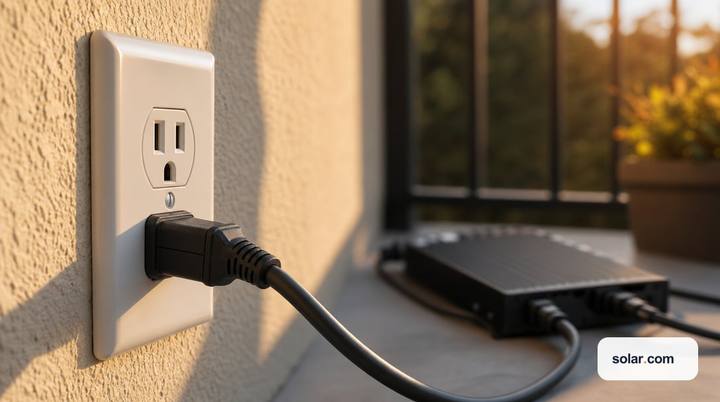
Plug-in and balcony solar are interchangeable names for the same thing: a movable panel that plugs into a standard 120-volt outlet and feeds a little power into your home’s circuits, offsetting what you’d otherwise pull from the grid. Think of it as a small appliance that runs backward.
The bill sets clear guardrails. Here’s what qualifies under the text of the Balcony Solar Act (S2368):
- 1,200 watts max. That’s the combined ceiling for all units at a single home or apartment. Want more? You’d need a full interconnection agreement.
- Standard outlet connection. No hardwiring, no electrician for the smallest units. Devices rated 400 watts or less are exempt from any code requirement that would force changes to your wiring or panel.
- Safety certification. Units must be listed to Underwriters Laboratories Standard 3700 (or a comparable standard) by a recognized testing lab.
- No backfeeding during outages. Each device must include a feature that stops it from exporting power to the grid during a power outage. That protects line workers.
There’s a process, too. Renters must give their landlord (or HOA) 14 days’ written notice before installing, including proof the device meets the standard. Landlords can set reasonable rules on size and placement, and they can ask you to release legal claims for injury or property damage. But they can’t say no outright.
Because these units don’t use net metering, they only offset power you’re actually using in real time. You generally won’t get credit for sending excess solar power to the grid. So the savings come from offsetting daytime consumption, not banking surplus.
Related: The Renter’s Guide to “No-Drill” Balcony Solar: Mounting, Safety, and Shading
Ready to see your numbers?
See your real solar price in 90 seconds
Enter your address — we'll show you the system, savings, and price for your exact roof.
Who benefits most, and who should look at rooftop
Plug-in solar was built for people the traditional market leaves out. As Environment New Jersey’s Doug O’Malley put it, “Close to 70% of the public can’t go solar, either because there’s too many trees, the roof doesn’t face the right way, or they’re a renter.” Germany proves the appetite is real. More than 1 million balcony units were installed there by June 2025.
Balcony solar makes sense if you:
- Rent your home or live in a condo with an HOA
- Have a sunny balcony, patio, or south-facing wall
- Want a low-commitment way to trim your bill, often for a few hundred dollars upfront
Rooftop solar is the stronger play if you:
- Own your home and plan to stay a while
- Have a decent roof and want to offset most or all of your usage
- Want a project that’s eligible for state incentives (like New Jersey’s SuSI Program)
- Want to pair panels with a home battery backup for outage protection
A plug-in unit shaving $50 a month is real money, roughly $600 a year. A full rooftop system, typically $13,000-$18,000, can wipe out most of your utility bill to provide thousands of dollars in savings a year.
Different tools for different situations.
If you own your roof and you’re wondering which path fits your budget, the smartest first move is to see what a full system would actually cost for your home before you commit to anything.
Solar.com’s Advice: If you rent, a plug-in unit is a genuine bill-trimmer worth exploring once the law takes effect. If you own, run the rooftop math first. The bigger system usually wins on total lifetime savings.
Your next step
See exactly what solar costs on your roof
We use satellite data and your utility rates to show your price and payback in about 90 seconds, with no sales calls.