Plug-In Solar Bill Advances in California. When Will It Be Legal?
Plug-in solar is one step closer to being legal in California. On August 25, the state Assembly passed Senate Bill 868, which would let residents plug portable solar panels into a standard wall outlet without requiring permission from their utility. The bill now heads back to the Senate to sign off on amendments, then to the governor’s desk. If signed, it takes effect January 1, 2027.
That’s a big deal. California is the most populous state in the country, and its electricity is among the priciest anywhere. So let’s break down what plug-in solar actually is, what SB 868 establishes, and whether it’s a fit for your home.
What is plug-in solar?
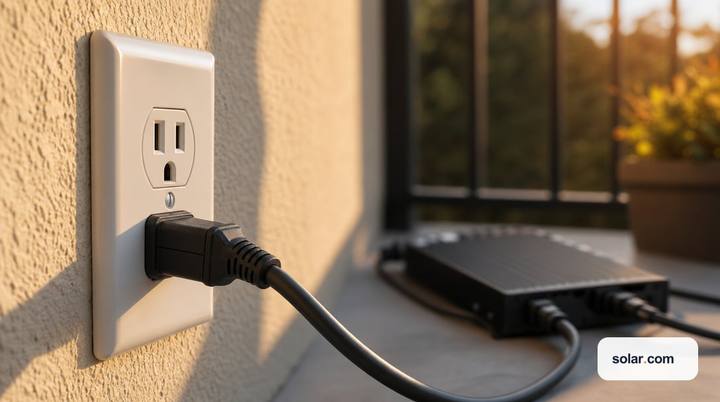
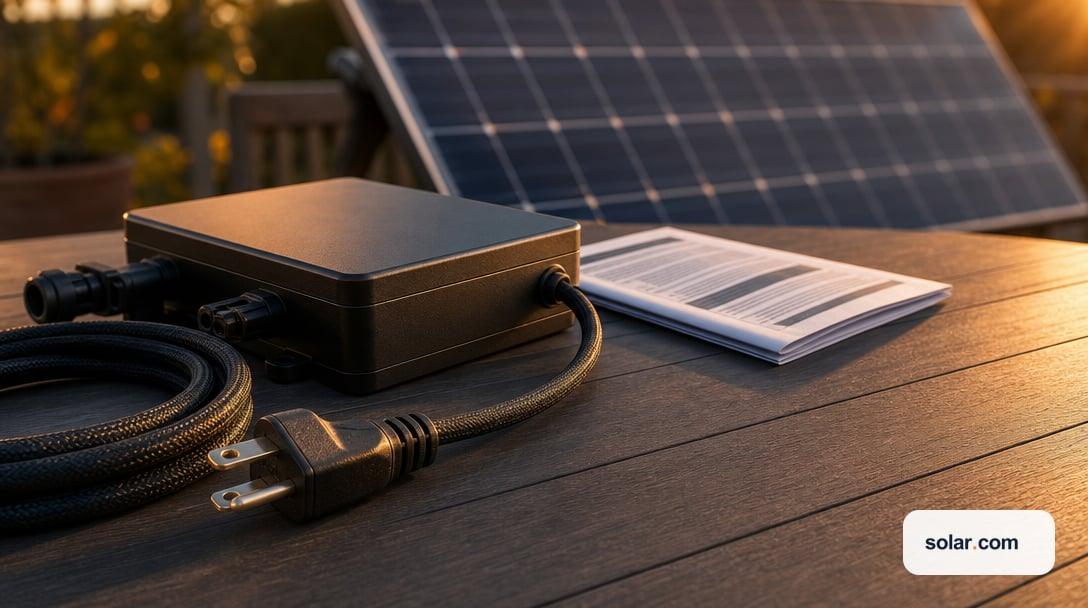
Plug-in solar (also called “balcony solar”) is 1 to 3 lightweight panels that clamp onto a balcony railing, patio, or fence. A rooftop system feeds your breaker panel, these don’t. They plug into a regular 120V outlet through a small device called a microinverter, which converts “raw” solar power into the same electricity that runs your toaster.
The idea is to treat a small solar kit like a household appliance instead of a power plant. If you can safely plug in a space heater, the thinking goes, you should be able to plug in a solar kit. We cover the nuts and bolts in our 2026 Guide to Balcony & Plug-In Solar.
A few things set it apart from traditional rooftop solar:
- No permanent construction. No-drill clamps and weighted mounts do the work, so renters don’t risk their security deposit. See how in our renter’s guide to no-drill balcony solar.
- It’s portable. When you move, your “power plant” comes with you.
- It’s small. These systems don’t take you off-grid. They shave down what you buy from the utility.
What SB 868 actually requires
The bill sets clear guardrails. To qualify, a system has to:
- Put out no more than 1,200 watts (1.2 kilowatts).
- Be used to offset your own onsite electricity use, not to sell power back to the grid.
- Meet the latest National Electrical Code and California Electrical Code standards.
- Be certified by Underwriters Laboratories (UL) or an equivalent testing lab.
Here’s the part that matters most: SB 868 would exempt these systems from interconnection agreements and from needing the utility’s permission to plug in. A utility can ask you to notify it. It can’t require a full interconnection process like full rooftop systems.
One catch worth knowing. The bill has been amended so the interconnection exemption and the right to install without permission sunset on January 1, 2030. So this is a runway, not a permanent lane, unless lawmakers extend it.
If it becomes law, California would be the ninth state to legalize plug-in solar, following Utah’s 2025 “plug-and-play” law and Maine’s bill that took effect in July 2026.
Ready to see your numbers?
See your real solar price in 90 seconds
Enter your address — we'll show you the system, savings, and price for your exact roof.
On safety: the UL standard is the whole ballgame
The fair question here is simple. Is it safe to plug a power source into your wall? In early 2026, UL Solutions launched UL 3700, the gold-standard certification for plug-in solar. A UL 3700 kit includes:
- Automatic power cut-off. Unplug the cord while the sun’s out, and the metal prongs go “dead” in under a second, so nobody gets shocked.
- Grid outage protection. If the neighborhood loses power, the panels stop sending electricity to your home or the grid. That protects the utility workers fixing the lines.
- Overload and ground-fault protection. Built-in sensors keep the system from backfeeding too much power into your home’s wires.
Our advice: buy a UL-certified kit, SB 868 requires that certification for a reason.
Is plug-in solar worth it in California?
Plug-in solar produces modest savings, not a full offset of your electricity bill.
A typical kit costs $600 to $1,500 and produces 1,000 to 1,400 kWh per year in sunny areas. An 800-watt setup can cover roughly 15% to 25% of an average apartment’s monthly electricity, mostly the “always-on” loads from your fridge, router, and standby electronics. Payback usually lands in the 3 to 6 year range, depending on your utility rate.
Run a simple example. Buy a $1,000 kit that produces 1,000 kWh a year. Over 10 years, you’ve paid $1,000 for electricity, that’s 10 cents per kWh. Buying that same amount of electricity from a utility at California’s average rate of 35 cents per kWh would cost $3,500.
That’s about $2,500 in savings from the plug-in solar kit, and a real hedge against rising energy costs.
Plug-in solar makes the most sense if you:
- Rent, or can’t put panels on your roof.
- Have a south-facing balcony or patio (west-facing is a solid runner-up for pricey afternoon power).
- Pay a high electricity rate and want a low-commitment way to trim it.
Solar.com’s Advice: If you own your home and have a viable roof, a full rooftop system with battery storage can often provide more value. It can offset most or all of your bill, provide backup power for outages, and often pencils out to a stronger long-term return than a plug-in kit.
Plug-in solar is a great entry point. It’s not a replacement for the real thing when a full system is on the table.
Where this leaves California homeowners
SB 868 isn’t law yet. It needs Senate concurrence and the governor’s signature, and nearly 30 states are watching how this plays out. But if it clears the final steps, January 1, 2027 opens a door that’s been shut for many Californians struggling with high electricity bills.
Own your roof? If you want to see what full-size solar looks like on your home, get a price for your roof in 90 seconds and see your savings potential.
Your next step
See exactly what solar costs on your roof
We use satellite data and your utility rates to show your price and payback in about 90 seconds, with no sales calls.