


Lease to Own Solar Panels: How Does It Work in 2026?
In 2026, many homeowners find themselves caught between two imperfect options for going solar. Most prefer to own the solar system powering their home, but only Third-Party Owned systems (i.e., leases and PPAs) qualify for a federal tax credit.
Fortunately, hybrid “lease-to-own” solar products—known as Prepaid Solar—are emerging in many markets and offering the best of both worlds: Access to a federal tax credit and a clear path to owning the system after 6 years.
Let’s take a closer look at the lease-to-own solar options in 2026, how they work, and whether it’s better to lease or own solar panels after recent policy changes.
Jump ahead:
- Lease to Own Solar Options in 2026
- The “Year 6” Milestone
- Is It Better to Lease or Own Your Solar Panels?
- Prepaid Solar: The Lease-to-Own Solar Product Made for 2026
- Frequently Asked Questions
Lease to Own Solar Options in 2026
In 2026, there are two lease-to-own solar models for homeowners to consider: Prepaid Solar and standard leases with buyout options. In order to take ownership, both models require a lump payment from the homeowner. The key differences are:
- When that payment occurs
- How the amount is calculated
| Prepaid Solar | Standard Lease | |
| Upfront Payment | Based on post-tax credit value of system | Usually none |
| Monthly Payments | None (unless upfront balance is financed with loan) | Yes |
| Can transfer ownership | After Year 6 at little to no cost | Select times after Year 6 with buyout at Fair Market Value |
| Incentives applied as | Discount on upfront payment | Discount on monthly payments |
Prepaid Solar
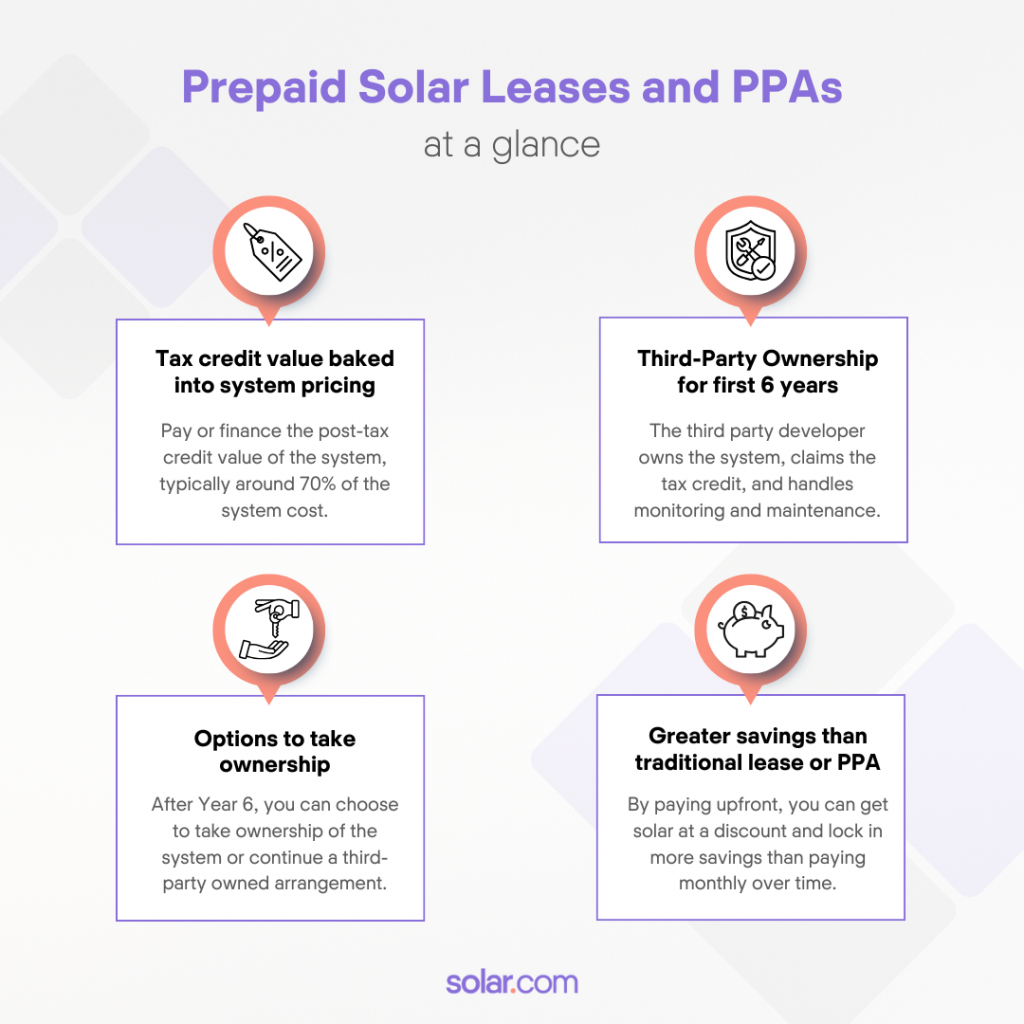
In a Prepaid Solar arrangement, the homeowner is presented with an upfront payment discounted by the federal tax credit and local incentives. This balance can be paid in cash or, in many cases, financed with a personal loan or HELOC.
A third-party service provider owns and maintains the system for at least 6 years in order to fully claim the tax credit for leasing solar panels (known as 48E). After this 6-year “tax credit recapture” period, the homeowner has the option to take ownership of the system at little to no cost and becomes responsible for monitoring, maintaining, and insuring the system. One of the better-known products in this space is HDM Renewable Finance’s Prepaid Solar PPA.
Since the balance is paid up front, Prepaid Solar products typically offer greater long-term savings than standard leases and PPAs.
Standard Leases
Standard solar leases typically have no upfront payment. Instead, the homeowner makes a monthly payment to “rent” a solar system installed on their property. These payments are typically consistent from month to month, but may increase by 1-3% each year if the lease agreement includes an escalator.
The lease provider owns the system, claims the 48E federal tax credit and other incentives, and passes through their value as lower monthly solar payments.
Can you buy solar panels if you lease them?
Most solar leases include buyout options at select points after the 6-year tax credit recapture period. Lease buyouts are typically based on the Fair Market Value (FMV) of the system—an appraisal influenced by the following factors:
- How old the system is: Newer systems are worth more; older ones are worth less.
- How much electricity it’s expected to produce in the future: More future power = higher value.
- What electricity costs in your area: Higher utility rates make solar more valuable.
- What it would cost to install a similar system today: Then reduced for age and wear.
- The condition of the equipment: Panel health, inverter age, and remaining warranties matter.
The Fair Market Value of buying out a lease is generally higher than the upfront cost of Prepaid Solar—and can even be higher than the cost of buying solar outright with cash. While this is technically a lease-to-own option for solar, it’s rarely the most cost-effective way to take ownership of a solar system.
Typically, there is an option to take ownership of a leased system at the end of the 20-25 agreement term, at no cost to the homeowner. However, by this point, the homeowner has made decades of monthly payments, and the system is quite outdated.
The “Year 6” Milestone: Why Can’t I Own the Panels Sooner?
If you are looking into a lease-to-own or rent-to-own solar plan, you will likely notice a recurring theme: you typically can’t take full ownership of the panels until Year 6.
This isn’t a random number chosen by solar companies—it’s a direct result of federal tax laws. Here is the simple breakdown of why Year 6 is the “magic number” for solar ownership.
Understanding the 5-Year Recapture Period
When a solar company installs a system on your roof via a lease, they are technically the owners. This allows them to claim the 48E federal tax credit. However, the IRS has a “recapture” rule that can reduce the value of the tax credit if the system changes ownership before the end of 5 full years.
If the solar company were to sell or transfer the system to you before those five years are up, they would have to pay back a portion of that tax credit to the government. To avoid this penalty, almost all TPO solar contracts are structured so that the option to transfer the system begins no sooner than Year 6.
What Happens in Year 6?
Once the recapture period ends, the “vesting” is complete. Depending on your specific plan, one of two things usually happens:
-
Prepaid Solar: You typically have the option to take ownership at little to no additional cost.
-
Standard Lease Buyout: If you have a monthly lease, Year 6 is usually your first opportunity to “buy out” the system at its Fair Market Value.
By waiting until Year 6, the provider ensures that the federal tax incentive has been secured, allowing you to step into ownership with a system that has already been tested and maintained for half a decade.
Is It Better to Lease or Own Your Solar Panels?
The decision to lease or own solar panels is more nuanced in 2026 than it has been in past years, and largely depends on your savings goals and preferences. Even without a federal tax credit for homeowners to claim, direct ownership often delivers the greatest return on investment over 25 years, while $0 down leases are a path to more immediate cash flow.
Here are a few more things to consider.
| OWNERSHIP (CASH OR LOAN PURCHASE) | STANDARD LEASE | |
| Federal tax credit | None | Claimed by solar company |
| Local incentives | Claimed by homeowner | Claimed by solar company |
| Monitoring, Maintenance, Insurance | Homeowner’s responsibility | Solar company’s responsibility |
| Cost to replace out-of-warranty battery storage | Homeowner’s responsibility | Often factored into lease payments |
| Impact to home value | Increases home value | Does not directly increase home value, but can make it more attractive to buyers |
| Selling your home | Straightforward | Transfer or buyout adds paperwork to closing process |
| Equipment selection | No restrictions | Restricted by FEOC rules |
Prepaid Solar: The Lease-to-Own Solar Product Made for 2026
With the consumer-claimed solar tax credit terminated, Prepaid Solar seems made precisely for this moment…. because it was. This lease-to-own option for residential solar allows homeowners to go solar at around 70% of the cost of an outright purchase, and choose to take ownership of the system after a relatively short period of time.
Ready to see your best path to energy cost savings? Connect with a solar.com Energy Advisor to review custom proposals for your home.
Frequently Asked Questions
How does a “rent to own” solar program actually work in 2026?
In 2026, rent-to-own solar is typically structured as a Prepaid Lease or a standard lease with a buyout option. Under these programs, a third-party provider installs and maintains the system on your home. You either pay a discounted lump sum upfront (Prepaid) or monthly installments (Standard Lease). After the 6-year federal tax credit recapture period, you typically have the option to buy out the contract at “Fair Market Value.”
When can I officially take ownership of my leased solar panels?
Under current IRS guidelines, you usually have the option to buy out a solar lease contract after Year 6. This timeline exists because the owner of the system (the leasing company) must hold the system for at least five full years to avoid “recapturing” the federal tax credit. Once this period ends, most lease-to-own contracts allow you to buy out the remaining value of the system and transition from a “renter” to a full owner with no further monthly payments.
Is a lease-to-own solar plan better than buying outright?
It depends on your savings goals and preferences. In 2026, many homeowners choose lease-to-own (Prepaid Solar) because it allows them to buy solar electricity in bulk, typically for 70% of what it costs to purchase a comparable solar system, and the option to take ownership after Year 6. While a cash purchase offers the highest long-term return on investment and wider equipment selection, a lease-to-own plan provides a lower barrier to entry and includes professional maintenance for the first six years.


