Solar Inverters: Types, Pros and Cons
By Sam Wigness · Updated October 2026
Solar inverters are the unsung heroes of solar power.
Their key function is turning the direct current (DC) power your panels make into the alternating current (AC) power your home runs on. There are four main types: string inverters, microinverters, string inverters with power optimizers, and hybrid inverters that also run a battery.
The right one depends mostly on your roof's shade and layout, and on whether you want a battery now or later. Below, we compare them using our installers' price lists and what thousands of homeowners say in their reviews.
Jump ahead:
- 4 types of solar inverters
- What does a solar inverter do?
- Pros and cons of each inverter type
- Pairing inverters with battery storage
- Inverter costs
- What homeowners say
- How to choose: a quick checklist
- Warranties and lifespan
- Efficiency and sizing
- Frequently asked questions
The 4 types of solar inverters at a glance
| String inverter | Microinverters | String inverter + optimizers | Hybrid or battery-integrated | |
|---|---|---|---|---|
| Best for | Simple, sunny roofs facing one way | Shade, roofs facing several ways, adding panels later | Some shade, with panel-by-panel data | A battery now or soon |
| Shade handling | Weak: one shaded panel can pull down others on its string | Strong: each panel works on its own | Strong: each panel is tuned on its own | Like a string inverter, unless paired with optimizers |
| Panel-level monitoring | No | Yes | Yes | Usually no |
| Battery pairing | Add an AC-coupled battery | Add an AC-coupled battery | Battery-ready models connect one directly | Built in |
| Typical warranty | 10 to 12 years | Up to 25 years | Inverter about 12 years, optimizers 25 years | About 10 years |
| Replacement | Plan for one over the panels' life | Failed units get swapped one at a time | Plan for one inverter replacement | Plan for one over the panels' life |
| Offered on our marketplace | 33% of installers | 96% of installers | 29% of installers | 38% of installers (most often the Powerwall 3) |
Disclosure: Solar.com is a Tesla Certified Installer.
What does a solar inverter do?
Think of it as a currency exchange for your power: panels make DC, while your home and the grid use AC. The inverter also keeps your panels at their best output, reports to your monitoring app, and shuts your solar off in a blackout so it can't send power onto lines crews are repairing. Staying on in an outage takes a battery or special equipment.
Ready to see your numbers?
See your real solar price in 90 seconds
Enter your address — we'll show you the system, savings, and price for your exact roof.
Solar inverter types, pros and cons
There are four basic types of inverters used for rooftop solar, each with their strengths and weaknesses.
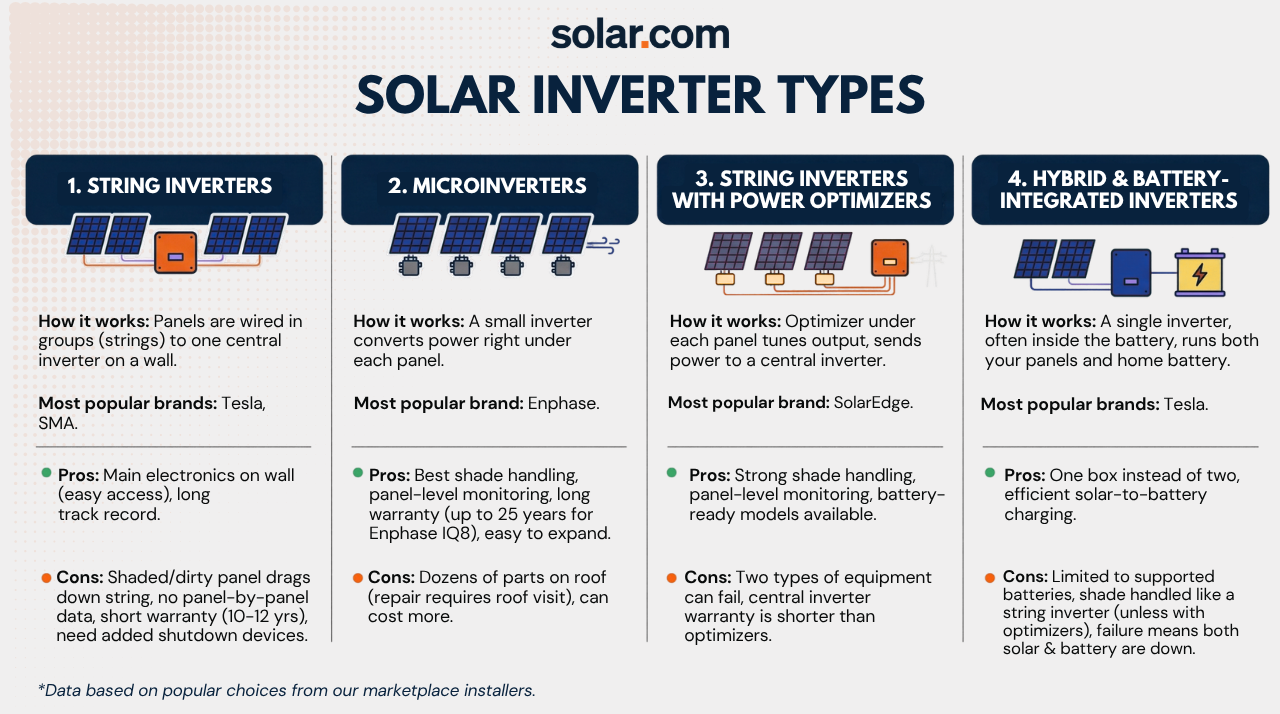
String inverters
Panels are wired together in groups called strings, and one inverter on a wall converts the power for all of them. The string inverters installers on our marketplace list most are from Tesla and SMA.
- Pros: the main electronics sit on a wall, easy to reach for service; long track record.
- Cons: a shaded or dirty panel can drag down the others on its string (models with two or more inputs help on roofs facing several ways); no panel-by-panel data; warranties usually end around year 10 to 12; rooftop systems need added shutdown devices.
Microinverters
A small inverter under each panel converts that panel's power on the spot. Shade on one panel doesn't affect the rest, and if one unit fails, the others keep producing. Enphase IQ8 is the microinverter most installers on our marketplace offer.
- Pros: the best shade handling; panel-level monitoring; warranties up to 25 years (Enphase IQ8); easy to add panels later.
- Cons: dozens of electronic parts on the roof, so a repair means a roof visit; some installers charge more for them.
String inverters with power optimizers
An optimizer under each panel tunes that panel's output, then sends the power to one central inverter on the wall. You get most of the shade benefit and panel-level data of microinverters, with the conversion done in one box you can reach. SolarEdge is the optimizer system installers on our marketplace offer most.
- Pros: strong shade handling; panel-level monitoring; battery-ready models available.
- Cons: two kinds of equipment that can fail; the central inverter's warranty is shorter than the optimizers'.
Hybrid and battery-integrated inverters
A hybrid inverter runs your panels and a home battery from one box. Some are "battery-ready," so you can add the battery later: SMA's Sunny Boy Smart Energy is sold to work with or without one. Others are built into the battery itself, like the Tesla Powerwall 3.
- Pros: one box instead of two; solar charges the battery without an extra conversion.
- Cons: you're limited to the batteries it supports; handles shade like a string inverter unless paired with optimizers; if it fails, solar and battery are both down.
Planning a battery now or later?
Your inverter decides how a battery connects, so settle this before you sign, even if the battery is years away. Ask which batteries your inverter can take, and get the answer in writing.
AC-coupled vs DC-coupled. Panels make DC, batteries store DC, and your home runs on AC. Each conversion loses a little energy. A DC-coupled battery connects on the DC side of a hybrid inverter, so solar charges it without an extra conversion. That's slightly more efficient.
An AC-coupled battery has its own inverter and connects next to your solar inverter. It converts power more times but works with almost any existing system. Enphase's IQ Battery 5P works this way, with six microinverters built in.
Powerwall 3: the inverter is built in
The Tesla Powerwall 3 is a battery and a solar inverter in one unit, rated for up to 20 kW of panels on six inputs and 11.5 kW of continuous power. On a new system it replaces a separate solar inverter, and it can also be added to a home that already has solar.
On our marketplace, its inverter is priced inside the battery: a median of about $15,000 installed with solar.
In California, utilities using the NEM 3.0 Solar Billing plan pay less for solar you send to the grid, so a battery is worth more there. What NEM 3.0 changed
Enphase IQ8: daytime power in an outage, with extra equipment
Enphase IQ8 microinverters can keep a few essential circuits running in a daytime outage without a battery, but only with extra equipment:
- An Enphase IQ System Controller, which disconnects your home from the grid
- Plus at least one IQ Load Controller, wired to a backup panel of up to four 240-volt or eight 120-volt circuits.
Enphase calls this Sunlight Backup, and it works only while the sun is out. If clouds cut production below what those circuits draw, the system shuts off, then restarts once there's enough sun, which can take up to two minutes. Enphase says to keep backed-up loads to about 30% of the microinverters' power and not to use it for the whole home. For power at night, you need a battery.
Related reading:
- Compare batteries and installed prices in The Best Solar Batteries of 2026
- Read Types of Solar Batteries
- Tour interactive battery explainer on your utility's rates.
What inverters cost on our marketplace
You usually won't see the inverter as its own line on a quote. Most installers build a standard inverter into their price per watt and charge extra only if you pick something else. In the current price lists of the active installers on our marketplace:
- 92% of installers include at least one inverter at no extra charge.
- Microinverters: 96% of installers offer them, and about 6 in 10 of those charge nothing extra. The rest typically add $1,150 to $2,100 on a 7 kW system.
- Optimizers and string inverters: fewer installers offer them (29% and 33% of installers), and most of those charge nothing extra.
So the inverter type often changes your price little or not at all. Which installer you choose, and whether you add a battery, usually matter more.
Is there still a federal tax credit? Not if you buy the system with cash or a loan: the homeowner credit ended for systems installed after Dec 31, 2025. Its value now reaches homeowners only through a lease or a Prepaid TPO, as an upfront discount. How the Prepaid TPO works
See your real price for your home, with the inverter your installer recommends.
What 4,800 homeowner reviews say about inverters
We read over 150,000 published Google and Yelp reviews of California solar installers for our installer rankings. 4,813 of them mention an inverter, a microinverter, an optimizer or an inverter brand. They tell a clear story: the inverter is where trouble shows up after the install.
| Share of reviews that... | Mention an inverter | All other reviews |
|---|---|---|
| Complain about system problems or service after install | 25.4% | 4.9% |
| Complain about delays, permits or utility approval | 10.5% | 5.0% |
| Are 1 or 2 stars | 22.7% | 11.1% |
Stars rate the installer's whole job, not any inverter.
38% of these reviews describe a part failing or being replaced, and 7% describe a monitoring or app problem. People mostly mention their inverter when something goes wrong, which is what makes these reviews useful. The common stories:
- A part fails a few years in. Good reviews describe a quick diagnosis and an installer who handled the warranty claim. About 1 in 5 inverter reviews mention a warranty.
- The wait. The angriest describe weeks or months of lost production waiting for a technician or a part.
- Nobody noticed. Some owners learned months later, from a big utility bill, that the system had stopped.
- The app went dark after a new Wi-Fi router or an expired cellular plan, so a failure went unseen.
- The company was gone. About 1 in 17 say the company that installed their system went out of business.
What to do with that: choose an installer with a strong record of service after the install, and ask who pays for labor on a warranty repair. Every installer in our California rankings is scored on its own customers' reviews, including service after install, and no installer can pay to change its score.
How to choose: a quick checklist
- Shade, or a roof facing several ways? Microinverters or optimizers. A sunny roof facing one way does fine with a string inverter.
- Battery now? A hybrid inverter, a battery with a built-in inverter, or microinverters with an AC-coupled battery.
- Battery later? Get in writing which batteries your inverter can take.
- Want to see each panel's output? Microinverters or optimizers.
- Warranty: compare the years, and ask who pays for labor on a repair.
- Budget: inverter choice usually changes the price little. Compare full quotes.
- Adding panels later? Easiest with microinverters, since each new panel brings its own.
Warranties and lifespan
Your inverter works every sunny hour for decades, and its warranty is usually shorter than the panels'.
- String and hybrid inverters: about 10 to 12 years. Some makers sell extensions to 20 or 25 years.
- Microinverters: up to 25 years (Enphase IQ8).
- Optimizer systems: about 25 years on the optimizers and 12 on the inverter. About 1 in 10 installers on our marketplace price an extension of the inverter warranty to 25 years, at $250 to $500.
Before you sign, check whether the warranty covers labor or only the part, and what the installer's own workmanship warranty covers. After install, keep the monitoring app connected and turn on alerts.
Efficiency and sizing, explained
- Efficiency: compare the CEC weighted efficiency, a California Energy Commission test that averages performance across a day's typical power levels. Most home inverters score in the high 90s (Enphase lists 97% for IQ8; Tesla lists 97.5% for the Powerwall 3's solar side), so a point either way rarely decides anything.
- MPPT: the circuit that keeps panels at their best output. Microinverters and optimizers do it for every panel; string inverters do it once per input.
- DC:AC ratio and clipping: panels are often rated 10% to 30% above the inverter (a ratio of about 1.1 to 1.3), because they rarely produce their full rating. On the sunniest middays the inverter then "clips" the extra, which is normal in a well-sized system.
Safety: rapid shutdown
Rooftop solar wiring can carry hundreds of volts of DC, so the National Electrical Code (section 690.12) requires rapid shutdown for solar on buildings. Since the 2017 code, shutdown happens at the panels, and wiring that runs away from the array must drop to 30 volts or less within 30 seconds, so firefighters can work safely.
- Microinverters do this on their own (Enphase IQ8 is listed as rapid shutdown equipment).
- Optimizer systems do it at each panel.
- String and hybrid inverters need small shutdown devices on the roof, such as Tesla's Mid-Circuit Interrupters for the Powerwall 3.
Solar inverter FAQs
What are the main types of solar inverters?
String inverters, microinverters, string inverters with power optimizers, and hybrid inverters that also run a battery. Lists that say "three types" usually fold optimizers into string inverters or leave hybrids out.
Which type of solar inverter is best?
It depends on your roof and battery plans: microinverters or optimizers for shade or a complex roof, a string inverter for a simple sunny one, a hybrid for a battery now.
Which is better, a microinverter or a string inverter?
Microinverters handle shade better, show each panel's output and carry longer warranties. String inverters keep the main electronics on a wall, where they're easier to service. Most installers on our marketplace don't charge extra for microinverters.
What are the disadvantages of microinverters?
More electronics on the roof, so replacing a failed unit means a roof visit. Some installers also charge extra for them: about 40% of the active installers on our marketplace.
How long do string inverters last?
Most carry a 10- to 12-year warranty, well short of how long panels are expected to last, so plan on replacing one once over the life of the system.
Is a hybrid inverter better than a normal inverter?
Only if you want a battery. A hybrid runs solar and a battery from one box. Without a battery, a standard inverter does the job.
How much does a solar inverter cost?
On our marketplace, it's usually built into the installer's price per watt: more than 90% of active installers include at least one inverter at no extra charge. Those that charge extra for microinverters typically add $1,150 to $2,100 on a 7 kW system.
Get the right inverter at the right price
The right inverter fits your roof and your battery plans, and comes from an installer who'll come back if something breaks. See your real price for your address in about 90 seconds, with no sales calls.
More in Solar Inverters: Types, Pros and Cons

4 Cool New Technologies from Solar Power International (SPI) 2019
Shawn Showkati·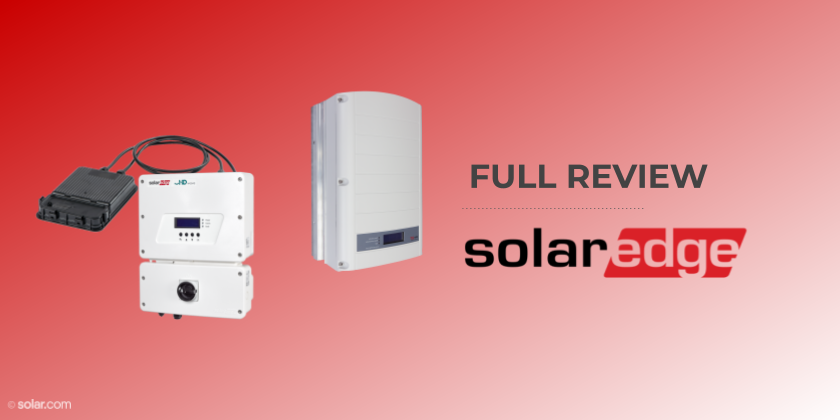
SolarEdge Inverters: The Complete Review
Hannah Glenn·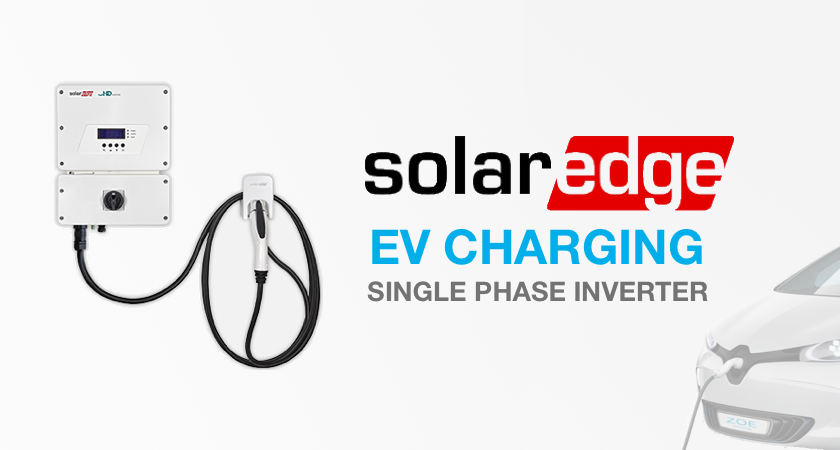
A Complete Review of the NEW SolarEdge EV Charging Single Phase Inverter
Isaac Ost·
Top 3 Solar Inverters Selected Through Solar.com in 2017
Hannah Glenn·
Microinverter vs String Inverter: Which is Right For Your Solar System?
Johanna Poole·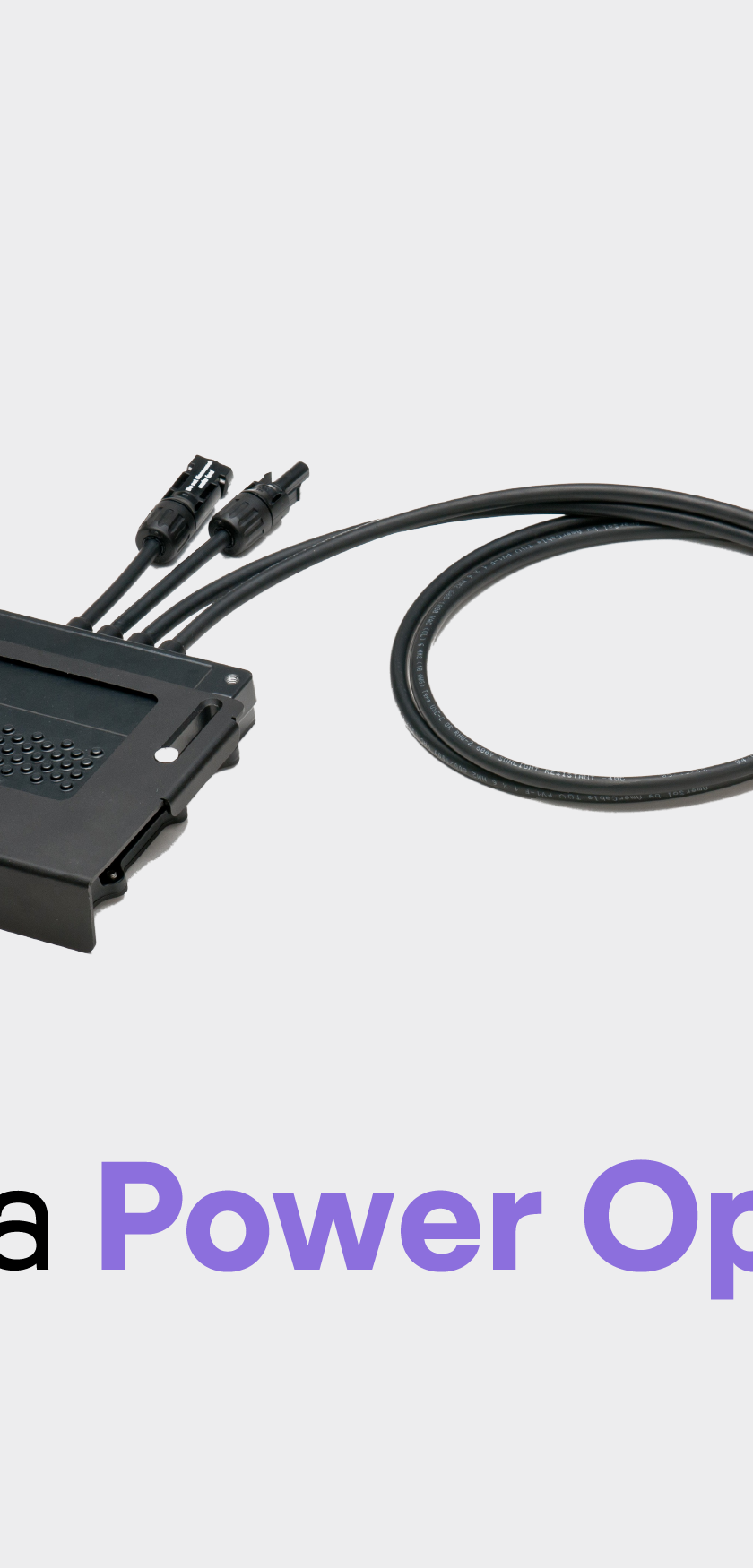
What is a Power Optimizer?
Philip Trapp·
Your next step
See exactly what solar costs on your roof
We use satellite data and your utility rates to show your price and payback in about 90 seconds, with no sales calls.