Page 145 | Solar.com

Please enter a valid zip code.

Can My Solar Panels Withstand a Hurricane?

By Solar Panel Installation Process No Comments


If you live in an area that experiences extreme weather like hurricanes, hail, thunderstorms, blizzards, heavy winds and more, then you should take the time to learn about how your solar panels may be affected by these conditions.

In the event of a hurricane or extreme storm, knowing how durable your specific solar panels are will give you confidence in whether or not your system is protected. Although rare, hurricanes that hit the United States can cause serious damage and occur about 1.75 times per year. Hurricane Harvey, which hit Houston, Texas in late August of 2017 caused 68 deaths and around $125 billion worth of damage.

Hurricane Irma made landfall in Florida a few weeks after on September 10th and caused roughly $50 billion in damage. Last year was a very bad year for hurricanes in the Gulf states, and due to climate change, there is a reason to believe that these types of storms may increase in frequency and severity.

How Much Can Your Solar Panels Withstand

One reason why solar panels are so expensive is that they are manufactured to a very high quality. As a result, most high-end solar panels can withstand practically any environmental condition. When looking at hurricanes specifically, there are a couple of characteristics that you want to focus on.

The biggest damage that a hurricane can cause to a solar panel system comes from wind and water exposure. Theoretically, strong enough winds could dislodge your solar panels from their mounting structure or cause debris or other objects to hit them, but this is all dependent on how strong the winds are. Water damage is also possible, but most insurance will cover this.

Because of all this, a solar panel’s wind load rating is especially important when determining how the panel can hold up in an extreme storm. The wind load is measured in pascals, which is a unit of measurement that, in materials science, represents the stiffness and strength of a material. Most solar panels are manufactured to withstand up to 2,400 pascals, which is the same as for winds of approximately 140 MPH, but the durability varies from state to state due to their different solar laws.

Florida is one of the best states in terms of solar potential, but they are also the states that experience the majority of hurricanes in the United States. There are millions of potential solar consumers that live in areas exposed to these types of conditions, so manufacturers almost always design their solar panels with hurricanes in mind. Florida, for example, has rules in place that require the majority of panels that can be installed to be able to withstand winds of at least 160 MPH or 3,300 pascals. The panels that Solar.com provides in Florida can easily withstand more than this amount.

Here’s a clip of a solar manufacturer’s test of a solar panel against hurricane-speed winds:

Nothing to Worry About

Unless you are unlucky enough to be caught in one of the worst hurricanes in history, you should not worry about your solar panel system getting damaged in a severe storm or even in a common hurricane. There are several cases where solar panel systems came out almost completely damage free after huge hurricanes like Hurricane Harvey and Irma, as well as other severe storms including a hail storm in the Denver area that only damaged one out of 3,000 solar panels.

At the end of the day, the type of conditions that will lead to your solar panels being destroyed are also the same conditions that would likely destroy your entire home. With this in mind, you can sleep comfortably knowing that your panels can withstand even some of the most extreme weather you may experience.

Your PG&E Bill After Going Solar

Here’s How to Understand Your PG&E Bill After Going Solar

By How Do Solar Panels Lower Your Electric Bill? No Comments

For residents of California who are customers of the Pacific Gas & Electric (PG&E) company, one of your biggest questions before you decide to switch to solar is what a typical electric bill would look like once your system is installed. Your monthly electric bill will vary from the utility company to utility company, so in this post, we will look at a solar electric bill from PG&E.

Understanding what your future bill looks like is important for any prospective solar panel owner because the primary purpose of adopting a solar system for many is the monthly savings they can receive on their electric bill.

Monthly Statement

Each month you will receive an energy statement from PG&E that shows you how much money is due. The total cost that you must pay for that month is only the minimum delivery charges.

Other charges in your bill such as charges for your electricity use and net energy metering (NEM) balance will be accounted for in your annual True-Up Energy statement. This report shows you your year-to-date charges and credits for NEM and will have you pay a balance if you used more electricity than you produced for that year.

Net Energy Metering (NEM)

For homeowners that install a grid-connected solar panel system, one of the biggest values that they can take advantage of is net energy metering. NEM allows you to earn energy credits for the excess energy that you produce with your solar panel system.

These credits can then be put towards an equal amount of energy that you used at a later time. This is especially useful for when homeowners are generating a significant amount of energy during the summer and they want to use those credits during later months when they are producing less.

On your PG&E electric bill after going solar, there will be a section going over your monthly NEM balance. This gets added to your entire balance that gets paid with your annual True-Up Energy statement.

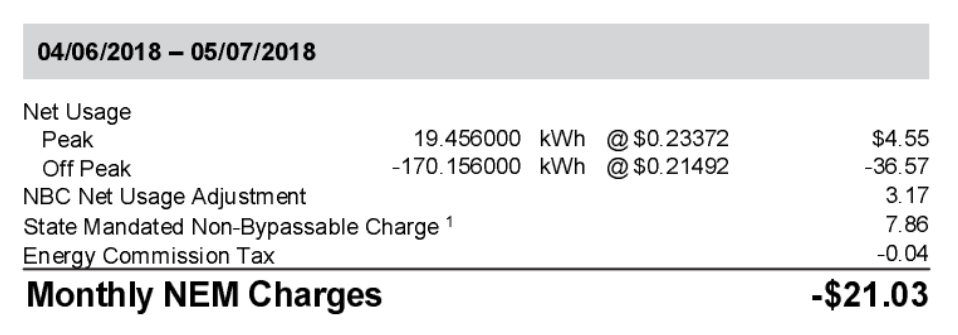
This part of your bill also displays your energy usage during peak and off hours. This relates to PG&E’s time-of-use (TOU) payment structure, where the rate for electricity varies throughout the day. Any negative numbers come from excess electricity being generated that month.

There is also a state-mandated charge of $7.86 no matter how much electricity you consume.

This charge, coupled with the NBC Net Usage Adjustment make up the minimum delivery charges that must be paid each month. This is why it is never fully possible to pay zero dollars on your electric bill, however you can earn money from your annual True-Up Energy statement if you produce more energy than you consume over the year.

The minimum delivery fees are necessary to keep your solar panel system connected to the grid and to allow you to continue using PG&E’s solar services.

NEM Balance

nemchargeYour NEM balance relates to the annual True-Up Energy statement where you pay all of your cumulative charges for NEM. You can minimize this balance by saving up credits and minimizing your own electricity consumption.

For instance, in the image above, the solar customer currently owes PG&E a positive amount from the winter months. However, this is on a downward trajectory as the customer approaches summer and the array begins to produce more electricity.

nembeforetaxes

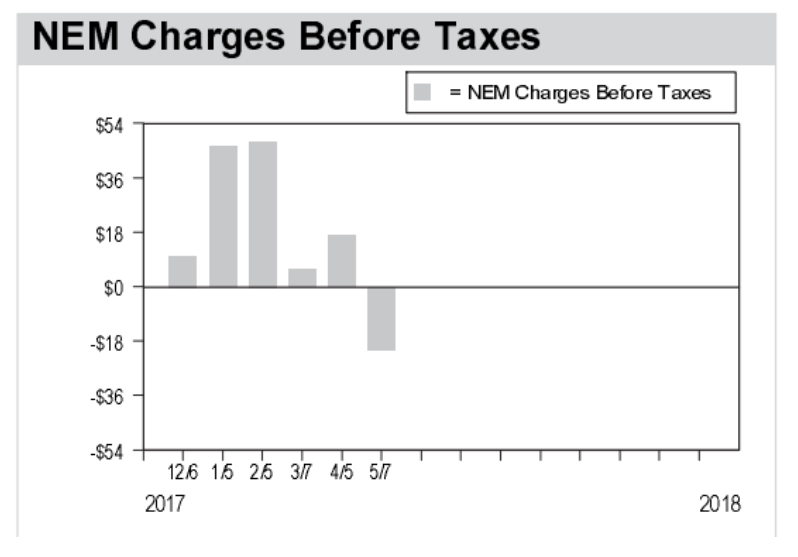
In addition, you will receive a graph of your NEM charges before taxes, which also shows you month-by-month performance, rather than a cumulative total. This gives you a better idea of which months you are negative and are producing more energy than you are consuming.

performance

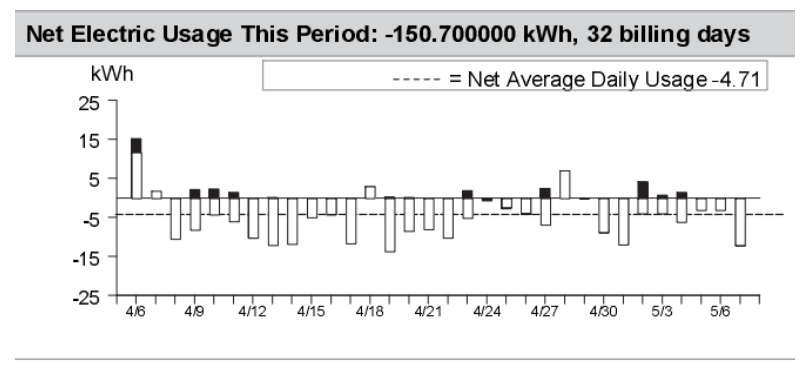
Lastly, you will be able to see your day-by-day performance. In the above image, you can see the overall amount of kilowatt hours (kWh) being consumed or produced. Whenever there is a negative value, that means the homeowner was able to generate more energy than what they used. Check this video to know more about kilowatt hour.

Your average daily use is also displayed in this section of your PG&E solar bill.

Flexibility and Opportunities to Save

PG&E offers a billing structure that allows an energy consumer to optimize their production and consumption of solar energy so that they can minimize their electric bill. From PG&E’s TOU payment structure to their NEM payment model, solar panel owners in California have a lot of flexibility in how they manage their energy use.

If you are a PG&E customer, solar could be a great option for you. When you are ready to move forward with your solar project, get started with one of our personal Energy Advisors here at Solar.com!