


What is soiling loss?
Soiling loss is the term given to all energy production loss in a solar system that is attributed to the panels being dirty. This panel soiling can come from:
- Atmospheric dust
- Bird Droppings
- Ash from wildfires
- Pollen from adjacent trees
- and other factors
We know that the economics of cleaning residential solar systems are not great. If a residential owner experiences 7% soiling loss annually on a 5-kW solar system in California, they will see about $65 lost over the course of the year. We are forced to ask ourselves if the cost to wash our panels justifies the savings, as this is generally how we view the economics of solar.
While the figure above wouldn’t motivate most people to climb up on the roof and clean their solar panels as often as they might clean the family car, it is not the full picture of what soiling does to our systems.
Economics are, of course, important but other factors must also be taken into consideration. To bring it back to the family car, it will probably not affect daily gas mileage when one decides between regular and synthetic oil, but the latter will likely ensure that the car lasts long enough to be handed down to that lucky first child when they come of age.
The same can be said for solar panels. Two important negative effects of soiling that do not necessarily impact daily energy production relate to two jargon terms: PID and Riso. Don’t worry, these terms are explained below.
Related reading: How To Choose Solar Panels for Your Home
Economics of Cleaning Solar Panels
We have seen above that a 7% average annual loss on an average sized system does not justify the effort of cleaning. Well, what if a system does not fall on the average? What if the annual loss is greater than the 7% average? In their study, Zorilla and Casanova found that daily soiling rates can reach up to 25% during the dry summer months. These rates are mitigated by a significant rain event, but during the extended dry periods of the summer, these levels can be sustained throughout times when we generate the most solar energy all year.
For Example
This leads to an annual average of 10% on a system that is above average at 10 kW we see the soiling loss value rise to nearly $190. If this can be recovered by simply hosing down the solar panels a couple of times a year at nearly zero cost, it becomes a lot more attractive to do so. The key to knowing if we should be addressing soiling losses at home is through determining daily soiling losses and daily soiling accumulation.
Local solar soiling losses can be determined using soiling measurements with devices located adjacent to the array or by taking measurements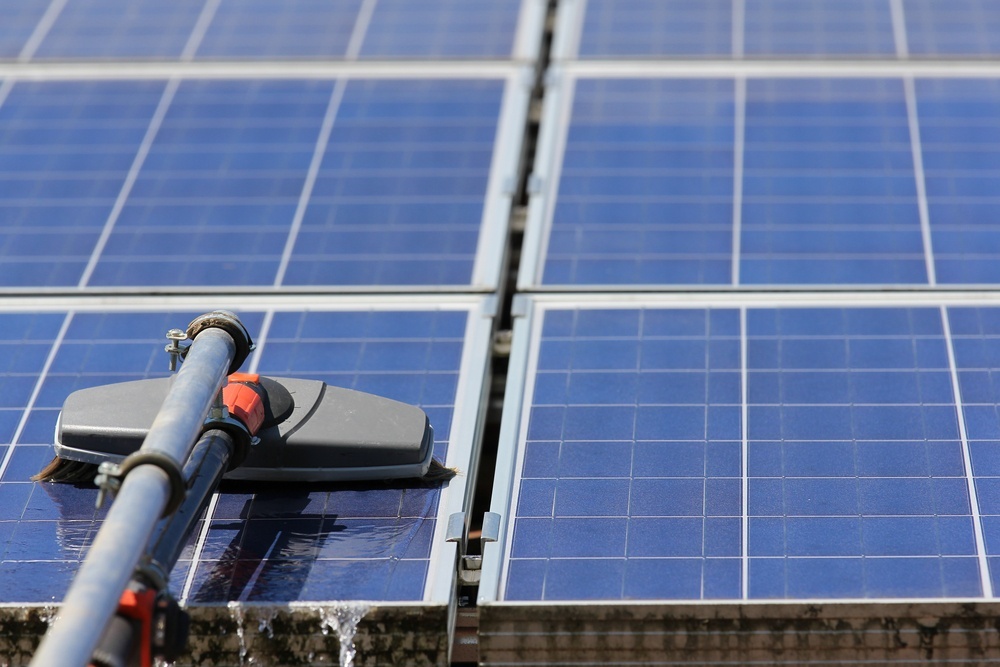 on the panels themselves before and after cleaning.
Once a daily soiling accumulation rate has been determined we can calculate the rate at which soiling losses build on a daily basis. This value will lead to the optimal time to clean from a financial perspective.
One aspect that needs to be taken into consideration if attempting to hose down a PV system is water hardness. It is true that water spots will negatively impact the production so this author recommends testing water hardness before attempting to clean panels with a quick spritz.
If the intrepid panel washing homeowner needs additional motivation for testing water, just ask the plants in the yard, they can also benefit from a little added knowledge of what is coming out of that hose. As with those plants in the yard, a solar array should be hosed down in the morning or early evening. This will prevent large temperature swings that could affect the panels as well as allowing for the water to run off without as much water-spot depositing evaporation. This should be done at domestic water pressure and never with a pressure washer.
Cleaning Modules
- If cleaning is required beyond a simple rinse, a soft (read: non-abrasive) means can be employed to remove more stubborn dirt. First, we use only pure water and a soft sponge, non-abrasive brush, microfiber cloth or anything you would take to your car’s finish to wipe the area while maintaining a wet surface. After wiping down, rinse the system again and let dry.
- Although rare, there are instances where the above steps do not fully clean the array. In such cases, it is ok to use a very mild biodegradable cleaning agent. Repeat the steps above employing the cleaning agent and rinse very well when complete.
It is important to note, that when working around solar panels, we should never step on any surface of the panel. Also, in many cases, using an abrasive cleaning method can void a manufacturer’s warranty so take exceptional care when cleaning your system.
Potential Induced Degradation (PID)
PID is a type of degradation that can build up in solar panels (and therefore arrays) over time. This loss can render a PV system useless. Without getting too far into the weeds, PID is caused by electrical fields in and around the solar panel itself. These electric fields are generally harmless but can be worsened when the surface of the panel is covered in an electrically conductive layer of dirt. I apologize for bringing up High School chemistry but dirty water allows electricity to flow and pure water does not.
What does this mean for solar panels? When the surface of the panel is dirty, it allows for interaction between these internal and external fields of the system. This interaction is the breeding ground for PID. Though, some manufacturers have mitigated this effect as of recently, avoiding PID via keeping an array clean is a cheap and effective way to prevent it for the previous generation of solar panels.
Isolation / Insulation Resistance (RISO)
Riso is a term given to a test that inverters perform before initiating system start. This test is designed to determine if the electrical connections are ok before starting up the system. If this test fails, the inverter will not turn on. This is an excellent feature for the safe operation of a PV system. The effects of soiling on this issue come into play in the same way as we saw with PID above.
If the system and its electrical connections become coated in dirt, this test could result in an unnecessary failure during early morning dewy situations. This will generally present itself as an error on the inverter (Riso Low) and can substantially impact the annual production of a system if the system must wait first for sunrise and then for everything to dry out before turning on.
These are a few of the important characteristics to consider when thinking about the issue of soiling on a solar system and whether or not to clean. All too often we think only about the immediate economics of our solar installations, but as time goes on, and we become savvier to all this technology that now pervades our lives, we learn more and more about how to use it to the utmost potential.
For high-tech and reliable soiling monitoring equipment, Fracsun has developed a state-of-the-art product. You can inquire about their technologies here. To request a product quote, you can visit here.
Guest Blogger Bio:
Catlin is the co-founder of Fracsun which has built a patented device that allows system owners and operators to locally measure soiling rates and determine financially optimal cleaning schedules.
Catlin has nine years of engineering experience in commercial and utility project development, module product management, new product development, sales engineering, estimating, system design, installation and project optimization. He has worked in project development in the Philippines, Thailand, Singapore, Vietnam, India, Nepal and Indonesia. In several of these markets, he has led training workshops, teaching engineers and installers of local companies industry best practices for design, installation, and maintenance of solar assets.


