Page 229 | Solar.com

Please enter a valid zip code.

Solar Energy Storage 101

By How Do Solar Batteries Work? No Comments


Storing energy generated from your solar panels is an effective way to make your home more sustainable. By saving energy from the daylight hours you’ll be less dependent on the power grid and even protected in case of a blackout. Let’s take a look at the technology and some of the recent advances in the field of solar energy storage.

How It Works

The solar panels on your roof generate a DC current. In a regular setup, this energy gets sent directly to a solar inverter. This device is a mandatory part of any solar panel system. It takes the DC current and converts it into an AC current that can be used by the appliances in your home. When your energy needs are high, the entire DC current is used by your home.

If you have a battery storage system, your setup will work differently. When the appliances in your home are switched off and the electricity demands are low, some of the DC currents will be diverted from the inverter and used to charge your backup battery. This process is automatic and depends on how much energy your home requires at any given minute. Because of how it’s regulated, a battery backup system is a smart choice. It only charges when your home doesn’t require all the energy available from the solar panels.

When you’re planning the installation of your home battery system, you should figure out how much storage capacity you need. A single, average sized battery will provide your home with enough electricity for a single evening. If you want something more robust, you can install a battery bank. A battery bank is a system of connected batteries, and it may provide enough electricity to power your entire home for three to four days. While this is a nice feature, many people consider it unnecessary, especially since blackouts in America rarely last more than a few hours.

The Benefits of a Battery Backup System

The biggest benefit of a battery backup system is that you’ll always have a constant supply of energy to your home. This can be an advantage because electrical rates from the utilities tend to be higher in the evening. By saving power from the day you’ll be able to use it at night and save on your bill.

Additionally, if you have enough solar panels and a large enough battery bank, you’ll be able to use renewable energy around the clock. You’ll never have to pay for electricity from the grid, which is a major incentive for some people. Using 100% renewable energy may not be a feasible option for everyone, but it’s more affordable now than it was just ten years ago.

Different Kinds of Batteries

If you’re ready to install a solar energy battery backup system, then you have a choice to make. There are two different kinds of batteries on the market, and you want to make sure that you pick the one correct for your home.

Lead Acid Batteries

These have been used for decades in various applications. They’re the cheapest option and have a proven record in providing reliable storage to homeowners. However, you should be aware that you may need to perform maintenance on the system. Flooded lead-acid batteries will require you to “water” them, equalize the charge, and keep the terminals clean. This maintenance isn’t extensive, but it might not be a good fit if you’re away from home often or prefer to buy a “set it and forget it” system.

Two other types of lead-acid batteries: gelled electrolyte and absorbed glass mat (AGM) are maintenance free. These batteries are more expensive though and they also require voltage regulated chargers.

Lithium-Ion Batteries

These are the type of batteries that are found in your cellphone, and they’re the most common battery in the world. Lithium-ion batteries are more expensive than lead-acid batteries. However, they typically last longer and they have a high discharge and charge efficiency. That means they’ll be able to store the DC current from your solar panels more effectively, losing less energy in the process.

One of the most exciting new technologies on the market (or soon to be on the market) is the Tesla Powerwall lithium-ion battery. Much like an Apple product, this new solar storage battery combines form with function. It’s small, easy to install, comes with a ten-year warranty, and it’s even beautiful to look at.

Hopefully, this new battery from Tesla is just the start. In the coming years, we may see an influx of new solar energy storage batteries which will be more efficient and have a lower price tag. This will make it more feasible for homeowners to generate electricity from their solar panels and store it for the evening and night. If you still don’t have solar panels on your home and would like to find out more, contact Solar.com today and see how you can make your dream a reality!

Sources

http://bosch-solar-storage.com/the-battery/lithium-battery/

http://www.solarpowerworldonline.com/2015/08/what-is-the-best-type-of-battery-for-solar-storage/

http://www.teslamotors.com/powerwall

http://www.energymatters.com.au/residential-solar/battery-storage/

http://www.wholesalesolar.com/solar-information/deep-cycle-battery-info


Elon Musk’s Gigafactory Should Be Dictating Your Solar Equipment

By Solar Panel Installation Process No Comments

All solar installations today should be thinking ahead to the not-so-distant future. The main question to be asking is whether your solar system will seamlessly integrate with a battery. Most solar systems installed today will not. And although battery backup may not be on your radar at all, it should be, and not for the reason you’re thinking.

Battery backup in the traditional sense has been geared toward power outages – hurricanes, Enron catastrophes, etc. As a solar expert, I would never recommend battery backup for these rare instances when the grid goes down. There are far cheaper and more versatile solutions for these circumstances, such as gas-powered generators.

There are also the grid independence proponents that think of battery backup as a way to completely disconnect them from the grid, but again this does not make any economic sense. Being off the grid with solar and batteries is a great concept, but what happens when it rains for a week straight and your solar system fails to replenish your batteries?

Smart battery solutions will be a part of our immediate future, and the reason for this strictly relates to policy. Utility companies throughout the country are in an uproar over net-energy metering and the effects it has on their grid. Why, after all, should a homeowner with solar reap benefits from the grid but not have to pay into the infrastructure? Rate reform, particularly in California, is coming in the form of flattening tier structures and minimum bill charges.

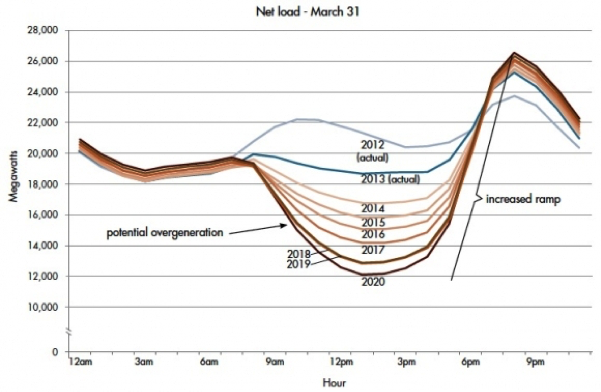
The California Public Utility Commission (CPUC) is adding an additional twist to rate reform. The CPUC has released new goals for a policy that will have all utilities in the state switching over to default Time-of-Use (TOU) rate schedules by 2019. This rate reform is being touted as a good thing for rooftop solar. And on the surface, it makes sense. On-peak rates are currently during daylight hours when solar is already kicking electricity back to the grid, which gives the solar owner the benefit of higher compensation for their solar production. But the policy is already entertaining evening on-peak windows, due to the increased demand as people start coming home from work. This duck curve illustrates that this ramp is set to increase as solar adoption rates continue to soar.

demand_curve.png

With an evening peak window, solar savings will decrease, and that’s why thinking ahead now is a must.

Smart battery solutions will be key in maximizing savings. Battery systems that know the optimal times to charge and discharge based off of rate structure will combat on-peak pricing. But there is a major issue with this: not all solar systems are capable of integrating with batteries.

Solar panels produce direct current (DC) electricity that needs to be converted to alternating current (AC) for household usage. A solar inverter is used to do this – but not all inverters are created equal. Let’s review the three main types of solar inverters, and how well they will work with battery back-up systems:

String Inverters:

This is the most common type of inverter and is typically a single unit on the side of the house. When introducing a battery to the equation, an issue comes up: batteries are DC, and in order to store energy produced from an inverter, the electricity would need to be converted back to DC – and then again back to AC for a household to use. These additional conversions will cause efficiency drops and completely offset any savings. A solar system installed with a string inverter would need to be altered and retrofitted to work efficiently with a battery – a costly procedure.

Micro-Inverters:

These inverters are commonly thought of as the premier inverter type available. With these systems, each individual panel has its own inverter, and the energy is converted from AC to DC right on the backside of the panel. This works great for maximizing efficiency in shaded conditions because these systems work in a parallel circuit, avoiding the Christmas-tree-light-string symptoms of a string inverter. However, when smart batteries are put into the equation, micro-inverters are completely incompatible. Workaround retrofits that are possible with a string inverter are impossible since the power lines coming off the roof are already carrying AC. Again, the additional AC to DC conversions will deter a battery system.

Check this video for more details on String and Micro inverters.

String Inverter with Power Optimizers:

SolarEdge is the only mainstream manufacturer of string inverters with optimizers. They are leaps ahead of their competitors in their technology and foresight. Their system integrates optimally with smart battery systems, eliminating double conversions of the current. Founder and VP of Product Strategy Lior Handelsman boasted to PV Tech Storage “Our inverter can do time-of-use, it can even take power from the grid, push it back into the battery and then reuse it later.” On top of all that, it also has the parallel circuit perks of the micro-inverter. Its price point is above a string inverter, but below micro-inverters. SolarEdge is working closely with Elon Musk’s Tesla Powerwall Home Battery – because battery backup is the future.

At GloSho, a recent CleanTech conference in Los Angeles, billionaire investor Steve Westly took the stage (video link) with an inspiring speech keying in on the fact that “[The Gigafactory] which comes online in 12 months… will more than double all of the lithium-ion capacity on the planet today.” Battery storage was the future, but that future is now.

Solar will be a huge part of the utility grid’s future, and because of this, the policy will change to not cannibalize the utilities. In doing this, it will put solar customer’s long-term investments at stake. In order to protect yourself from the future policy change, all possibilities must be thought out, and appropriate measures must be taken. Your inverter selection is not something to be overlooked.

Disclaimer: Author has no investments or business relationships to SolarEdge. This is strictly an opinion piece based off of market trends and available products.