


Solar PPA Rates in 2026: What’s a Good Rate for Your Home?
Solar Power Purchase Agreements (PPAs) are one of the most popular ways for homeowners to go solar without paying thousands of dollars upfront. But one question comes up more than any other: what’s a good solar PPA rate for my home?
This guide breaks down typical residential solar PPA rates, explains what qualifies as a good PPA rate, and answers a common concern: Does a solar PPA increase home value?
Jump ahead:
- What Are Typical Residential Solar PPA Rates in 2026?
- What Is a Solar PPA (and How Is It Different From Buying Solar)?
- What Is a Good Solar PPA Rate?
- What Affects Residential Solar PPA Rates?
- Does a Solar PPA Increase Home Value?
What Are Typical Residential Solar PPA Rates in 2026?
Residential solar PPA rates in 2026 typically range from 8-28 cents per kilowatt-hour (kWh), depending on project-specific factors like your utility rate, local policies & incentives, sun exposure, and the type of PPA.
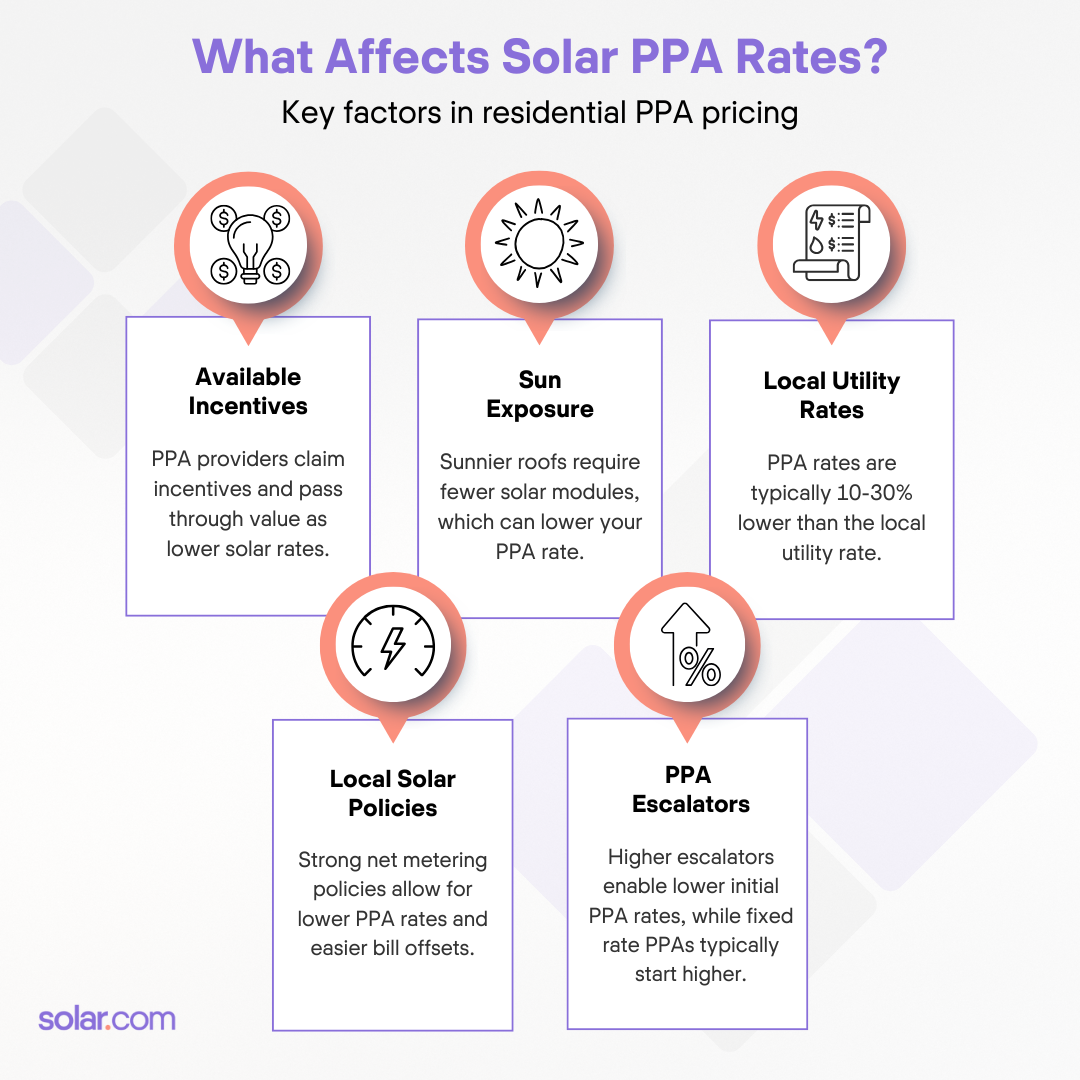
The most influential factor is typically your local utility rate. PPA providers generally offer rates that are 10-30% below the local utility rate, ensuring an immediate reduction in electricity costs for the homeowner. For instance, the average American paying 19 cents per kWh for utility electricity will likely see PPA rates in the 13-17 cent range.
In 2026, utility electric rates range from 12-40 cents per kWh, so a “good” PPA rate in Nevada will be drastically different than a “good” PPA rate in California.
Typical Solar PPA Rate Ranges
| Examples | Typical Utility Rates (c/kWh) | Typical PPA Rates (c/kWh) | |
| Low-cost states | Nevada, Washington, Tennessee | 12-17 | 8-12 |
| Average-cost states | New Jersey, Illinois, Minnesota | 17-24 | 12-17 |
| High-cost states | California, Connecticut, Massachusetts | 24-40 | 17-28 |
Unlike utility rates, which can change unpredictably, solar PPA rates either stay the same or escalate at an agreed-upon pace (usually 1-3% annually) for the 20-25 year agreement term.
What Is a Solar PPA (and How Is It Different From Buying Solar)?
A solar Power Purchase Agreement allows a homeowner to use solar energy without owning the panels. Instead:
- A solar company installs and owns the system
- You pay only for the electricity it produces
- There is typically no upfront cost
- Maintenance and repairs are included
Entering a solar PPA is like switching electricity providers. You’re not buying equipment—you’re buying clean electricity at a lower, more predictable price than your utility can offer.
Another key difference in 2026 is that PPAs are still eligible for a federal tax credit (claimed by the provider), whereas the consumer-claimed tax credit for purchasing solar is no longer active.
What Is a Good Solar PPA Rate?
A good solar PPA rate is easy to identify: If the PPA rate is 20-30% lower than your current utility rate, it’s generally considered competitive and will deliver immediate electricity cost savings.
For instance:
- Utility rate is $0.19 per kWh
- Good PPA rate: $0.13 to $0.15 per kWh
Factors That Make a PPA Rate Better (or Worse)
1) Annual Escalator
PPA rates can stay flat or increase slightly each year—typically by 1-3%—if it includes an escalator. A higher escalator typically results in a lower initial PPA rate and less long-term savings. A low or flat escalator typically results in a higher initial rate, but greater long-term savings.
2) Contract Length
PPA contracts typically range from 20-25 years. Longer contracts often mean lower starting rates.
3) Net Metering Rules
States and utility districts with strong net metering policies typically allow for lower PPA rates. Net metering is a billing structure that allows producing solar power to offset the cost of using grid electricity when the sun isn’t shining.
4) Local Utility Prices
The higher your utility rate, the more attractive a PPA becomes—even if the PPA rate itself looks average to begin with. Part of the appeal of residential PPAs is the ability to protect yourself from future utility rate increases.
Red Flags to Watch for
- PPA rate close to or higher than utility prices (especially if the PPA has an escalator)
- High annual escalators (3% or more)
- Poor transfer terms if you sell your home
What Affects Residential Solar PPA Rates?
Several factors influence what rate a homeowner is offered:
- State and local solar incentives: PPA providers claim incentives and pass the value through to homeowners by reducing the PPA rate
- Sun exposure and roof orientation: Sunnier roofs require fewer panels to produce electricity, which can help lower your PPA rate
- Local electricity costs: Local utility rates are a key benchmark for setting PPA rates
- Utility policies and grid rules: Local net metering policies and building codes can affect your PPA rate. For instance, California’s NEM 3.0 solar billing policy makes battery storage essential for maximum bill savings, and puts upward pressure on PPA rates.
Because these variables are location-specific, two neighbors can receive very different PPA offers.
Does a Solar PPA Increase Home Value?
A solar PPA does not increase home value the same way owning solar panels does—but it can still make a home more attractive to buyers. For instance, imagine you’re looking at two comparable homes in the same neighborhood. One has a solar PPA rate of $0.17 per kWh that is fixed for another 15 years, and the other gets electricity from the local utility at $0.24 per kWh and is exposed to future rate hikes.
Which home would you choose?
How Solar PPAs Affect Resale
- PPAs are usually transferable to a new buyer
- Homes with low electric bills can be easier to sell
- Buyers may hesitate if the PPA rate is high or escalates quickly
When a PPA Helps vs. Hurts a Home Sale
Helps when:
- The PPA rate is below local utility prices
- The PPA provider has a department dedicated to transferring the system (this is common in 2026)
- Contract terms are simple and transferable
Hurts when:
- The rate is higher than utility pricing
- The escalator is steep
- The buyer doesn’t understand the agreement
Are Solar PPAs Worth It for Homeowners in 2026?
For many households, solar PPAs can provider immediate electricity cost savings a valuable hedge against fast-rising utility rates. Homeowners who prefer an investment with greater long-term savings may be better served by a Prepaid PPA. By prepaying for all the power upfront and access the federal tax credit as an upfront discount, prepaid PPAs can offer power at a substantially lower rate.
Which type of PPA better suits your savings goals? Connect with a solar.com Energy Advisor to review custom solutions for your home.
*
*


