


On October 28, 2016, Elon Musk unveiled Tesla’s solar roof product – a line of roof tiles and shingles with embedded photovoltaic cells. To an enthusiastic crowd, Musk said at the product’s debut that the solar roof will have “an installed cost that is less than a normal roof plus the cost of electricity.”
The event, the aesthetically-stunning products, and the lack of detail given caused a lot of buzz in the industry and major news outlets in the days and weeks to follow. Musk has stated that Tesla’s mission is to accelerate the world’s transition to sustainable energy. Will his solar roof product be an industry game-changer that rapidly accelerates the adoption of rooftop solar, or will it be a specialty product for those who don’t mind, or who can afford, paying a premium for outstanding aesthetics? We think this will largely come down to cost. Let’s take a closer look!
Over fifty years ago, a photovoltaic cell capable of powering a toy Ferris wheel was demonstrated by Bell Labs. Since then, photovoltaics have come a long way in terms of efficiency, installed capacity, and aesthetics. While the clear majority of solar PV products today come in the form of modules or panels that can be retrofitted to a structure, building integrated photovoltaics or “BIPV” – pieces of a building envelope (roof, skylights, windows, etc.) with integrated PV cells, have been around since the mid-2000s. Solar roof tiles and shingles first became commercially available in the US when Dow Chemical entered the market. Dow’s line of solar roof products debuted in 2005 but was discontinued in 2016.
The efficiency of each Tesla tile or cell is probably going to be less than what is commercially available from the leading solar modules (~18-20%), due to Tesla’s products being treated with a veneer intended to diminish the sightlines to the integrated solar PV cell from ground-level. Keep in mind that because conventional solar panels are mounted a few inches above the roofline, the ventilation-effect has a positive effect 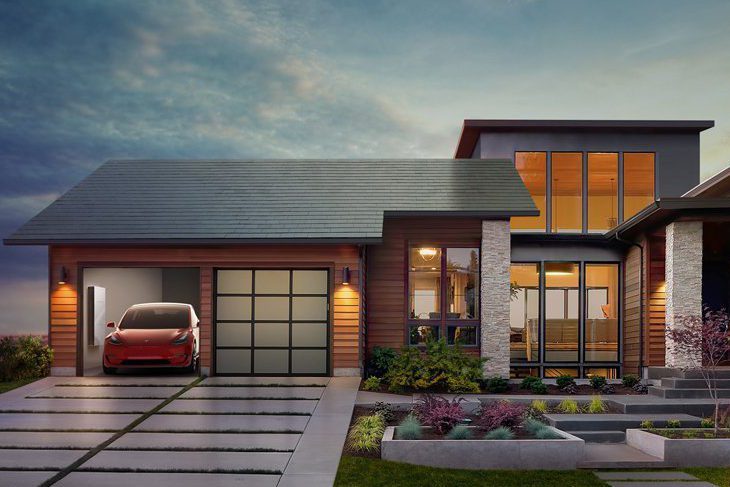
on their efficiency. When PV cells, or solar tiles, become hot (as roof shingles tend to do), their efficiency goes down. If these cells “are the roof” as Musk says, they’re likely to be less efficient when they become hot.
Now let’s think about some of the “nuts and bolts” of the product. Barry Cinnamon, industry expert and CEO of Spice Solar, in a November ‘16 piece for Greentech Media, hypothesized that each Tesla solar slate, tile, or shingle might produce about 6 Watts per unit (each unit with its own +/- DC connectors) – this would mean you’d need 2,000 connectors and 1,000 solar shingles to arrive at a 6 kW system. I agree with Barry’s thought that this introduces an exorbitant amount of possible failure points for a residential system, so the roof tiles will likely be assembled or manufactured in modular (panel-like) pieces, reducing field-introduced failure points and facilitating installation. More connections are necessary if rapid shutdown devices are added in the field.
At the time of writing this article, SolarCity (recently acquired by Tesla) sells residential solar PV systems in California (costs are different in other states) at approximately $4.22/Watt DC (before the Investment Tax Credit). That means for a normal-sized residential PV system of 6 kW (6,000 Watts DC), SolarCity (Tesla) is asking approximately $25,320 before incentives ($17,724 net cost, after tax credit). The company’s standard offering currently consists of solar modules in the range of 265 Watts DC paired with dual-MPPT inverters. Meanwhile, according to a survey by the SEIA, the national average cost of a turnkey (material, labor, permits, warranties, etc.) residential solar installation in 2016 was below $3.50/Watt DC. That means an “average” customer in California might purchase a similar 6 kW system in 2016 for $21,000, before incentives ($14,700 net cost, after the 30% federal tax credit). In an increasingly competitive residential solar market where local, regional installation companies can offer prices oftentimes lower than larger, national brands for high-quality solar components and competitive financing terms, Solar.com is here to help you find the best value through our competitive bidding platform.
Let’s talk about roofing costs. Here in southern California, residential roofing costs can vary widely depending on the materials, the scope of work, and labor employed. For instance, a “square” (roofing jargon for 100 square feet) of 3-tab or dimensional composite shingles’ material and labor costs less (approximately $350/square) than the same area of concrete tile (approximately $500/square) or handmade terracotta clay tile (around $600/square), and much less than a higher-end slate product (about $800/square or more). Using these rough assumptions, a new composite shingle roof, installed professionally, costs about $7,000 for a home with 2,000 sf of roof space.
Again, Musk claimed it will cost less than a normal roof plus the cost of electricity. I’d interpret this to mean: “…plus the cost of electricity [over the useful life of that roof].” So, assuming that roof lasts 25 years (as long as a common shingles’ manufacturer’s warranty, [also the length of leading solar panels’ performance warranties]), the cost of electricity can be a very large number. In the investor-owned utilities (SCE, SDG&E) of southern CA, a residential customer’s baseline cost/kWh (Tier 1) is approximately $0.17/kWh. Let’s assume a residential customer’s annual electricity costs sum to $1,500/year (and consumes just shy of 9,000 kWh/yr.). Even if a utility’s rates for residential customers were to remain flat over the next 25 years, “a new roof plus the cost of electricity” could mean, in this example, more than $40,000! Depending on when the Tesla roof product is rolled out, a new solar PV system and roof could cost about half that figure. That means you could start saving money and offsetting your energy footprint today for considerably less!
The aesthetics of Tesla’s solar roof are certainly impressive. Each of the tiles, slates, and shingles is sleek and attractive. However, when going solar, aesthetics should not be the only factor to consider – especially if money “is a thing”. A thoughtful solar PV design for your home will consider your budget, aesthetics (panel color, array shape & location), site-specific factors such as your roof, any shading factors or obstructions, and equipment to achieve your financial, home energy and environmental goals for going solar. Solar.com has in-house experts that will help with each step of the process.
While solar tile and shingle products can make economic sense in many areas of the US with new construction and tract homes (coordinating installation of many projects together, in close proximity, and while the roof surface is “exposed” and walls unfinished to accommodate electrical conduit runs), there is a wealth of proven, mature solar products and installers that can help you get started in achieving your energy goals today! While we do not yet know details about the material and installation costs of Tesla’s solar roof product, this piece is an attempt to estimate them. Industry data suggests that this solar roof product may be more expensive than Elon initially teased in the product’s debut.
For this reason, Solar.com encourages all homeowners to consider all their options – including those that are available now. We invite you to add your two cents in the comments, or if you’d like to know what it costs to go solar now while the federal tax credit and some regional incentives are available, we’d love to speak with you and help you find the best value solar installation in the market! Please call (888) 454-9979 (ext. 114) and we can discuss your options!
Want more information? Subscribe to our blog by clicking here.


