


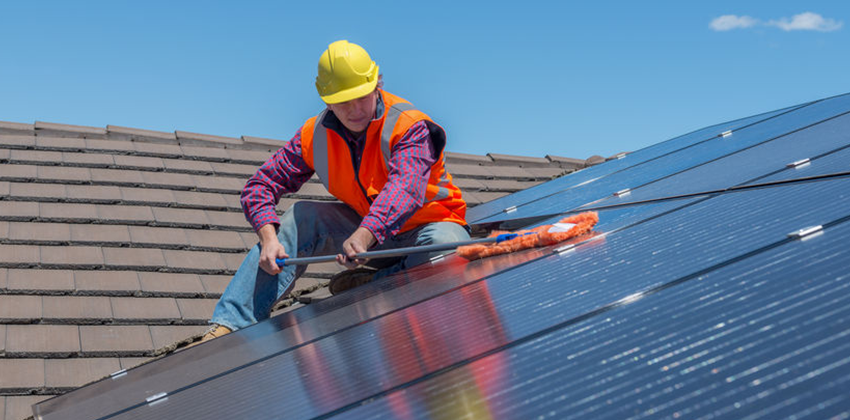
The economics of solar panel cleaning
We all know what a fresh cleaning does for windows. The world outside suddenly seems brighter, more vibrant, because sunlight is no longer partially absorbed by a thin film of dirt. The same happens with solar panels. The longer they go without cleaning, the less light hits the solar cells and ultimately gets converted into electricity.
Homeowners with solar panels have to ask themselves two questions. How much energy do I lose from soiling? And is it worth it to clean the panels?
The short answer on panel washing is: no, it’s not worth it.
Soiling losses
“You definitely wouldn’t get your money back after hiring someone to wash your rooftop panels,” says Jan Kleissl, a professor of mechanical and aerospace engineering at UC San Diego and the principal investigator on a study about soiling on solar panels. But it is worth looking at the details of Kleissl’s study and how he reached his conclusion.
The dirt itself does not hurt solar panels. It comes down to economics. To find out if the cleaning cost is justified, we have to calculate the potential losses from soiling. That is more complicated than it may sound because there are a lot of contributing factors.
Solar panels with an aluminum frame, for example, stay dirtier after rainfall than frameless panels. If the panels are tilted five degrees or more, chances are that rain, wind, and snow do a good enough job to keep production up.
In a dry climate or an area with heavy air pollution, soiling losses can add up. Excessive bird droppings can be a problem, too. Even though they are relatively small, they can continuously shade parts of the panel, creating destructive hot spots and panel degradation.
Kleissl and his collaborators looked at 186 commercial and residential solar systems from San Francisco to the Mexican border. The panels hadn’t seen rain or any type of cleaning for 145 days during a summer drought. Efficiency losses amounted to 7.4 percent. That might sound like a lot. Keep reading, and you’ll see it’s really not.
Not many researchers have tackled cleaning for residential systems, but those who have came to similar conclusions. Heinrich Häberlin, professor at the Berner Fachhochschule für Technik und Architektur, Switzerland, saw almost twice as much energy loss due to soiling, but it was not enough to pay for professional cleaning either.
Pay a lot, save a little
Companies in the US charge a fixed fee for cleaning solar panel arrays or they bill by the panel. Either way, the total cost is usually about $120 to $140 for the average residential system.
The amount of solar energy you produce and your cost of buying electricity from the grid vary depending on where you live. In New Orleans, Louisiana, an average-sized, 5 kW system will produce about 550 kWh a month. (Use the National Renewable Energy Laboratory’s PVWatts calculator to look up the energy production for a solar panel system where you live.)
Since energy losses due to soiling range from 7.5 to 15 percent, a New Orleans solar home stands to lose about 40 to 80 kWh of energy per month. At the price people pay for electricity there, 9₵ per kWh, this would set you back $3.75 to $7.50 a month.
Add up the cost of soiling losses for a full year. That’s $45 to $90. You can see that a solar panel washer would make money providing annual cleanings, but you would not.
How about DIY panel cleaning?
You might ask yourself why not take out the garden hose and make it rain on your modules all by yourself? That’s a bad idea for several reasons.
Drinking water contains minerals that will leave a white film on the glass. In a worst-case scenario, a little critter has, unbeknownst to you, damaged one of the wires under the modules. Do you want to risk electrocution?
So you just climb on the roof and use a brush, you think. Well, consider the danger of falling off and breaking every bone in your body. Also consider that solar panel glass is not ordinary glass, it has a microstructure to catch as much sunlight as possible that can be damaged if you use the wrong brush.
If you really have to clean your panels yourself, use a soft cloth and a gentle soap solution. Make sure you don’t step on the panels though. They won’t break, but the cells could get damaged. Professionals work with deionized water and special brushes with very long handles.
In the end, it all might come down to this: When thinking about maintenance, solar panel systems are like cars. You might get away with no maintenance at all for a long time and save some money, or you might have things checked regularly by a professional.
Solar panels, inverters, and wires should be inspected by an expert once a year. So why not find a provider that maintains your system and washes panels as needed, maybe every three to five years?
Besides all economic calculations, clean modules certainly look better—which is, of course, priceless.


