Page 75 | Solar.com

Please enter a valid zip code.

solar without battery

Best and Worst Moments for Solar Power in 2022

By The Pros and Cons of Rooftop Solar in 2026, Disadvantages of Solar Energy No Comments

With groundbreaking legislation and new milestones, 2022 was a historic year for solar power.

And, after tallying the year’s triumphs and setbacks, one thing is clear: We’ve only seen the tip of the iceberg.

To celebrate the progress made this year – and to foreshadow what’s ahead – we’ve compiled a list of the best and worst moments for solar power in 2022.

Compare multiple binding solar quotes here.

Best moments for solar power in 2022

Despite substantial challenges, 2022 was an epic year for solar power in several ways. Here are some of the year’s most notable achievements.

Inflation Reduction Act turbocharges solar

On August 16, 2022, President Joe Biden signed the Inflation Reduction Act (IRA) into law which set the federal solar tax to 30% until 2032.

The tax credit was previously set at 26% for 2022 and was scheduled to step down to 22% in 2023 before going away entirely for residential solar 2024.

best and worst of solar power in 2022

For homeowners, the 30% tax credit is worth $7,500 on a $25,000 solar project – effectively reducing the cost and payback period of the project and increasing the overall energy cost savings. The tax credit also applies to battery storage which, beginning in 2023, does not have to be connected to a solar system.

While the enhanced tax credit is something to cheer about, it’s the long-term effects of the Inflation Reduction Act that promise to turbocharge the solar power industry.

The IRA also includes incentives for:

In all, the IRA is a major investment in a clean energy future led by solar power.

Solar and battery save the day during natural disasters

Residential solar and battery aren’t only a solution for slowing climate change, they’re also crucial for responding to it.

In 2022, we saw solar and battery rise to the occasion during extreme weather events on both the east and west coasts.

In California, residential batteries charged by rooftop solar provided around 340 MW of power to support the local grid and avoid blackouts during a record heat wave. The 340 MW provided by solar and battery owners is more capacity than a mid-sized power plant and represents a fraction of the total storage held in garages around the state.

“A new analysis by the California Solar and Storage Association (CALSSA) shows that California had more than 80,000 customer-sited batteries connected to the electric grid capable of providing 900 MW of solar power.”

Less than a month later, in Florida, a solar-powered community near Fort Myers survived Hurricane Ian nearly unscathed, and provided power and shelter to displaced victims in the aftermath.

Renewables set to surpass coal

Thanks to rapid growth in wind and solar, power generation from renewable energy is expected to surpass coal and nuclear in 2022, according to the US Energy Information Agency.

Renewables (mainly solar, wind, and hydro) are on track to provide 22% of the US’s energy mix this year, up from 20% last year. Meanwhile, coal is on track to generate 20% of the overall mix, down from 23% in 2021.

Energy source Share of 2021 US generation Share of 2022 US generation Projected share of 2023 generation
Renewables 20% 22% 24%
Coal 23% 20% 19%
Nuclear 20% 19% 20%

And renewables – especially wind and solar – are just getting started. The US is on track to nearly double its total solar capacity over the next three years.

The US currently has around 77 GW of solar capacity and has nearly 72 GW of “high probability additions” lined up for October 2022 through September 2025 – by far the most of any energy source. The next closest is wind with 18 GW of “high probability additions.”

It’s also worth noting that solar is the only energy source with zero planned retirements over the next three years.

Record number of residential solar additions in Q3

Homeowners added a record 1.57 GW of solar capacity in the third quarter of 2022 alone, according to the Solar Energies Industry Association (SEIA). That makes up over 34% of the total 4.6 GW of solar capacity added in Q3.

According to the SEIA: “California made up 36% of this total as installers continue to push to sell residential solar before changes to current net metering rates.”

california vs other states solar power

Surging electricity prices increase solar savings potential

The average price for grid electricity jumped 16% year-over-year in October 2022 – the largest one-year increase in over 40 years.

Rising price of electricity

This includes a 64% rate increase in Massachusetts and a 50% rate increase in Connecticut expected to add around $1,000 per year to electricity bills.

The rapid rate increases in 2022 highlight and increase the savings potential of residential solar. Going solar leads to lower and more predictable electricity payments, adding up to tens of thousands of dollars in energy cost savings over the 25-year life of the system.

Related reading: The Pros and Cons of Solar Energy in 2023

Worst moments for solar power in 2022

The road to a clean energy future is lined with speed bumps and setbacks. Here are some of the biggest hurdles for solar power in 2022.

California all but guts net metering

In December, the California Public Utilities Commission (CPUC) approved a new version of net metering – known as NEM 3.0 – for customers of California’s three major investor-owned utilities (PG&E, SCE, and SDG&E).

Solar owners under NEM 3.0 will earn ~75% less for the excess electricity they push onto the grid. This will substantially increase the payback period and decrease the overall energy cost savings of going solar.

NEM 3.0 was approved despite strong public opposition, including a three-hour marathon of over 100 anti-NEM 3.0 public comments leading up to the vote.

In a silver lining, both Michigan and Florida rejected attempts to weaken or remove net metering in 2022.

Rate hikes make solar loans more expensive

In an effort to tamp down inflation, the Federal Reserve has been raising interest rates throughout 2022. This is designed to discourage borrowing and spending in order to slow an overheating economy.

While mortgage rates get most of the media attention, interest rates for solar loans have also been affected. Higher interest rates add to the overall cost of solar and lengthen the payback period.

While going solar is still much cheaper than paying for grid electricity, higher interest rates eat away at the lifetime energy cost savings.

Supply chain tangles delaying and adding costs to solar power

From lumber to meat, the pandemic wreaked havoc on supply chains in all industries, including solar.

The mangled supply chain for panels, racking, inverters, and raw materials caused the price of solar power to increase for the first time in at least a decade – although it remains the cheapest source of energy.

Supply chains are expected to improve in 2023 leading to reduced prices and more installations.

The bottom line: 2022 was a good year for solar power

While 2022 contained several speed bumps for the solar industry, it also featured major victories and milestones.

In an era of inflation and uncertainty, more homeowners are recognizing solar as a means to lower and more predictable energy costs.

Get multiple solar quotes to see how much you could save.

Going solar in old age

Is It Worth Going Solar in Your Golden Years? A Retired NASA Scientist Weighs In

By Solar Panels for Home No Comments

For many homeowners, solar panels are a long-term investment in energy cost savings. On average, it takes between 7-10 years to break-even, leaving decades to accumulate savings.

But what if you’re not sure if you’ll be in your home for 7-10 years?

Going solar in your golden years can be daunting, but it can also be a way to free up fixed income, increase your home value, and add to your legacy.

In this article, we’ll explore the benefits and road bumps of going solar later in life, and recount the experience of retired NASA scientist Lenny Pfister, who recently went solar at 72 years young.

Is it worth going solar in your 70’s?

For most homeowners, the measure of whether it’s “worth it” to go solar is how much money they will save in electricity costs. That’s especially true for retired homeowners living on fixed income.

Rising electricity prices pose a serious problem to people living on fixed income. Typically, the cost of electricity rises 3-5% per year. However, in October 2022, the average US electricity price increased nearly 17% year-over-year – the largest one-year increase since 1981.

Here’s how this one-year increase translates into monthly costs:

Electricity source Rate in September 2021 (cents/kWh) Cost per month in 2021 (833 kWh) Rate in September 2022 (cents/kWh) Cost per month in 2022 (833 kWh) Year-over-year bill change
Grid – US average 14.14 $118 16.32 $136 $18
Grid – California 23.49 $196 26.6 $221 $25
Grid – New York State 20.66 $172 23.97 $200 $28
Grid – Florida 12.34 $103 14.59 $122 $19

Based on grid electricity prices and average monthly consumption figures from the US Energy Information Agency.

Over the course of a year, this adds up to an extra $216-336. Younger homeowners still in the workforce may be able to keep up as their income increases, but that’s typically not an option for retirees and older adults.

It’s also worth mentioning that utility bills vary from month-to-month, which can make it very hard to budget a fixed income

Going solar is a way of locking in a lower, fixed monthly payment for your electricity. In fact, designing a system to your needs and selecting a financing option puts you control of price you pay for electricity — not the utility.

Related reading: The Pros and Cons of Going Solar

“I better have solar because electricity is very expensive”

Rising electricity prices is what drove Lenny Pfister, a retired NASA scientist of over 40 years, to put a solar system on his home at the age of 72.

Pfister said the 1960’s homes in his area of Northern California historically haven’t had air conditioning. However, living standards have changed and so has the climate, bringing more instances of hot weather.

“So, I decided to get AC and, I thought, ‘If I really want to go green, I should be using electric heat with a heat pump, too,’” Pfister said. “So, I knew my electricity usage would increase. And if I’m going to do that at a reasonable rate, I better have solar because electricity is very expensive in this state.”

Pfister was also motivated by the changing net metering policy in California, know as NEM 3.0, which will be less favorable to solar owners in the future. Learn more about the new policy here and how to be grandfathered into the current one here.

What about solar scams?

We will be the first to admit that the solar industry is plagued with scams and sleazy installers. And to be frank, those dirty rascals tend to target older homeowners.

So how can you tell a reputable installer from a scam?

Well, Electrum – the parent company of Solar.com – was founded for the exact purpose of weeding out scammy solar companies. We rigorously vet installers before allowing them to join our network and won’t even consider them if they don’t have:

  • Certification and insurance
  • 3+ years of experience
  • Solid financial standing
  • An excellent track record of customer experience

This not only takes power away from scammers; it fosters healthy competition between local installers that leads to savings for homeowners.

But don’t just take our word for it.

“It’s reasonable to go through a company like yours,” Pfister said. “I was referred to Electrum by my utility because you do vet the solar companies in some way. It’s actually competitive because I got a bid from someone else outside the system and you actually had better than the price.”

When will my solar savings kick in?

Going solar is a way of reducing and stabilizing your monthly electricity costs. Exactly when and how much you save by going solar largely depends on how you choose to finance your system.

There are two main ways to finance a solar system: Cash or solar loan.

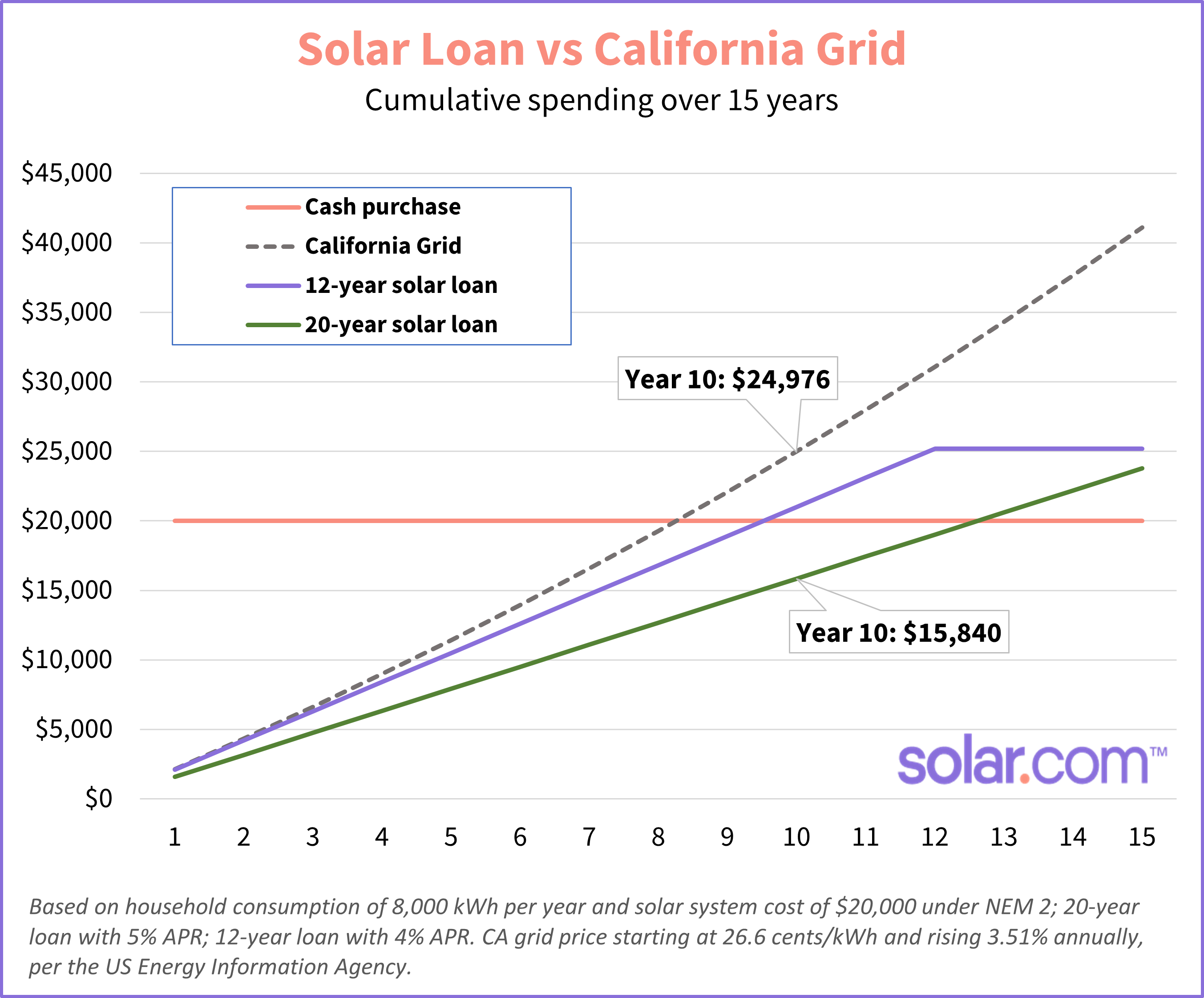
Paying in cash maximizes your long-term savings, as you spend less money on interest and loan fees. But taking out a solar loan can lead to quicker – often instant – savings, as shown below in a chart for a typical California homeowner’s option.

going solar in old age chart of loan options vs utility costs

All three solar financing options provide savings, but at different times.

Here are the takeaways:

  • A 20-year loan can provide instant savings as the monthly payments are often lower than the monthly electricity bills they replace. However, longer loans tend to accumlate more interest
  • The payments on a 12-year loan may not be lower than utility payments right off the bat. However, after a few years of utility rate increases, they become the path to energy cost savings
  • A cash purchase requires the largest upfront investment, but it is most cost-effective option in the long run

So, the big question becomes: “How long do you plan on being in your house?”

If the answer is less than 10 years, a longer solar loan is usually best to free up fixed income right away.

If it’s more than 10 years, a shorter loan or a cash purchase can increase your total savings over the life of the solar system.

Now, you’re probably thinking, “What if I leave my house before my solar loan is paid off or before I see a return on investment for a cash purchase?”

Wonderful question — let’s dive in!

What if I move before my solar system is paid off?

Given solar panels are typically warrantied for 25 years and last much longer, it’s very common for older homeowners to leave their house before their system is paid off or they see a return on investment.

This is something Lenny Pfister pondered while exploring his solar options.

“I did wonder how long I’m going to be in the house,” Pfister said. “I figure I’ll be in the house probably for 5-10 years. I can get pretty close to paying it back and I’m guessing that it adds some value to your home.”

As a matter of fact, Pfister was correct about added home value. Studies by Zillow and the Lawrence Berkeley National Laboratory have shown that solar panels increase your home value by around 4.1% or $4,000 per kW of capacity installed (depending on who you ask). Solar panels can also help your home sell faster, as today’s buyers value energy efficiency and green home features.

So, if you need to sell your home before your solar system is paid off, the buyer essentially pays for it in the sale – just like they would an air conditioner, furnace, and the house itself!

Then, you can use the additional proceeds from the home sale to pay off your solar loan, and the solar system stays with the new owners to help them reduce their energy costs.

Added home value allows you to enjoy the instant savings of a long-term solar loan without the worry of making payments for 15, 20, or even 25 years.

Leaving a legacy

In addition to energy cost savings, there is another major reason to go solar: To try to leave the world in better shape than you found it.

Pfister said his decision to go solar was about 50% financial and 50% environmental.

“For what it’s worth, the science that I was studying at NASA was Earth science,” Pfister said. “I just figured it was time to (go solar), and I had the money to do it. It’s basically that I tried to put my money where my mouth was.”

In the last few decades, solar has emerged among the cleanest and cheapest energy sources, with the added bonus that it’s accessible by the general public. Rooftop solar is especially unique because it requires zero extra land use and can help create a more resilient and affordable electricity grid for everyone – especially when paired with battery storage.

In other words, a home solar system (and the energy cost savings it provides) is the perfect gift to leave behind for future generations that will face the most severe consequences of climate change.

Going solar with Electrum and solar.com

The beauty of going solar is it gives you control over your monthly electricity costs, which is especially valuable for older homeowners on fixed income.

Even if you don’t live in your house long enough to pay off the system, most homeowners recoup the cost of the system through added home value when they sell.

Finally, rooftop solar is a clean, cheap energy source and the perfect gift to leave behind for future generations.

Connect with an Energy Advisor to learn more and compare multiple quotes from vetted installers.