Page 79 | Solar.com

Please enter a valid zip code.

adu solar requirements california

California’s ADU Solar Requirements: Does My ADU Need Solar Panels?

By Solar Panels for Home No Comments

In 2020, California became the first state to require new homes to be equipped with solar panels to offset the use of grid electricity as part of its goal to achieve net-zero emissions by 2045.

Known as the California Solar Mandate or Title 24, this standard applies to single-family homes, apartments, condos, and – you guessed it – Accessory Dwelling Units (ADUs).

ADUs are small, fully-finished living spaces that can be rented out or used as additional living space. They are also known as in-law suites, granny flats, and casitas.

In this article, we’ll take a closer look at:

Let’s start by exploring California’s Title 24 ADU requirements.

Building an ADU? Get multiple solar quotes here.

Are solar panels required for ADUs in California?

For the most part, new ADUs need to have solar panels to be in compliance with California Title 24 Building and Energy Efficiency Standards.

Here’s what it says in the California Department of Housing and Community Development (HCD) 2020 ADU handbook :

“Yes, newly constructed ADUs are subject to the Energy Code requirement to provide solar panels if the unit(s) is a newly constructed, non-manufactured, detached ADU.”

Solar panels are required to offset the ADUs electricity consumption, but they do not necessarily need to be installed on the ADU. They can also be:

  • Installed on the main house, ground, other eligible structures
  • Added to existing on-site arrays or, in some cases, community solar arrays

It’s important to note that these standards only apply to ADUs for which permitting was submitted after January 1, 2020. So if you had or built an ADU prior to 2020 you don’t need to add solar panels for it (although it might be worth it for the energy savings and additional home value).
california adu requirements

ADU solar exemptions

Now, you may have noticed in the Title 24 ADU requirements above that HCD specifically requires solar panels for “newly constructed, non-manufactured, detached ADU(s).” That leaves room for exemptions for the solar requirement for some ADU projects.

Specifically, HCD’s 2020 ADU handbook states:

“ADUs that are constructed within existing space, or as an addition to existing homes, including detached additions where an existing detached building is converted from non-residential to residential space, are not subject to the Energy Code requirement to provide solar panels.”

Let’s take a closer look at some scenarios that could qualify for an exemption from Title 24.

This article does not constitute legal or financial advice. Please consult a licensed contractor, your city planning officials, or the California Energy Commision (title24@energy.ca.gov) with questions regarding Title 24 ADU exemptions.

Is the ADU new construction or an addition/conversion?

If you are adding to or converting an existing structure to create your ADU, you may be exempt from Title 24 solar requirements.

That’s because additions and conversions can be permitted as alterations instead of new construction. And, as the HCD pointed out, addition and conversion projects are not subject to the solar panel requirements in the energy code.

Exempt additions or conversions may include:

  • Converting a detached garage to an ADU
  • Converting part of your primary home to ADU
  • Constructing an ADU as an addition to your primary home

Now, there are some gray areas here. For example, if you completely tear down a detached garage and rebuild it as an ADU, is that a conversion or new construction?

The answer will likely require a discussion with your city planning department, and it may be worth considering early on whether to risk delaying your ADU project in order to skirt around solar panel requirements.

California is the only state that currently requires solar for ADU’s, but it is likely to become adopted elsewhere in the years to come.

Is the ADU a manufactured unit?

Manufactured ADUs are also exempt from Title 24 solar requirements.

Just like manufactured homes, manufactured ADUs are built off-site, transported, and placed on a foundation on-site. Manufactured ADUs are regulated by a differently than site-build ADUs and are exempt from solar panel requirements in California.

Manufactured ADUs may include tiny homes, modular homes, and other structures built primarily offsite. However, it’s worth consulting your city planners ahead of time to fully understand what qualifies as a manufactured ADU.

Does the ADU have a small or shaded roof?

Another avenue for Title 24 exemptions is for particularly small or shaded roofs. Even as the biggest advocates of rooftop solar, we’ll be the first to tell you solar panels and shade don’t mix.

According to a 2020 newsletter from the CEC:

“No PV is required if the effective annual solar access is restricted to less than 80 contiguous square feet by shading from existing permanent natural or man-made barriers external to the dwelling, including but not limited to trees, hills, and adjacent structures. The effective annual solar access shall be 70 percent or greater of the output of an unshaded PV array on an annual basis.”

However, if you file for exemption because your roof is too small or shaded, your city planners may explore alternative options for making solar viable on your lot.

Where to get solar panels for an ADU

Whether they are part of the requirement or not, putting solar panels on your ADU in California is likely worthwhile based solely on energy savings alone. Electricity is expensive in California and far outweighs the cost of going solar over the 25+ year lifespan of solar panels.

However, it can be tricky to find installers for an ADU solar project because larger companies often turned down smaller projects to prioritize large ones.

But through solar.com, you can get multiple quotes from our deep network of vetted local installers in California all from the comfort of your home. Better yet, we’ll pair you up with a dedicated Energy Advisor to help you compare quotes, claim incentives, and line up financing.

In order to customize a solar system for your ADU, we’ll need blueprints for the structure that includes the layout, square footage, roof pitch  – the more info the better.

California ADU solar requirements FAQs

Does the 30% solar tax credit apply to ADU projects?

Yes, the 30% Residential Clean Energy Credit can be claimed for the installed cost of the solar panels required for newly constructed ADUs.

For example, if installing solar panels adds $10,000 to your ADU project, you can claim a tax credit worth $3,000. It’s important to note that the solar tax credit is non-refundable, which means it can only be used to lower your tax liability.

This article does not constitute tax advice. Consult a licensed tax professional with questions regarding the 30% federal solar tax credit.

How many solar panels do I need for an ADU?

The number of solar panels required for newly constructed ADUs under California’s Title 24 depends on the size, location, and projected electrical usage of the ADU.

According to the 2022 Building Energy Efficiency Standards, the formula for determining the minimum solar capacity for dwelling spaces goes as follows:

kW (PV)required = (CFA x A)/1000 + (NDwell x B)

Where:

  • kW(PV) = kW(DC) size of the PV system
  • CFA = Conditioned floor area
  • NDwell = Number of dwelling units
  • A = Adjustment factor (from Table 7-1 below)
  • B = Dwelling adjustment factor (from Table 7-1 below)

california hdu solar requirements size chart

How much does it cost to install solar panels on an ADU?

The cost of installing solar panels on an ADU varies based on the size and location of the project. But at an average cost of 8 cents per kWh, going solar through solar.com is much cheaper than paying for grid electricity in California.

Cost of solar vs grid electricity in California

Electricity source Average cost*
Solar through solar.com 8 cents per kWh
Grid – Los Angeles 25.7 cents per kWh
Riverside 26.0 cents per kWh
San Diego 40.9 cents per kWh
San Francisco 30.7 cents per kWh

*October 2022 prices per Bureau of Labor Statistics.


payback period for solar panels

What Is the Average Payback Period for Solar Panels?

By How Much Do Solar Panels Save?, Solar Panel Cost No Comments

How long does it take for solar panels to pay for themselves?

The amount of time it takes for the energy savings to exceed the cost of installing solar panels is know as the payback period or break-even period. A typical payback period for residential solar is 7-10 years, althought it varies depending on your utility rates, incentives, system size, and other factors.

Everybody’s solar payback period is different based on their unique circumstances. So in this article, we’ll explore:

Let’s jump right in by exploring what counts as a good solar payback period.

What is a good payback period for solar panels?

The average payback period for solar panels is 7-10 years – which is pretty good considering solar panels are warrantied for 25 years and can last much longer. That leaves around two-thirds of the warranty period – 15-18 years – to accumulate energy savings.

But the payback period can vary quite a bit from homeowner to homeowner. Based on real quotes presented to solar.com customers, some solar projects have a payback period under 3 years while for others it’s closer to 12.

Even at the high end, a 12-year payback period still leaves more than half of the system’s warrantied life left to accumulate energy savings.

What if I move before my payback period?

One downside of solar panels is that you can’t take them with you if you move. However, it’s well documented by Zillow and Berkeley Lab that solar panels increase your home value.

So even if you move before your payback period, you will likely recoup the cost of installing your solar panels, if not a little more.

What influences your solar payback period?

The payback period for solar panels is different for every homeowner. There are four main factors that influence your payback period, beginning with the total cost of your solar system.

Gross solar system cost

The gross cost of a solar system depends on:

  • Its size (in kWh)
  • The cost of the equipment installed
  • The installation company
  • Your financing methods (cash vs solar loan)

One way to think of the gross cost of a solar system is that you’re buying 25-years worth of solar electricity once. There’s going to be some sticker shock, but when you break the cost down to years, months, days, and kilowatt hours, it is much cheaper than paying for grid electricity.

It gets even cheaper when you factor in tax credits, rebates, and other incentives.

Tax credits, rebates, and other incentives

Solar incentives like the 30% federal tax credit and state rebates can be used to bring down the upfront cost of going solar and shorten your payback period.

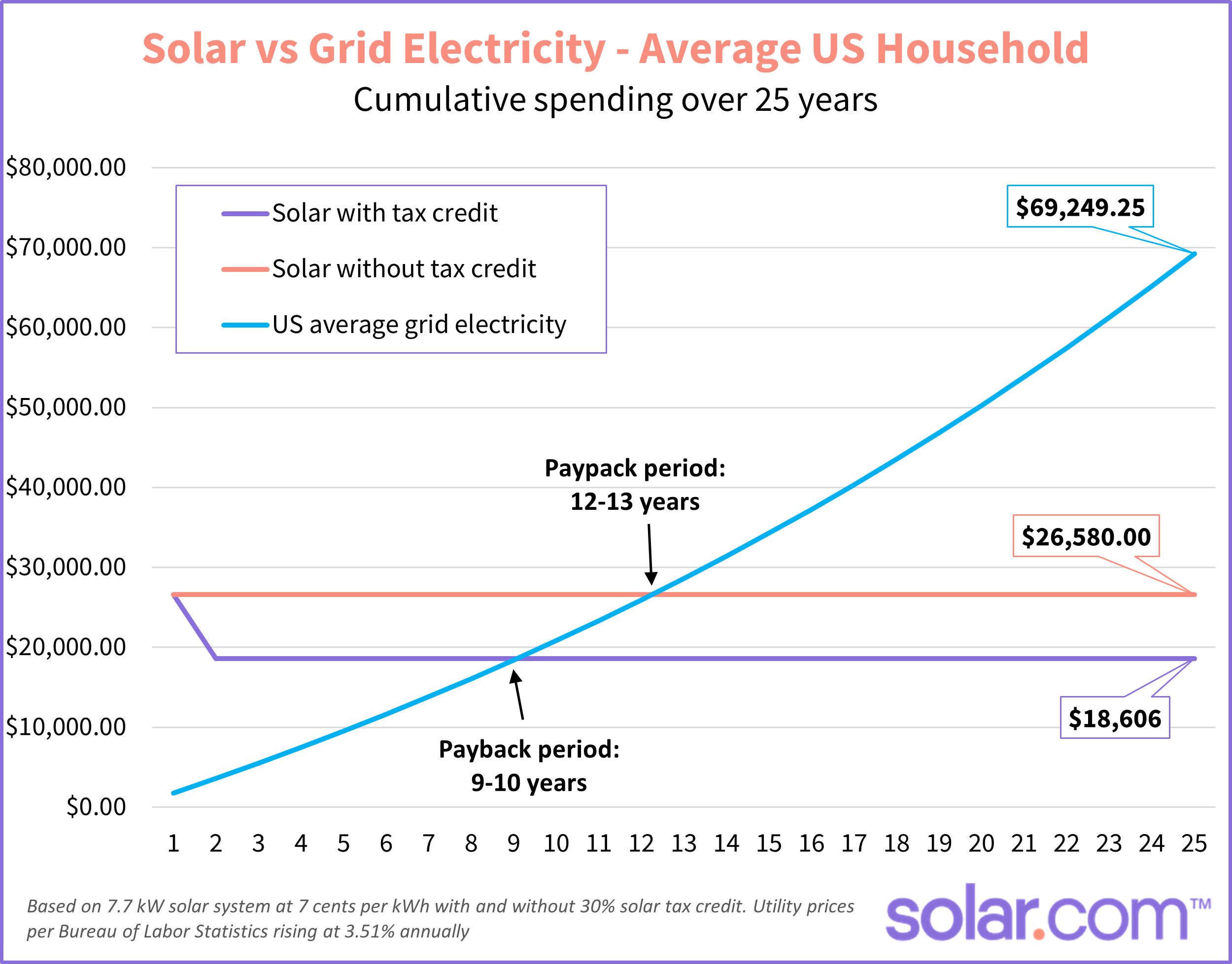
Here’s how that looks for the average American homeowner looking to completely offset their electricity bill.

payback period of solar panels national average

Without the 30% solar tax credit, the average homeowner is looking at a payback period of 12-13 years. But claiming the solar tax credit reduces that payback period to 9-10 years, and adds nearly $8,000 to their energy savings.

Here are some solar incentives to look into:

Utility electricity price

One of the biggest factors in determining the payback period of solar panels is your grid electricity price. The higher the price, the shorter your payback period.

As of July 2023, the national average price for grid electricity was 16.9 cents per kWh. Meanwhile, the average price for solar panels purchased through solar.com is around 7 cents per kWh.

The price of grid electricity varies widely across the US. The table below shows the relationship between utility prices and the break even point of going solar.

Estimated payback period of solar panels for major US metros

Location May 2023 grid price (cents per kWh) Estimated average payback period*
National average 16.9 9-10 years
New York City metro 25.1 7-8 years
Minneapolis metro 19.1 9-10 years
Houston metro 15.7 7-8 years
San Francisco metro 34.9 4-5 years
San Diego metro 47.5 3-4 years

*Based on 7.7 kW solar system at net cost of $18,606 after claiming 30% solar tax credit versus October 2022 utility prices rising at 3.51% annually, per BLS.

How to calculate the payback period of solar panels

The easiest and most accurate way to calculate the payback period of solar panels is by getting multiple quotes from vetted local installers, which you can do right here on solar.com.

But if you want to get a ballpark estimate on your own, here’s the formula for calculating your payback period.

Payback period = Net Cost of Going Solar / Annual Energy Savings

 Let’s go through an example to see how this equation plays out.

Net cost of going solar

What it is: The total cost of going solar after factoring in tax credits, rebates, and other incentives

How to find it: Get multiple quotes from vetted local installers.

Example scenario: Let’s say the gross cost of your solar system is $24,000. The 30% federal tax credit alone brings the net cost down to $16,800.

State, local, and utility incentives could bring the net cost down even further. But for the purposes of our example, we’ll stick with $16,800.

Annual energy savings

What it is: Your electricity costs before going solar. Once you go solar, this cost becomes savings because you’re no longer paying for electricity!

How to find it: Dig up a year’s worth of your most recent electricity bills and add them together. Or, if you can only find a handful of bills, average the monthly cost and multiply by 12 to find your annual cost.

Example scenario: The average American household uses around 10,000 kWh of electricity per year and pays 16.7 cents per kWh for that electricity. So for our example, we’ll use $1,670 as the annual energy savings.

Payback period

Now that we have our net cost of going solar and annual energy savings, we can calculate the payback period of going solar.

$16,800 / $1,670 = 10.05 years

Hold on, didn’t we say the average payback period of solar panels is 7-10 years?

Well, there’s one more important factor to account for: Inflation.

Factoring inflation into your solar payback period

Electricity prices are subject to inflation and have been rising at an average annual rate of 3.5% over the last 5 years, according to the Bureau of Labor Statistics. To account for this, we need to increase the annual energy savings by 3.5% every year, which shortens the payback period of solar panels.

Here’s how that looks over 25 years:

Year Annual energy savings without inflation Annual energy savings including inflation
1 $1,670 $1,670
5 $1,670 $1,916.36
10 $1,670 $2,276.04
15 $1,670 $2,703.22
20 $1,670 $3,210.58
15 $1,670 $3,813.16
Cumulative electricity cost over 25 years $41,750 $65,046
Average annual cost over 25 years $1,670 $2,601.85

Now, here’s where things get tricky. Since $2,601 is the average for 25 years of utility payments, and we know the break even period is within 10.5 years, it wouldn’t be accurate to use that figure as our annual energy savings. After all, your annual energy savings wouldn’t hit $2,601 until year 13-14.

That’s where graphs come in handy. Below, you’ll see the rising cost of electricity costs charted against the flat cost of going solar. The lines cross between year 8-9, signifying a payback period around 8.5 years – right in the meat of the 7-10 year average.

payback period of solar panels

Again, the easiest and most accurate way to find the payback period of solar panels is to get multiple binding solar quotes. Get started here.

Going solar pays off – the only question is when you’ll break even

To recap, the average payback period for solar panels is 7-10 years, but can vary depending on your solar costs, electricity rate, and available incentives.

To get a rough estimate of your solar payback period, divide the net cost of going solar by your annual savings (your current electricity costs). However, the math gets more complicated – and accurate – when you factor in the ever-rising cost of energy.

Finally, even if you move before your break-even point, your solar panels will likely pay for themselves through additional home value.

Start your solar journey here with multiple quotes from vetted installers.