Page 90 | Solar.com

Please enter a valid zip code.

30% Federal Solar Tax Credit Extended Through 2032

By Federal Solar Tax Credit No Comments

July 2025 Update: Congress is moving to terminate the 30% solar tax credit early through the “One Big Beautiful Bill.” If signed into law as currently written, homeowners will need to install solar and/or battery storage by December 31, 2025 to qualify for this tax credit before it is gone. 

In an unexpected yet welcome move, the Inflation Reduction Act of 2022 increased the solar tax credit t0 30% and extends it until the end of 2032.

This is huge news for homeowners, as this tax credit — officially known as the Residential Clean Energy Credit — is the greatest financial incentive available for solar and battery storage projects. At 30%, the tax credit is worth $7,500 for a $25,000 solar system — effectively knocking the price down to $17,500.

The credit was previously at 26% for systems installed in 2022 and scheduled to step down to 22% in 2023 before going away entirely in 2024.

Better yet, Americans who installed solar in 2022 expecting a 26% credit will now be eligible for 30%. That’s an extra $1,000 in tax credit for purchasing a $25,000 solar or battery system.

See how much you can save by going solar with the 30% tax credit.

What is the Solar Tax Credit?

The Residential Clean Energy Credit, also known as the Investment Tax Credit (ITC), is a tax incentive worth 30% gross solar system cost.

The only requirements are that:

  1. You own the system by purchasing your solar via cash or a solar loan (lease or PPA financing cannot claim the tax credit)
  2. You have an income tax liability, which is what this incentive reduces

Note, if your 30% tax credit is $6,000 total, and you only have $5,000 in personal income taxes one year, you can roll over the remaining $1,000 to next year’s income taxes.

This incentive has been huge for home and business owners since 2005 as part of the Energy Policy Act. The federal government has already extended the incentive expiration date three times before. The most recent extension in 2020 added a 26% extension until 2022 and “step down” schedule that gradually phases out the credit over a few years.

The Inflation Reduction Act Solar Tax Credit Step Down Schedule

With the Inflation Reduction Act (IRA) now law, the solar tax credit doesn’t begin stepping down until 2033.

Here’s the new Residential Clean Energy Credit step down schedule compared to the old schedule:

federal solar tax credit before and after inflation reduction actHere’s a table of the ITC step down:

Solar Tax Credit Step Down Schedule
Year Tax Credit
2022-2032 30%
2033 26%
2034 22%

How do I make sure I’m eligible to claim the Residential Clean Energy Credit?

To qualify for the 30% Residential Clean Energy Credit, you’re solar system needs to be installed and deemed operation by a city inspector in any of the tax years 2022-2032. The 30% credit applies retroactively to systems installed in 2022 when the credit was still at 26%.

Even though physically installing a solar system usually does not take more than a single day, many homeowners do not realize that a solar project may take weeks to complete after contract signing. This is due to factors such as permitting, financing approval, utility approval, and so on.

While you don’t have to worry about the tax credit stepping down for another 10 years, there are plenty of reasons to install solar sooner rather than later. First, the sooner you install, the sooner you will see a return on investment. Second, net metering policies are subject to change over time, so it’s best lock net metering while its available.

How big of a difference is a 26% tax credit versus a 30% tax credit?

The Investment Tax Credit is applied to your solar array’s gross system cost, so the amount you receive is dependent on the amount of solar you’re purchasing. The bigger system, bigger credit.

Here’s a quick example of the difference in a 26% credit versus a 30% credit for a $27,000 solar system.

At the full 30% level, your credit would be $8,100, compared to $7,020 at 26%.

That’s a savings difference of $1,080 compared to the previous year.

Tax credit difference in 2019 versus 2020 for $27,000 solar project
Year Gross Solar Cost Credit % Credit Amount Net Solar Cost
2022-2032 $27,000 30% $8,100 $18,900
2021 $27,000 26% $7,020 $19,980

A thousand extra dollars is a nice bump to your tax refund and a great jumpstart to your solar savings.

See how much you could save by going solar.

How do I claim the tax credit?

Disclaimer: This content is for informational purposes only. Please consult with a CPA or Tax Advisor before filing.

To claim your project tax credit when filing taxes, complete IRS Form 5695 – Residential Energy Credits — like so:

For an in-depth explanation of filing the credit, follow our full step-by-step guide here. Of course, consult a licensed tax professional for all tax advice.

The bottom line

With utility electricity prices surging, going solar was already a means to energy cost savings for many Americas. With the solar tax credit increasing from 26% to 30%, the savings increase and payback periods decrease — making solar even more worthwhile.

While the tax credit is scheduled to remain at 30% through 2032, solar is a long-term investment. So, the sooner you go solar, the sooner you start saving.


Frequently Asked Questions

How does the solar tax credit work?

The Residential Clean Energy Credit is a dollar-for-dollar tax credit worth 30% of the total cost of solar and/or battery storage expenditures. As a non-refundable tax credit, it lowers your tax liability on your federal tax return. If you do not have sufficient tax liability, the tax credit can be rolled over into future years.

In order to qualify, you must purchase (not lease) the solar system and it must be installed and deemed operational by a city inspector. If the system was installed in 2023, you can file for the Residential Clean Energy Credit on your 2023 tax return filed in 2024.

How do you claim the solar tax credit?

The solar tax credit can be claimed on IRS Form 5695 for Residential Energy Credits. Consult a licensed tax professional for advice regarding claiming the Residential Clean Energy Credit.

Is the solar tax credit a one-time credit?

The Residential Clean Energy Credit can only be claimed once per solar system. However, if the value of the credit exceeds your tax liability, you can roll it into future tax years.

The Residential Clean Energy Credit also applies to battery storage, and can be claimed if you add battery to an existing solar system or — as of January 1, 2023 — on it’s own.


The Expanding Presence of Women in Clean Technology

By Gain Energy Independence No Comments

Though the solar and cleantech industries are rapidly expanding, women are still underrepresented, holding only 28% of solar jobs in 2016. I spoke with Lisa Ann Pinkerton, Founder and Chairwoman of Women in Cleantech and Sustainability, to gain her insight on the role of women in the clean technology space and how companies can encourage more women to explore careers in the industry.

The cleantech industry is spreading like wildfire. Every day, new startups emerge and existing companies expand, opening doors for those seeking careers in solar, energy storage, electric vehicles, and more. In 2016, careers in solar grew by 25% from the previous year, and 1 in 50 new jobs in the U.S. was in the solar industry.

With an ever-growing need for clean energy solutions to combat climate change, the growth of cleantech shows no sign of decline. Still, it has been criticized for a lack of female representation – women holding only 28% of jobs in solar according to the Solar Foundation’s 2016 National Solar Jobs Census.

In an industry so quickly expanding, it is crucial that women are welcomed and supported in the cleantech world.

Women in Cleantech and Sustainability


Women in Cleantech and Sustainability

Before starting Women in Cleantech and Sustainability, Lisa Ann Pinkerton founded Technica Communications, a PR and marketing firm geared toward cleantech companies. Quickly, she noticed a lacking female presence at industry events. Additionally, she explains, “the men that I spoke to would assume that I was either somebody’s assistant, or I was an admin or low-level associate role, not that I own my own company.”

At the same time, Pinkerton was attending events for Women in Business and found that the supportive community of women across industries not only fostered meaningful connections but was fun to be a part of. The need for an industry-specific organization to encourage and support women in their careers was evident to Pinkerton, and Women in Cleantech and Sustainability was born.

What began as a networking group in 2011 has since grown into an organization that provides monthly events ranging from speaker panels and mentorship programs to educational workshops on industry topics. With frequent meetings, Pinkerton hopes to build a true community of professionals, explaining, “if you’re going to build a community, and if you’re going to support people in their careers, there has to be frequency.”

Now with nearly 1,000 members and countless successful events executed, Pinkerton’s vision for Women in Cleantech and Sustainability seems to be working.

Women in Cleantech and Sustainability is well-known for its annual WCS Talks event. The inspiration for this event came after the organization put on several panels and learned that many of the female speakers had never before had the opportunity to speak at an event.

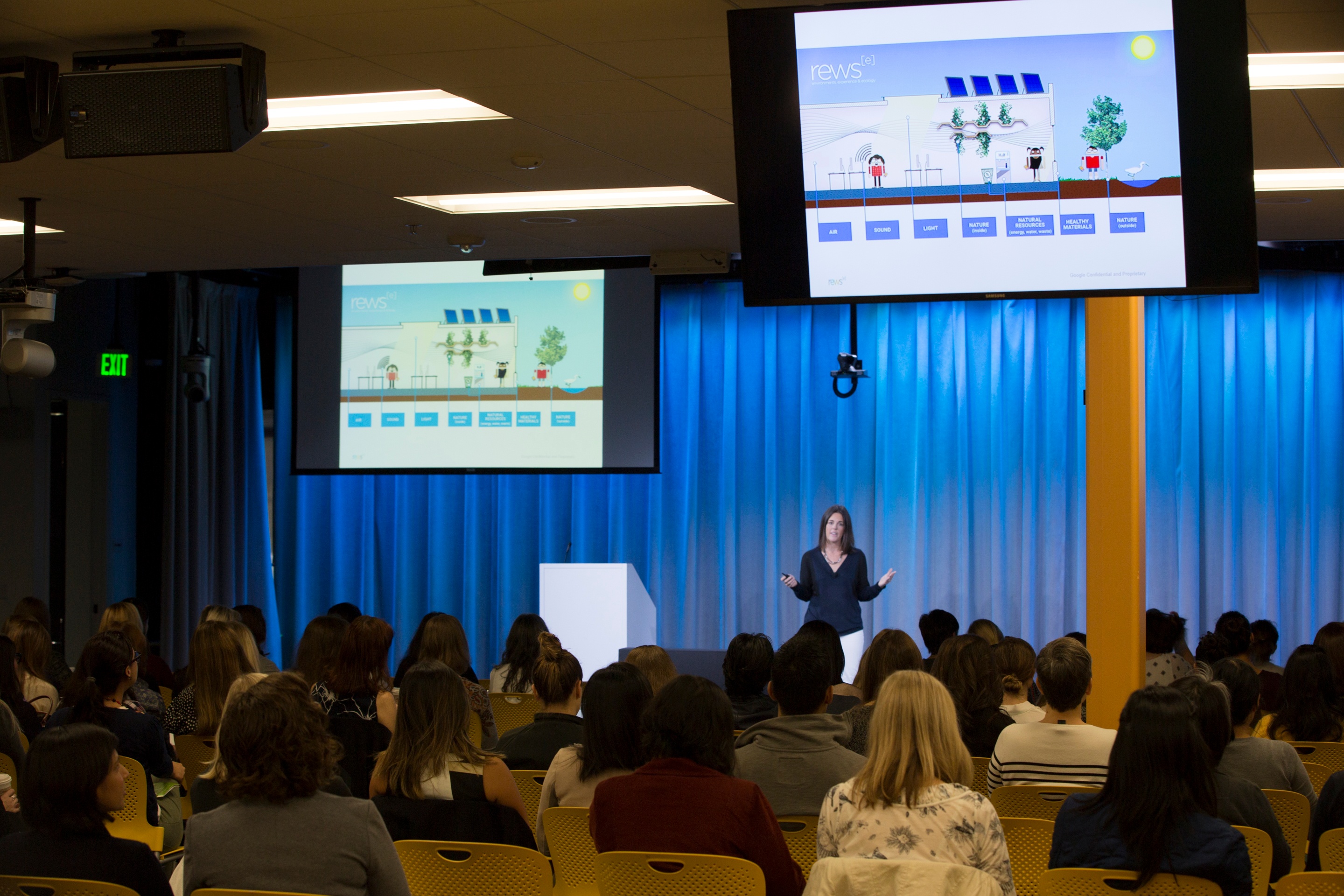
After having the experience of sharing their stories, these women were often empowered to continue presenting at other industry events. Pinkerton saw a need for more women to have a platform for their voices and designed WCS Talks to fill that gap. For the event, women and men gather at the Google office in Mountain View, CA, and listen to ten TED-style talks by professionals in the industry – the majority of whom are women.

At this year’s event in November, attendees will hear from Kate Brandt, Lead for Sustainability at Google, Michael Kobori, VP of Sustainability at Levi Strauss & Co., and many others.

WCS Talks


Getting to the C-Suite

Not only do women hold fewer jobs at cleantech companies, but they are also less likely to hold the top roles at those companies. Though Pinkerton notes that the situation has been improving, women must continue fighting for senior positions. Often, men are more comfortable taking ownership of their accomplishments and requesting promotions. “Women, we kind of have a double standard,” Pinkerton explains, “We’re not supposed to brag, we’re not supposed to show off.”

As a result, achievements may go unnoticed, and opportunities for promotions missed. Her advice? “Be your own advocate.” She recommends taking responsibility for the value that you add to your company and being open about it with superiors.

For example, by sending monthly emails to supervisors with project updates from that month, employees can ensure that their work is not going unnoticed.

Pinkerton hopes that WCS workshops, which have been held on topics including networking and salary negotiation, will also empower women to further their careers. Striving toward greater representation of women at the executive level in solar and cleantech is crucial to encourage more women to enter the field.

Pinkerton explains, “we know from research that most women and girls, starting very young, will not strive for certain careers or certain paths because they do not believe that they can be successful, because they do not see other women being successful.” She hopes that WCS Talks, an opportunity to showcase some of the most powerful women in the industry, will also show young women and girls that this is a field in which they can excel.

What Your Company Can Do

All companies, including those in the solar and cleantech industries, can benefit from including female employees and board members. Increasingly, women are making the solar purchasing decisions for their families, and an understanding of this customer base will benefit the bottom line of solar companies.

Research has also indicated that the inclusion of women on corporate boards offers companies more diverse viewpoints and potential financial benefits.

To encourage more female employees to join the cleantech space, Pinkerton suggests that companies start with a blind evaluation of resumes, and determine the salary of new hires based on what similar employees are paid at that company rather than the hire’s previous salary.

Pinkerton also stresses the importance of supervisors creating safe spaces for employees to discuss their successes and ask for what they want. “By having that experience of asking for what she wants, […] that action becomes safer and easier to do in the future.

We want to support women and make sure they’re getting everything they want, but at the same time, if you’re giving them everything automatically they’re not going to learn the lesson of putting themselves on the line.” As women are generally less likely to negotiate their salaries, companies can also support female employees by offering workshops on negotiation.

Several solar companies are starting to catch on. When SunEdison noticed a lack of women in senior positions, they partnered with GRID Alternatives on a Women in Solar Initiative.  Looking at approaches that worked for women in other industries, SunEdison instituted policies on flex time and maternity and paternity leave.

GRID Alternatives hopes to double the number of women on their installations, many of which they plan to train as team leaders. By supporting female employees, solar companies can ensure that the trend of an increasing female presence continues in the coming years.

Pick My Solar Women in Solar

A Bright Future

Clean technology is here to stay. Though it may have its ups and downs like any industry, increasing awareness of the need for sustainable solutions, both for environmental and financial reasons, will drive growth in coming years.

Because the industry is relatively young, it is also space where young people can start from the bottom and climb the ladder quickly. It’s an exciting field for all – male or female – to join, and we will all benefit from the equal representation of women in the cleantech workforce.

For women interested in entering the cleantech and sustainability industries, Pinkerton suggests developing a clear plan and sharing it openly with others: “Map out the ideal situation and make sure you let everybody know.

Go out and meet as many people as you can, because that’s what’s going to matter in your career – the people who know you, and care about you, and want to see you succeed. You would be surprised about how many of those people are out there.”

Solar.com is committed to taking an active role in the progression of women in cleantech. We strive to hire women and provide a welcoming, inclusive workspace. If you’re interested in working with us, please check out our careers page here.