


Prepaid Solar Leases & PPAs: A New Path for Going Solar in 2026
A prepaid solar lease is a financing model where a homeowner pays most or all of a solar lease upfront—typically 70% of system cost—in exchange for long-term solar energy production at a fixed cost and the option to eventually own the system, while a third-party owner claims the tax credit and maintains the system during the lease term.
With the consumer-claimed solar tax credit now terminated, many homeowners are seeking ways to benefit from the business-claimed solar tax credit without locking themselves into a 25-year lease or Power Purchase Agreement (PPA).
Enter prepaid solar products—a fast-growing alternative that offers the benefits of a federal tax credit and a path to ownership without the long-term commitment. Once a niche option, prepaid solar leases and PPAs are surging in popularity after the passage of the One Big Beautiful Bill.
How do prepaid solar leases and PPAs work?
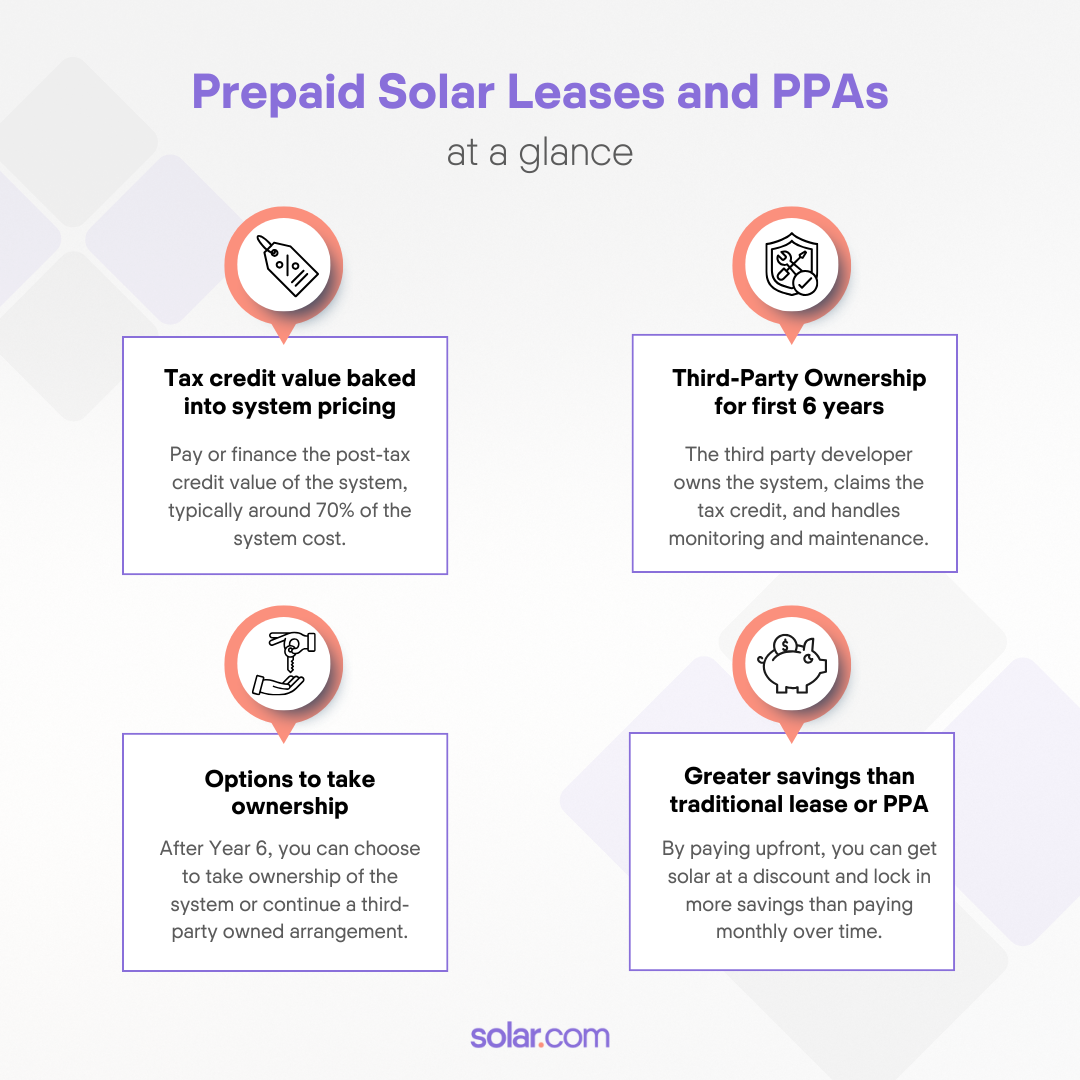
In a prepaid solar lease or PPA, a third party owns the system, claims the tax credit, and agrees to monitor, maintain, and service the array during their hold period. The homeowner “prepays” for the value of the system, and after 6 years, has the option to take ownership.
-
- A third-party developer installs and owns the solar system.
- The homeowner prepays ~70% of system value upfront (or finances with a loan).
- The third party claims the 48E federal solar tax credit.
- The system operates as a lease/PPA for 6 years, with the third-party owner responsible for monitoring and maintenance.
- After the 6-year tax credit recapture period, the homeowner can choose to take ownership of the system.
- The homeowner owns the system with no payments and is responsible for monitoring and maintenance.
The pre-payment is typically at or close to 70% of the cost to install the system, so it provides a discount equivalent to the value of the tax credit, which homeowners can no longer access on their own. With payment collected upfront, the third-party investor has almost no risk in the system (other than performance risk), and they’re able to accept lower rates of return than an asset owner otherwise would for the lease or PPA paid monthly over 25 years.
In many cases, the prepayment doesn’t need to be done up front. The homeowner can take out a loan, spread the monthly payments out over time, and get Day 1 savings from their lease or PPA.
Prepaid lease and PPA products are similar in all but a few ways:
- Lease payments are based on a consistent monthly payment to lease the equipment, while PPA payments are based on the system’s power production (which varies month-to-month)
- The availability of leases and PPAs varies from state to state
Prepaid solar lease vs. Prepaid PPA
| Feature | Prepaid Solar Lease | Prepaid PPA |
| Payment | Upfront or financed with personal loan | Upfront or financed with a personal loan |
| Billing Structure | Lease of equipment | Purchase of solar energy |
| Option to take ownership | After 6 years | After 6 years |
| Tax credit recipient | Third-party owner | Third-party owner |
Related: What Is the Difference Between a Standard PPA and a Prepaid PPA?
Prepaid Solar Lease vs Purchase
In 2026, the key differences between prepaid solar products and purchasing solar are:
- Access to a federal tax credit
- Who owns the system for the first 6 years
- Equipment selection
In a prepaid solar arrangement, the developer owns the system for at least the first 6 years while they claim and monetize the 48E federal tax credit. As such, they must adhere to Foreign Entity of Concern (FEOC) rules regarding equipment selection, and will likely have limited selection of premium, FEOC-compliant solar modules, inverters, racking, and battery storage.
In a solar purchase, the homeowner owns the system from the very beginning and equipment selection is restricted only by what’s available on the market. However, in 2026, there is no federal tax credit for homeowners to claim directly (hence the emergence of prepaid leases and PPAs!).
Prepaid Lease/PPA vs Purchase: Quick Recap
| Prepaid Lease or PPA | Solar Purchase | |
| Federal tax credit in 2026? | Yes | No |
| Who owns the system initially | Prepaid Provider | Homeowner |
| Equipment selection | Limited by FEOC rules | No restrictions |
| How to pay upfront cost | Cash or finance with loan | Cash or finance with loan |
Are Prepaid Solar Products Legal?
Yes. The U.S. tax code allows for prepaid PPAs and leases—as long as they are compliant with the statutory requirements of the underlying legislation.
However, not all prepaid solar products are created equal, and some take far more “liberal” applications on what’s eligible to be included as part of the tax credit and the underlying accounting treatment they use (i.e., allowing for the tax credit to be taken on back-end rebates or other inflated elements of the contract). While the homeowner isn’t necessarily at risk – that exists with the claimant of the tax credit – having your asset tied up in bankruptcy or litigation is messy and something no one should want to be in the middle of. For this reason, the solar.com team recommends following the old adage of “it seems too good to be true, it probably is.”
Considerations for Prepaid Solar Products
There are two big considerations for homeowners considering the prepaid route. The first is equipment selection. Because the third-party owner is claiming the tax credit, the system must conform to the rules and regulations for the 48E Clean Electricity Investment Credit, including restrictions on Chinese equipment known as FEOC. This means, as a homeowner, your ability to select your preferred technology may be significantly limited by the “approved vendor list” of the third-party owner.
The next consideration is whether the lender (if one is involved) knows about the prepaid structure and is comfortable with their position against the asset they’re using as collateral on the loan. We’ve seen some lenders enter into agreements with homeowners only to realize they’re not in “first position” when they file a lien, and then they demand payment in full, citing breach. This can put a homeowner in a terrible spot, and is why you should have a document, in writing, that says the lender knows who the prepaid counterparty is and that they accept this arrangement.
Pros and cons of prepaid solar leases & PPAs
| Pros | Cons |
| Lower upfront cost compared to buying a system outright | Limited equipment choice due to FEOC and approved vendor restrictions |
| Immediate savings from discounted prepayment (typically 20-30% off system cost) | Complex legal and tax structures that vary by provider |
| Eligible for tax credit through third-party owner, even though the homeowner can’t claim it directly | Risk if the TPO provider uses aggressive tax positions that may create future complications |
| No long-term monthly lease or PPA payments after prepaying | Availability is limited and not offered in all states |
| Ownership option after 6 years, providing long-term energy savings | Lender conflicts may arise if financing the prepaid amount |
| Maintenance covered by the third-party owner during the hold period | Homeowner responsible for maintenance after taking ownership of system |
| Easier to transfer in a home sale than a traditional lease/PPA | Prepaid providers may be new or unproven, raising long-term reliability questions |
Final Thoughts on Prepaid Products
Prepaid PPAs and leases are fantastic products for homeowners who want to own their array, while keeping their project eligible for the tax credit. Unlike a traditional lease or PPA, they forgo the 25 years of maintenance and guarantees – but the trade-off is greater savings and little to no restrictions on property transfer.
Unfortunately, prepaid products are currently relatively limited in the United States in where they can be sold, and the companies that offer them are relatively new. So, it’s a relative unknown if they’ll be around for the long haul.


