30% Federal Solar Tax Credit: 2032 Extension Cut Short, Ended After 2025

Update: The “One Big Beautiful Bill” was signed into law in July 2025 and terminated the 30% homeowner solar tax credit early. Only systems installed by December 31, 2025 qualified — for systems purchased in 2026 or later, the homeowner-claimed credit is no longer available. The remaining federal value flows through third-party-owned options, where the provider claims the business credit and passes it through as an upfront discount.
In an unexpected yet welcome move, the Inflation Reduction Act of 2022 increased the solar tax credit t0 30% and extended it until the end of 2032 — a schedule that no longer stands.
At the time, this was huge news for homeowners, as this tax credit — officially known as the Residential Clean Energy Credit — was the greatest financial incentive available for solar and battery storage projects. At 30%, the credit was worth $7,500 for a $25,000 solar system — effectively knocking the price down to $17,500 for those who installed by the 2025 deadline.
The credit was previously at 26% for systems installed in 2022 and scheduled to step down to 22% in 2023 before going away entirely in 2024.
Better yet, Americans who installed solar in 2022 expecting a 26% credit will now be eligible for 30%. That’s an extra $1,000 in tax credit for purchasing a $25,000 solar or battery system.
See how much you can save by going solar with the 30% tax credit.
What is the Solar Tax Credit?
The Residential Clean Energy Credit, also known as the Investment Tax Credit (ITC), is a tax incentive worth 30% gross solar system cost.
The only requirements are that:
- Through 2025, you had to own the system by purchasing your solar via cash or a solar loan to claim the homeowner credit
- Through 2025, the credit reduced federal income tax liability for eligible buyers
Note, this rollover treatment applied to eligible homeowner credits through 2025. For systems purchased in 2026 and later, there is no federal buyer credit to roll over.
This incentive has been huge for home and business owners since 2005 as part of the Energy Policy Act. The federal government has already extended the incentive expiration date three times before. The most recent extension in 2020 added a 26% extension until 2022 and “step down” schedule that gradually phases out the credit over a few years.
The Inflation Reduction Act Solar Tax Credit Step Down Schedule
With the Inflation Reduction Act (IRA) now law, the solar tax credit doesn’t begin stepping down until 2033.
Here’s the new Residential Clean Energy Credit step down schedule compared to the old schedule:
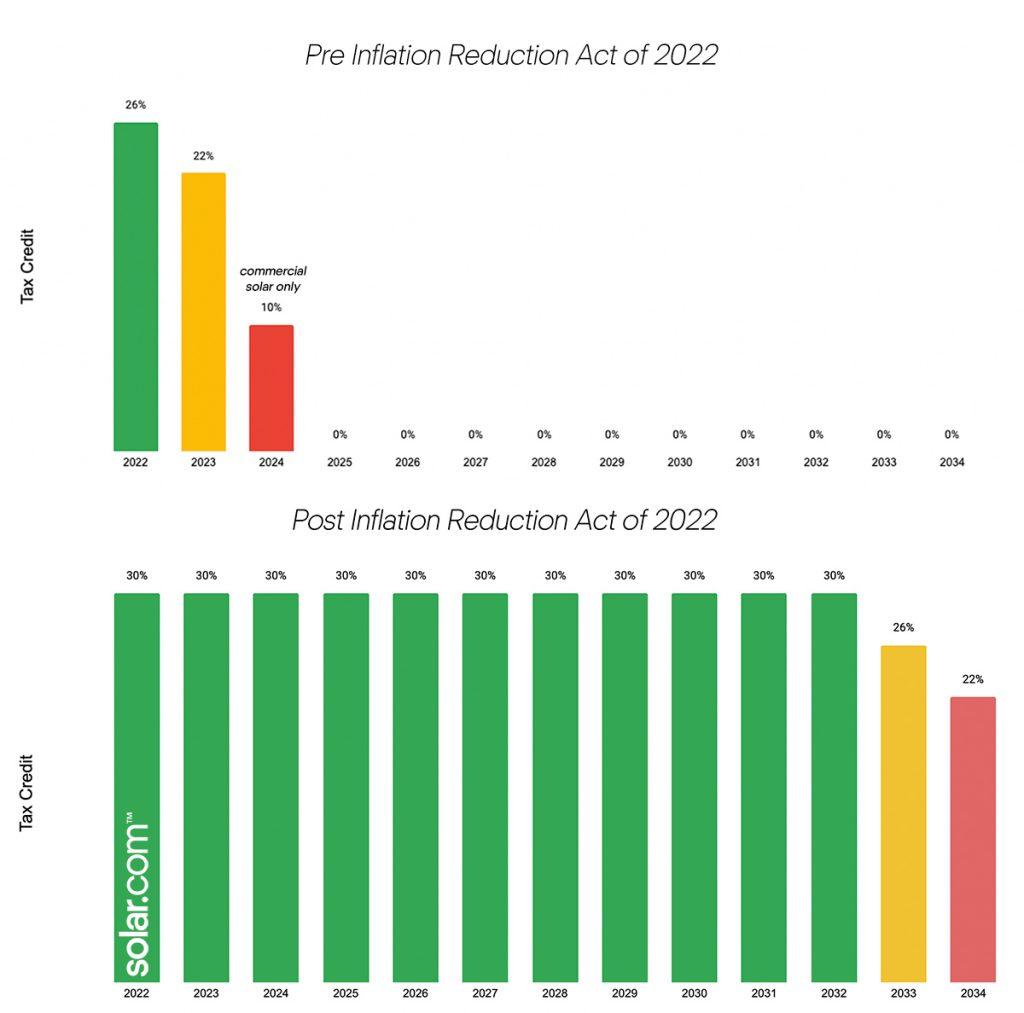 Here’s a table of the ITC step down:
| Year | Tax Credit |
|---|---|
| 2022-2032 | 30% |
| 2033 | 26% |
| 2034 | 22% |
How do I make sure I’m eligible to claim the Residential Clean Energy Credit?
To qualify for the 30% Residential Clean Energy Credit, you’re solar system needs to be installed and deemed operation by a city inspector in any of the tax years 2022-2032. The 30% credit applies retroactively to systems installed in 2022 when the credit was still at 26%.
Even though physically installing a solar system usually does not take more than a single day, many homeowners do not realize that a solar project may take weeks to complete after contract signing. This is due to factors such as permitting, financing approval, utility approval, and so on.
While you don’t have to worry about the tax credit stepping down for another 10 years, there are plenty of reasons to install solar sooner rather than later. First, the sooner you install, the sooner you will see a return on investment. Second, net metering policies are subject to change over time, so it’s best lock net metering while its available.
How big of a difference is a 26% tax credit versus a 30% tax credit?
The Investment Tax Credit is applied to your solar array’s gross system cost, so the amount you receive is dependent on the amount of solar you’re purchasing. The bigger system, bigger credit.
Here’s a quick example of the difference in a 26% credit versus a 30% credit for a $27,000 solar system.
At the full 30% level, your credit would be $8,100, compared to $7,020 at 26%.
That’s a savings difference of $1,080 compared to the previous year.
| Year | Gross Solar Cost | Credit % | Credit Amount | Net Solar Cost |
|---|---|---|---|---|
| 2022-2032 | $27,000 | 30% | $8,100 | $18,900 |
| 2021 | $27,000 | 26% | $7,020 | $19,980 |
A thousand extra dollars is a nice bump to your tax refund and a great jumpstart to your solar savings.
See how much you could save by going solar.
How do I claim the tax credit?
Disclaimer: This content is for informational purposes only. Please consult with a CPA or Tax Advisor before filing.
To claim your project tax credit when filing taxes, complete IRS Form 5695 – Residential Energy Credits — like so:
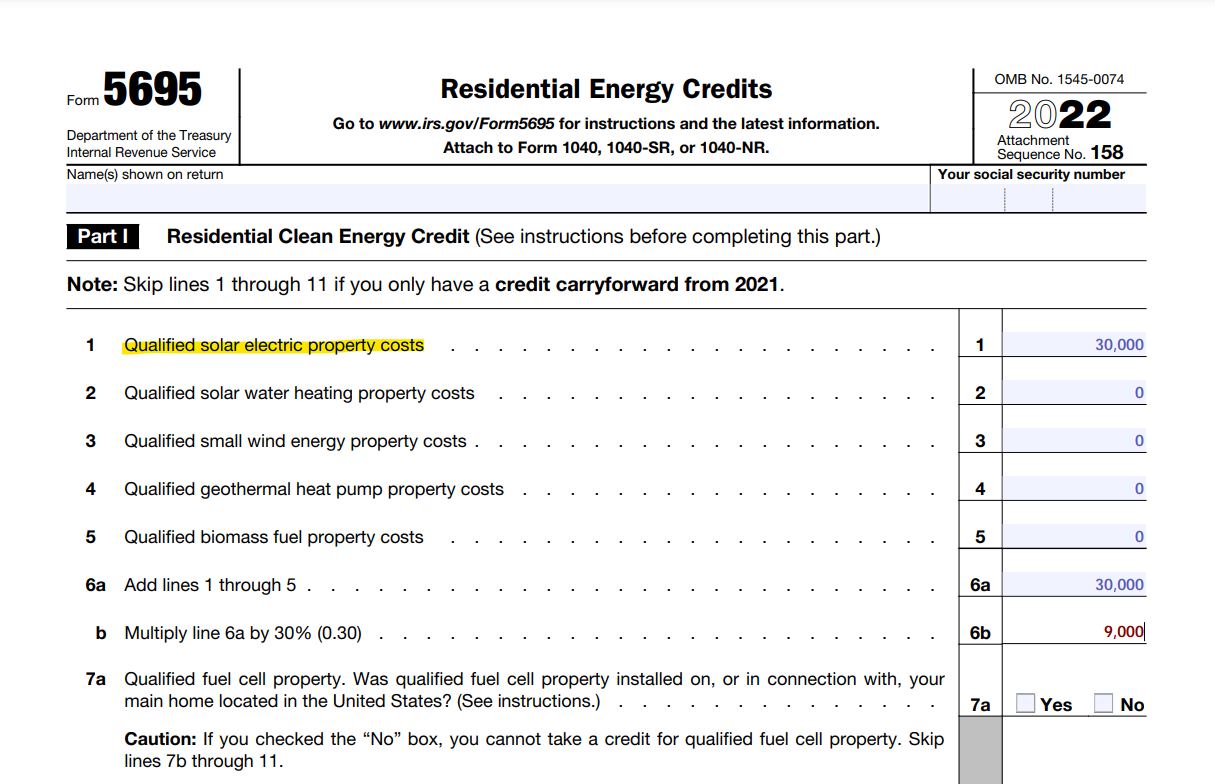
For an in-depth explanation of filing the credit, follow our full step-by-step guide here. Of course, consult a licensed tax professional for all tax advice.
The bottom line
With utility electricity prices surging, going solar was already a means to energy cost savings for many Americas. With the solar tax credit increasing from 26% to 30%, the savings increase and payback periods decrease — making solar even more worthwhile.
The homeowner-claimed tax credit was once scheduled to remain at 30% through 2032, but the One Big Beautiful Bill ended it after 2025. Solar is still a long-term investment, and the sooner you go solar, the sooner you start saving on electricity.
See it for your home
Get your real solar price in 90 seconds
Enter your address — we’ll show the system, savings, and price for your exact roof. No sales calls.
Frequently Asked Questions
How does the solar tax credit work?
Through 2025, the Residential Clean Energy Credit was a dollar-for-dollar tax credit worth 30% of eligible solar and/or battery storage expenditures. For systems purchased in 2026 and later, homeowners cannot claim this federal credit or roll it into future tax years.
In order to qualify, you must purchase (not lease) the solar system and it must be installed and deemed operational by a city inspector. If the system was installed in 2023, you can file for the Residential Clean Energy Credit on your 2023 tax return filed in 2024.
How do you claim the solar tax credit?
For eligible systems installed through 2025, the solar tax credit was claimed on IRS Form 5695 for Residential Energy Credits. For systems purchased in 2026 and later, homeowners do not file for a federal solar tax credit.
Is the solar tax credit a one-time credit?
Through 2025, the Residential Clean Energy Credit could only be claimed once per solar system. For systems purchased in 2026 and later, there is no federal homeowner credit to claim or roll forward.
The Residential Clean Energy Credit also applies to battery storage, and can be claimed if you add battery to an existing solar system or — as of January 1, 2023 — on it’s own.
Your next step
See exactly what solar costs on your roof
We use satellite data and your utility rates to show your price and payback in about 90 seconds, with no sales calls.