Page 51 | Solar.com

Please enter a valid zip code.

5 Things to Know When Installing Flat Roof Solar Panels

Solar Panels on a Flat Roof: 5 Things to Know

By Solar Panel Installation Process No Comments

Can you install solar panels on a flat roof?

Yes, you can successfully install solar panels on the flat roof of your home or business. However, there are some challenges to be aware of.

Flat roofs have a minimal slope allowance that will accommodate solar PV panel systems. A roof having a rise of 0.25 inches over a 12-inch run — known as a 0.25:12 pitch roof — is considered a flat roof. These roofs are also commonly known as:

  • Low pitch roofs
  • Low slope applications

Flat and low pitch roofs do provide some challenges for installers, but there are a number of solutions to adapt a solar system to unique roof types.

Skip to 12:15 to hear Rex and Patrick discuss the main solar solutions for different kinds of flat roofing on Solar.com LIVE!

The challenges of installing solar panels on a flat roof

The key to a successful flat roof installation is identifying obstacles early in the process. Here are some structures to consider before installing solar panels on a flat roof:

  • Drains
  • Vents
  • Exhaust fans
  • Rooftop units
  • Curbs
  • Parapets

The key to overcoming these challenges is identifying them early on and choosing an experienced installer that can confidently navigate them. With hundreds of carefully vetted installers and dedicated Energy Advisors, the solar.com marketplace is a great place to start.


5 things to consider when installing solar panels on a flat roof

1. You can install solar panels on a flat roof

Installing solar panels on a flat roof takes a little extra consideration, but you can do it! There are a number of flat roof mounting techniques available on the market to accommodate your roof, and an expert energy engineer can to get you on the right path to a successful solar panel installation.

Your main concern as a homeowner is to find an experienced and reputable installer to handle the job!

2. Costs are on par with the typical pitched roof

Not only are flat roofs a viable solar electricity producing surface, but the cost can be on par with that of standard sloped roof installation. Use this solar calculator to get a ballpark of how much solar would cost for you home and how much you can save by going solar.

3. Your solar panels may or may not be tilted

When installing solar panels on your flat roof, the resulting product can be tilted or not. There two main factors in the design of a successful solar panel system generating maximum electricity:

  1. Solar panel tilt angle
  2. Solar panel orientation

An optimum tilt angle and orientation of your solar panels on a flat roof will ensure top energy production performance of your system. Only top manufacturers give warranties on panels installed at an angle of fewer than two degrees.

Although these warranties exist and make sense in some situations, you’ll need to weigh the production difference when installing your solar panels horizontally – or near horizontally.

4. There are higher risks for leakage because of pooling

Compared to standard sloped roofs that direct water to eaves and gutters, flat roofs tend to collect water in certain areas. This is known as pooling or ponding.

Even without solar panels, pooling poses a risk of leakage and water damage to your home. So this may be something to address before going solar.

Pooling increases the risk of water leaking into the drill holes used to mount solar systems — it’s just the nature of the beast.

While pooling and leakage are are certainly something to consider, there are options for minimizing this risk. Instead of drilling into the roof to attach the solar panels, installers can use ballast (weights to keep the solar system in place) or a combination of ballast and drilled attachments to reduce the number holes and the risk of leakage.

Optimal energy performance can be achieved through any of these flat roof solar panel installation methods. However, it’s important to raise this concern early in the design process.

5. Solar panels on flat roofs may require frequent cleaning

Solar panels on a standard pitched roof tend to clean themselves when precipitation washes down them. In fact, just a slight degree of tilt – 3 to 4 degrees – can help keep solar panels clean when it rains.

However, flat panels tend to collect water, dust, and debris, which can reduce electricity generation by up to 10 percent. So if you install entirely flat solar panels, you’ll need to perform more frequent cleanings to maximize your generation and savings.

That’s not the end of the world. Solar panels can be cleaned with a quick dusting, spray of a hose, or wipe of a squeegee.

However, if you’d rather not spend more time cleaning your panels, raise this concern early in the design process.

Related reading: How To Choose Solar Panels for Your Home

How to find solar panel installers for a flat roof

As we’ve mentioned throughout the article, the key to successfully installing solar panels on a flat roof is finding an experienced and reputable installer to do it.

Solar.com is a free online marketplace offering potential the best pricing quotes from a carefully-vetted network of installers. In fact, we accept just 30% of solar installers that apply to join our network (we’re that picky).

Through the solar.com marketplace, you’ll be paired with a dedicated Energy Advisor that will help you:

  • Design a solar system that meets your goals
  • Find qualified solar installers in your local area
  • Compare quotes, equipment options, and warranties
  • Line up financing options
  • Take advantage of federal, state, and local solar incentives (like the 30% federal tax credit!)

Start a solar project today with multiple quotes from vetted installers.


best time to install solar panels

When Is the Best Time to Buy Solar Panels?

By Solar Panels for Home No Comments

The best time to own solar panels is when you receive an electricity bill for zero dollars. But when is the best time to buy solar panels?

The answer to this question depends on a few things like your location, net metering policy, and local incentives. In this article, we’ll cover some of the things to think about when you’re planning your solar project.

Team up with an Energy Advisor here to determine your best time to go solar.

When is the best time to buy solar panels?

For many US homeowners, fall is the best time to buy solar panels because it sets them up for a late winter/early spring installation, which has its advantages.

The process of going solar typically takes between three to five months from start to finish, so in order to have your solar system up and running by March, you’d need to get the process going in late fall/early winter.

There are two major advantages of shopping for solar panels in the fall:

  1. By shopping in fall or winter, you’re missing the late summer solar rush that can lead to longer project timelines
  2. By installing and activating your solar system in early spring, you can avoid overlap between your solar and utility payments

Avoid the summer solar rush

Like most industries, residential solar has its busy and slow seasons.

Summer is typically the busiest time of year because with the sun shining, air conditioners humming, and peak utility rates in effect, homeowners get their biggest electricity bills of the year and react by switching to solar. Fall and winter are slower for the opposite reasons – less sunlight, little to no A/C, and lower energy bills. But that’s exactly what makes it the best time to go solar, especially for proactive customers who want to set themselves up for peak summer bills.

Three reasons to start your solar project in the fall

  1. Greater scheduling flexibility for calls and appointments
  2. More face time to ask questions and address concerns
  3. Stronger personal connections with the people managing your solar project

Think of shopping for solar panels like going out for breakfast. If you go during the Sunday morning after Church rush there will be a line out the door, 10 other tables competing for your server’s attention, and the food will take longer to prepare and deliver – it’s just the nature of the beast.

But if you go out for breakfast on a Tuesday morning you’ll have an entirely different – and in many ways better – experience. The restaurant will be at most half full, the server will have time to chit-chat and customize your order, and the food will come out hot, fresh, and fast.

Now, solar panels aren’t a $13 plate of eggs benedict. They are a major investment in lowering your essential electricity costs. So having that extra time, care, and attention from your installer and Energy Associate is absolutely worth starting your project during the off-season.

Related Reading: How To Choose Solar Panels for Your Home

Avoid overlapping solar and utility payments

Another reason why fall is the best time to buy solar panels is can help you avoid overlap between your utility and solar payments.

After all, replacing your utility bill with a lower solar payment is a huge reason for going solar, and it would be a shame to pay for both at once. Here’s how shopping during the offseason can help you avoid this overlap.

In general, solar systems tend to produce more electricity than your home uses beginning in March.

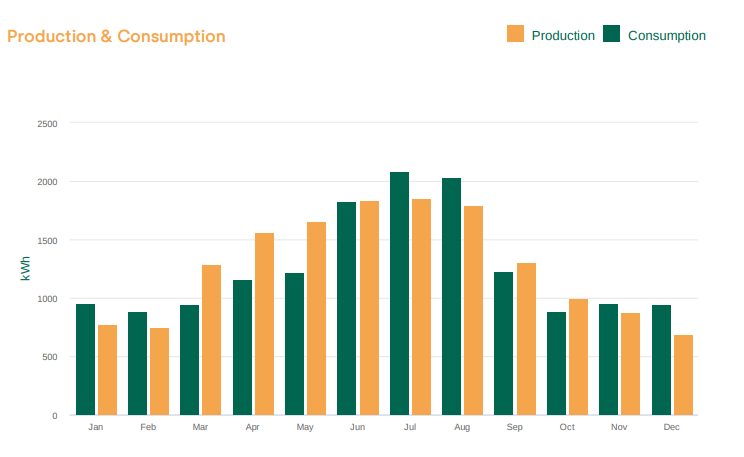
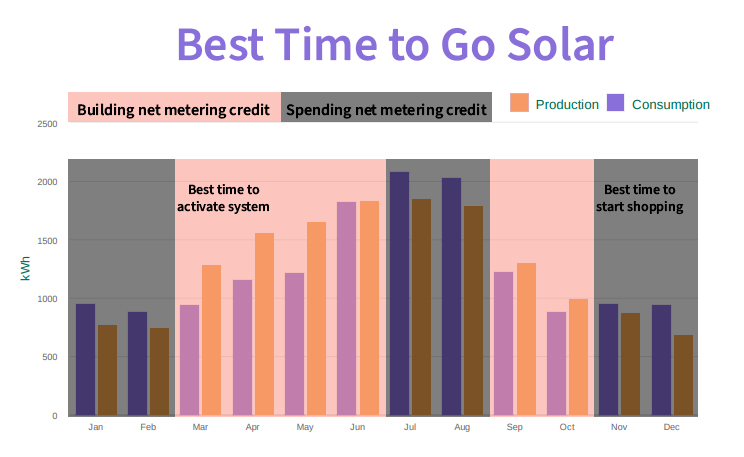
The best months for overproduction – and best chance to build up net metering credit – are often March, April, and May as shown by the charts below for a home near Los Angeles. Note: Production and consumption will vary by location, solar production, and electricity consumption.

solar production vs consumption graph

By taking a proactive approach and planning ahead for a late winter/early spring installation date, you are setting yourself up to start overproducing and earning credit right off the bat — which will minimize, if not eliminate, your utility bill — by the time your solar loan payments kick in.

best time to go solar graph

Now, if you take a reactive approach by starting your solar project when your summer bills hit, you’ll end up installing in late fall/early winter — right when solar production declines for the year. That means you’ll be making electricity bill and solar loan payments each month until at least March.

For example, if your system is installed and activated in late October, you could have four months of double payments.

Why it’s best to buy solar panels sooner rather than later

By shopping for solar panels in the fall you can improve your customer experience and minimize your first net metering bill. But there are a few other things to consider when choosing when to go solar.

To make sure you can use the solar tax credit

The best solar incentive available to most homeowners is the federal solar tax credit worth 30% of the installed cost of your solar project.

That means if you paid $20,000 for your solar system, you can claim a $6,000 credit on your federal tax return, effectively reducing the cost of the project to $14,000.

However, this non-refundable tax credit can only be used to reduce your tax liability – it’s not a “Thank You For Going Solar” Hallmark card with a $6,000 check inside.

Having sufficient tax liability generally isn’t an issue for homeowners who are still in the workforce, but it tends to become an issue for retirees who no longer have much taxable income.

Frankly, this can come as a frustrating surprise to retired homeowners and it’s worth keeping in mind as you plan your solar project. So if retirement is on the horizon, the best time to buy solar panels may be before you hang up your boots.

This article does not constitute tax advice. Consult a licensed tax professional with questions regarding tax liability and the federal solar tax credit.

To claim incentives and net metering policies before they change

Net metering and incentives have been monumental for increasing residential solar adoption and nurturing a growing industry. However, the cost of solar panels has decreased rapidly in the last decade and changed the landscape.

Solar incentives put in place a decade ago, like New York’s MW Block Incentive, are winding down and are unlikely to be renewed or extended because home solar costs so much less now.

Another thing to consider is changes to net metering policies. Just like solar incentives, many net metering policies were formed 10-20 years ago when solar was still an expensive, budding technology.

Now that solar is much cheaper, utilities – namely in California and New York – are proposing and making changes to net metering policies that would increase costs for solar owners.

So the best time to buy solar panels is before those changes happen so you can be grandfathered into a more favorable net metering policy.

The sooner you go solar, sooner you’ll save

Perhaps the best reason not to wait to go solar is because you can’t start saving until you start generating.

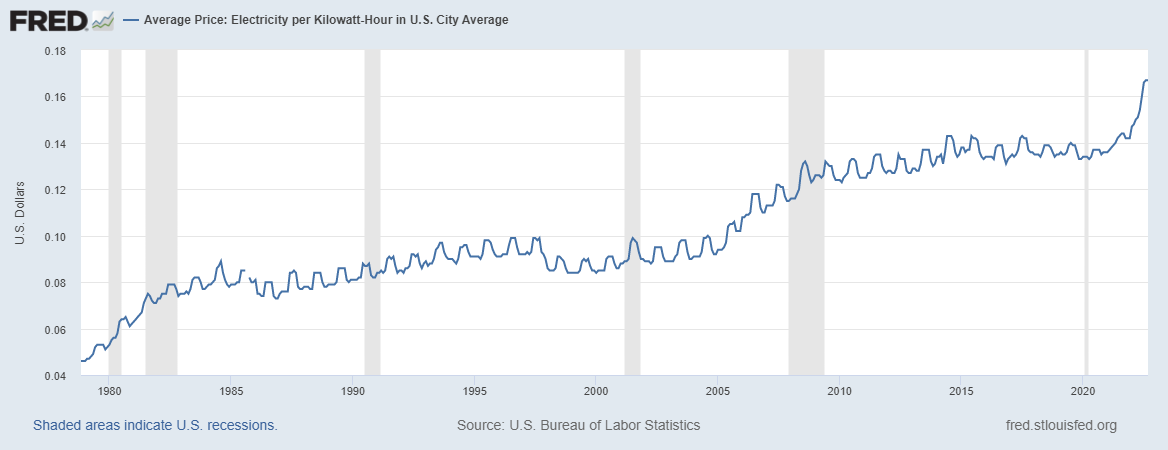
Like real estate and your 401k, solar is a long-term investment, often with a substantial return. But, you can’t start saving until you make the investment. And the longer you wait, the longer you’re subject to grid electricity prices (shown below), which makes yesterday the best time to buy solar panels.

Best time to buy solar panels is when you’re ready

Just like buying a house, solar is a long-term investment and there’s more to be lost than gained by trying to time the market. The best time to buy solar panels is when you are ready to make an investment in your future.

However, if you are trying to choose a time of year to start your search, fall and winter provide some unique advantages. By starting the search in the offseason, you’ll have more hands-on service from installers and Energy Associates. You’ll also set yourself up to avoid overlap between your solar and utility payments.

Start your solar journey here with multiple quotes from vetted installers.